




The TL;DR
Merge is a two-product company wearing one brand name, and knowing which product you actually need decides whether the rest of this review even applies to you.
-
• Two Different Products Under One Roof
Merge Unified syncs data across 220+ integrations. Merge Agent Handler is a separate MCP tool-calling layer, priced on credits instead of linked accounts.
-
• The Linked Account Math
$650/month covers 10 linked accounts, then $65 per account after. Professional and Enterprise are contract-based. Cost scales with customer count, not revenue.
-
• What 253 G2 Reviewers Actually Flag
4.7/5 from 253 reviews. Support leads the praise with 71 mentions. Recurring complaints include complex field mapping, documentation gaps, and cost at scale.
Merge has been building unified API infrastructure since 2020, and its newest product doesn’t sync a single row of data. Merge Agent Handler gives AI agents governed, MCP-compatible access to the same connectors Merge built for its original Unified API. Two products now share one brand, one dashboard, and two completely different pricing models, and weighing Merge against the right Merge.dev alternatives means knowing which product you’re actually evaluating first.
That split matters more than most comparison pages let on. A team evaluating Merge to power customer-facing integrations is answering a different question than a team evaluating it to give an internal AI agent access to Salesforce. Pricing looks nothing alike between them. Neither does the failure mode when something goes wrong.
This review checks both products against Merge’s own pricing and security pages, reads through 253 G2 reviews for the pattern behind the star rating, and closes with the alternatives worth putting on a shortlist and who each one actually fits.
What Is Merge.dev?
Merge ships two different products under one brand. Knowing which one you’re evaluating matters before anything else in this review.
Merge Unified
The original product. A single REST API that normalizes data across seven categories, HRIS, ATS, CRM, accounting, ticketing, file storage, and knowledge base, so a team writes one integration instead of dozens. Merge’s G2 listing puts the catalog at 220+ integrations. Merge polls each third-party platform on a schedule and caches a normalized copy, so your application reads from that cache instead of hitting Salesforce or Workday directly.
It’s not a no-code workflow builder like Zapier. It’s API infrastructure built directly into a product.
Merge Agent Handler
The newer product, and a different architecture entirely. It’s an MCP server built on the Model Context Protocol, exposing write actions and tool calls across the same connector list. Every input and output routes through a security layer that scans for sensitive data, the kind of control recent MCP security hardening guidance has been pushing vendors toward by default. Claude has native MCP support, and other model providers reach Agent Handler through open-source MCP client libraries, per Merge’s own FAQ.
A third product, Merge Gateway, routes LLM calls across providers and sits outside the scope of this review.
How to Set Up Merge.dev
Merge publishes its setup process for both products, and the two paths share almost nothing.
Setting Up Merge Unified
A customer authorizes access through Merge Link, an embedded flow your own end users see and approve. Once authorized, data flows into Merge’s cache on a schedule set by your plan, from quarterly on lower tiers up to daily by default on Launch, per Merge’s pricing table.
Setting Up Agent Handler
Setup runs through the CLI or a direct MCP configuration. Merge’s local development docs walk through pointing an IDE’s MCP config at Agent Handler’s hosted URL and connecting tools to agents like Claude Code, Cursor, or anything that reads an AGENTS.md file. Each registered user is a container for credentials tied to one identity, the same per-user token model MCP OAuth is built around, rather than one shared key for every action.
Two things worth knowing before you build on it:
- Local servers are out of reach: Agent Handler runs server-side and cannot connect to a locally launched MCP server, one started with
npx <package>, running on your own machine. It’s the same local MCP connection boundary that trips up plenty of other agent setups, not a Merge-specific quirk. - “Slow” is usually the third party, not Merge: Merge’s own FAQ breaks down latency per call, auth resolution, a security gateway scan, connector dispatch, and the third-party round trip, and is upfront that the third-party API is typically the bottleneck.
Merge.dev Pricing in 2026
Both products publish list pricing. Figures below are verified directly against Merge’s live pricing pages, August 2026.
Merge Unified Pricing
| Plan | Price | What’s Included |
|---|---|---|
| Launch | Free for 3 linked accounts, then $650/month for up to 10, $65 per additional account | Daily sync, 100 requests/min, 3-day log retention, email support |
| Professional | Contract-based | Custom fields, custom sync frequency, field-level scopes, 60-day sandbox access |
| Enterprise | Contract-based | Audit Trail, unlimited sandboxes, dedicated account manager, uptime SLA |
Pricing verified against merge.dev/pricing/unified, August 2026.
A linked account is one customer connecting one third-party platform. If a single customer connects a CRM, an HRIS, and a ticketing tool, that’s three linked accounts from one customer, not one. Run the math on a mid-market SaaS company with 200 customers averaging three connections each. Six hundred linked accounts works out to $650 plus 590 additional accounts at $65 apiece, or exactly $39,000 a month, before any Professional or Enterprise contract terms apply.
Merge Agent Handler Pricing
| Plan | Price | Credits |
|---|---|---|
| Free | $0/month | 2,000 credits/month |
| Pro | Starts at $1,000/month | 25,000 credits/month, scaling to 100,000/month on higher tiers |
| Enterprise | Custom pricing | Custom deployments, on-prem option, SIEM log streaming |
Pricing verified against merge.dev/pricing/agent-handler, August 2026.
Agent Handler for Workforce, the version IT teams use to govern which tools employees’ AI clients can reach, prices differently again, at $10 per user per month on Pro, with Enterprise custom, per the same pricing page.
Credits and linked accounts don’t convert into each other. A team pricing out “Merge” as a single number needs to budget the specific product it actually plans to use.
Merge Gateway Pricing
Merge also sells a third product, Gateway, for teams routing LLM calls across providers rather than syncing data or exposing MCP tools. It’s a different category from Unified and Agent Handler, but since this review covers Merge’s pricing in full, here’s where it lands.
| Plan | Price | What’s Included |
|---|---|---|
| Free | $0/month, $10 in free credits the first month | All major LLM models, built-in fallback routing, automatic cost optimization, no credit card required |
| Pro | LLM cost plus a 5% fee, $10/month in free credits | No spending cap, bring your own key (BYOK), custom routing policies, SSO/SAML |
| Enterprise | Custom pricing | VPC or on-prem deployment, dedicated account manager, support and uptime SLAs |
Pricing verified against merge.dev/pricing/gateway, August 2026.
Every Gateway plan, including Free, includes data loss prevention, prompt-injection protection, and zero data retention by default.
Merge.dev Limitations and Drawbacks
Merge’s own G2 reviews, 253 of them at a 4.7/5 average, point at the same few friction spots repeatedly rather than one isolated complaint. Field mapping is the recurring one. Common model mapping depends on each system, and when an integration doesn’t support a required field, the fix is often a manual workaround rather than something the platform handles automatically. A smaller number of reviewers flag unreliable webhooks, one described needing a nightly full API sync as a backup, and per-linked-account pricing as their main gripe.
That pattern lines up with a more detailed architectural critique from Truto, a competing unified API vendor, in its 2026 guide to Merge’s limitations. Read with the skepticism a competitor’s own marketing deserves, but its core claim about schema rigidity matches what Merge’s own reviewers report independently. Three claims are still worth weighing against your own requirements:
- Custom fields can get dropped: Merge’s common data model maps standard fields across providers. A Salesforce admin’s custom field, or any vendor-specific object outside the canonical schema, typically lands in a generic custom-fields blob rather than a structured field you can query and write back to directly.
- Cached data adds a security-review question: Because Merge polls and stores a normalized copy of third-party data, an enterprise buyer’s security team will ask where that cached copy lives, how long it’s retained, and how it’s encrypted. Merge answers these questions with real infrastructure, covered below, but the question itself comes with any store-and-sync architecture.
- Rate limit errors get normalized: A vendor-specific 429 or 403 response can arrive at your application as a generic sync failure, which makes building your own retry and backoff logic harder than working against the raw upstream error would be.
None of these rule Merge out on their own. They’re the direct cost of the abstraction that also makes Merge fast to integrate against in the first place. A team with standard field usage across mainstream platforms will rarely run into them.

“has anyone successfully shipped a relatively complex CRM integration using Merge or similar tools?”
Compliance and Data Handling
Merge’s compliance program is a real differentiator once these questions come up.
- Certifications: SOC 2 Type II, ISO 27001, HIPAA, GDPR, and CCPA, all listed directly on Merge’s own security page
- Data residency: AWS data centers across US, EU, and APAC regions depending on plan, with single-tenant hosting available as an add-on
- Encryption: standard encryption at rest and in transit, plus an added layer of application-level encryption for PII
For a team whose main blocker is a security questionnaire rather than a schema mapping problem, this answers most of it before the questionnaire is even sent.
Merge.dev Reviews and Ratings
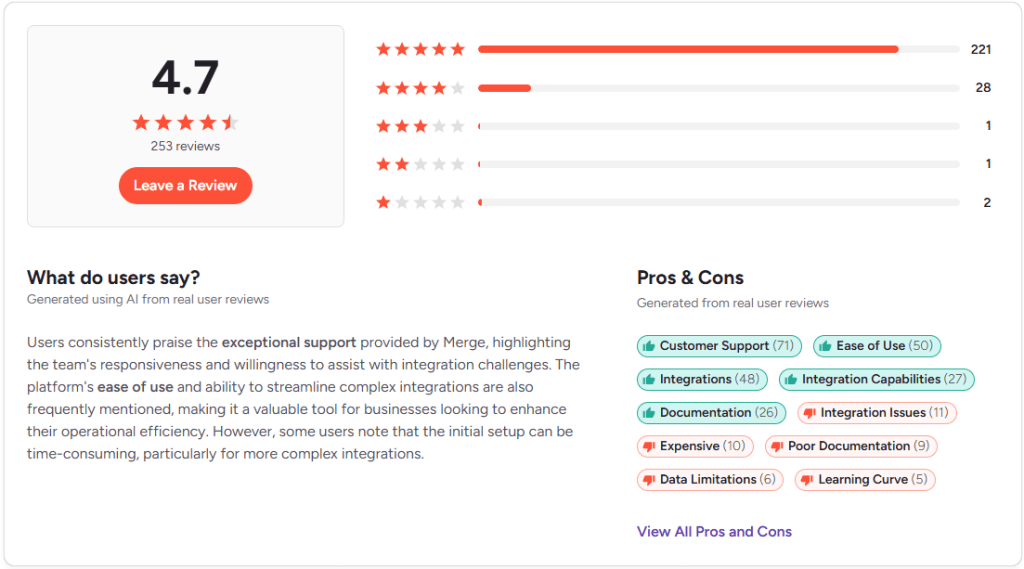
Merge Unified holds a 4.7 out of 5 rating from 253 reviews on G2 as of this writing.
What Users Like About Merge.dev:
- Customer support, the single most-tagged theme by a wide margin (71 mentions), including one reviewer who credited their account manager by name and said Merge actively shapes its roadmap around customer feedback
- Ease of use and easy integration setup (50 and 48 mentions)
- Integration capabilities and well-documented APIs (27 and 26 mentions)
Common Merge.dev Complaints:
- Integration issues with complex models (11 mentions), the same custom-field limitation described above
- Cost, specifically per-linked-account pricing at scale (10 mentions)
- Documentation gaps (9 mentions) and data limitations leading to unexpected schema issues (6 mentions)
- Input validation gaps in Merge Link’s UI during onboarding, per one reviewer who wanted incorrect field values flagged at the point of entry instead of after
- Enterprise sales process flexibility, per a reviewer who wanted more time to test features before committing to a contract
The pattern holds across the review set rather than concentrating in one or two outliers. Nobody complains about integration breadth or uptime. The friction sits specifically in schema depth, documentation completeness, and per-account cost at scale.
Best Merge.dev Alternatives in 2026
Merge fits a specific profile well. Teams building customer-facing integrations across mainstream HRIS, ATS, CRM, or accounting platforms, with standard field usage and budget to absorb per-linked-account pricing as the customer base grows, get exactly what they’re paying for. Outside that profile, a few alternatives solve the same problem differently.
1. Workato: Teams that need a visual workflow builder with customer-facing configuration screens sit in a different category, closer to embedded iPaaS tools than to Merge. Workato’s AI-native alternatives are worth a separate look if that’s the actual requirement.
2. Nango: Instead of a fixed schema and pre-built catalog, Nango gives engineering teams a code-first runtime where integration logic is written and versioned like any other code, with AI coding agents able to build new integrations directly against it. Pick this one when integrations are core to your product, or when your agents need custom tool calls outside a pre-built catalog.
3. Apideck: Prices on active consumers rather than linked accounts, which changes the growth math for products where each customer connects several integrations. Runs its own MCP server exposing hundreds of tools across 200+ connectors. Consumer-based pricing is the whole pitch here, worth checking if it fits your customer profile better than per-connection billing does.
4. MCP360: Takes a gateway approach instead of Agent Handler’s pre-built catalog, exposing 100+ tools across search, SEO research, scraping, and data APIs through one MCP connection, with search_tools and execute_tool meta-tools so an agent loads only what a task needs. Pricing runs on published, self-serve tiers from $0 to $333 a month with SOC 2 Type II, GDPR, and ISO 27001 compliance. This one solves a different problem than Merge Unified entirely, broad agent tool access rather than normalized HRIS and ATS data.
A team evaluating Merge purely for its data-sync side should weigh Nango, Apideck, Truto, and Unified.to more heavily. A team evaluating Agent Handler specifically, and finding its pre-built tool catalog too narrow, is the audience MCP360 and Nango’s MCP support both serve better.
Is Merge Right for You
Choose Merge If
- Your integration needs sit inside HRIS, ATS, CRM, accounting, ticketing, file storage, or knowledge base, and standard field mapping covers most of what your customers need
- A managed, fully staffed integration team maintaining connectors on your behalf matters more than owning the code yourself
- Your compliance team needs SOC 2 Type II, ISO 27001, HIPAA, and GDPR documentation ready to hand over on day one
- You’re evaluating Agent Handler specifically for governed access to mainstream SaaS tools like Salesforce, Slack, or Workday, and a pre-built connector catalog covers your use case
Consider Alternatives If
- Enterprise customers require custom Salesforce objects or vendor-specific fields your integration needs to read and write back
- Your linked account count is projected to grow past a few hundred within 12 to 18 months, since the per-account math compounds fast
- A security review specifically flags cached third-party data, and a pass-through architecture would shorten that conversation
- Your AI agent needs a custom tool call outside Agent Handler’s pre-built shape, or broader tool access outside Merge’s seven categories entirely (HRIS, ATS, CRM, accounting, ticketing, file storage, knowledge base)
Merge earns its reputation in the categories it covers well, and 253 reviews at a 4.7 average isn’t a number vendors fake. The decision point sits somewhere tighter than “does Merge work.” It’s whether the linked-account pricing model still holds up once your customer count triples, and whether your schema needs stay standard enough that the field-mapping gaps reviewers flag never become your problem. Model both before the contract renews, not after.
Frequently Asked Questions
What is a unified API?
A unified API is a single interface that normalizes access to many third-party platforms in the same category, so a team writes one integration instead of a separate one for each vendor. Instead of building custom code for Salesforce, HubSpot, and Pipedrive separately, a unified API returns the same data shape regardless of which CRM a customer connects. This differs from an MCP gateway like MCP360, which exposes agent tools rather than syncing structured records.
What’s the best unified API platform?
It depends on what you’re syncing and how much customization your customers need. Merge and Apideck cover the broadest mainstream categories out of the box, Nango and Truto give more control over custom fields, and Unified.to spans the widest range of categories. If the actual need is broad tool access for an AI agent rather than normalized CRM or HRIS data, gateway platforms like MCP360 solve a different problem entirely.
Is Merge.dev worth it in 2026?
For teams syncing mainstream HRIS, ATS, CRM, or accounting data with standard field usage, yes. Merge holds a 4.7 out of 5 rating across 253 G2 reviews, and its support team gets praised constantly. It’s a harder call if enterprise customers need custom Salesforce objects, if the linked-account count is heading past a few hundred, or if a security review specifically flags cached third-party data.
How much does Merge.dev cost?
Merge Unified starts free for 3 linked accounts, then costs $650 a month for up to 10, plus $65 for every additional account. Professional and Enterprise tiers are contract-based. Merge Agent Handler prices separately on credits, starting free at 2,000 credits a month, with Pro plans starting at $1,000 a month for 25,000 credits. The two products don’t share a budget or a pricing model.
Can Merge.dev handle custom CRM fields and objects?
Only partially. Merge’s common data model maps standard fields across CRMs, but a vendor-specific object or a custom field like a Salesforce lookup usually lands in a generic custom-fields blob instead of a structured field you can query and write back to directly. Teams with heavy customization, complex filters, or custom JS requirements on the customer side tend to hit this limit before teams using standard field sets do.
What’s the difference between Merge Unified and Merge Agent Handler?
Merge Unified syncs and normalizes data from third-party platforms into a cached copy your product reads from, built for data sync and analytics. Merge Agent Handler is a separate MCP-compatible product that lets an AI agent call tools and take actions on those same platforms directly, priced on credits instead of linked accounts. They share a connector layer but are sold, priced, and architected as two distinct products.
What are the best alternatives to Merge.dev?
It depends on the gap you’re hitting. Nango is the code-first pick if custom fields and full control matter more than a pre-built catalog. Apideck prices per consumer instead of per linked account. Truto and Unified.to use pass-through architectures that avoid storing customer data at rest. MCP360 solves a different need entirely, broad MCP tool access for an AI agent rather than normalized CRM or HRIS sync.
Does Merge.dev sync data in real time?
No, not by default. Merge Unified uses a polling architecture that pulls from each third-party platform on a schedule, quarterly, monthly, daily, or hourly depending on the plan, and caches a normalized copy your application reads from. That’s a real gap for teams needing live CRM data, and it’s a common reason engineering teams evaluating Merge for real-time sync end up comparing pass-through alternatives like Truto or Unified.to instead.
Tags

Article by
RajniAI & Tech | Senior Content Writer
Rajni is a senior content writer covering AI agents, automation, and no-code tools. She writes across the AI space, from chatbots and customer support to MCP and agent workflows, focused on how businesses actually put these tools to work.