



The TL;DR
Building an MCP gateway starts as a routing problem but quickly becomes a governance challenge. Identity, compliance, auditability, and ongoing protocol changes are where most of the real cost appears.
-
• The Proxy Is Cheap, Governance Is Not
A working proxy can take two to four weeks to build. Identity management, SCIM provisioning, audit logging, access controls, and SOC 2 evidence are what require the larger investment.
-
• A Real Build Clears Six Figures Fast
A minimal governed MCP gateway can cost between $150,000 and $300,000 in its first year. Development, security, maintenance, and infrastructure costs can push the three-year total toward $900,000.
-
• The Protocol Won’t Hold Still
MCP’s next specification ships on July 28, 2026, with breaking changes to session handling. A custom-built gateway must absorb the engineering and migration cost, while a managed gateway typically handles protocol updates for you.
Teams that decide to build an MCP gateway are usually pricing a proxy, not a gateway, and a proxy is the smallest line item on the eventual invoice.
An engineer wires up a Slack connector and a Postgres reader over a weekend, wraps them in the JSON-RPC handshake, and the demo works by Monday. Leadership approves the project. Then someone in security asks who can revoke access when an employee leaves, and the real scope of the build shows up for the first time.
That gap between the weekend demo and a governed production system is where the actual cost of building an MCP gateway lives, and it rarely appears on the original whiteboard estimate. This guide breaks down what an internal build costs in year one and beyond, what buying looks like in comparison, and the line items that decide which path wins for a given team.
What It Takes to Build an Enterprise MCP Gateway
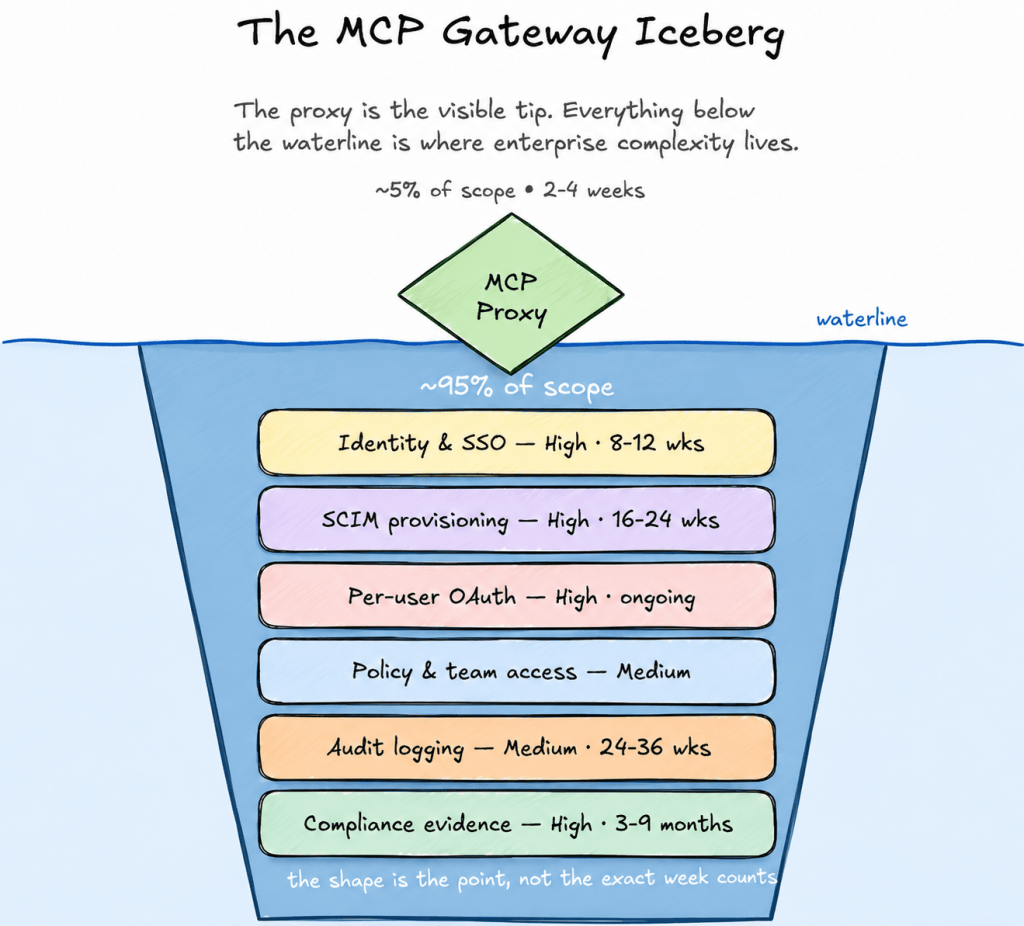
An MCP gateway build breaks into two very different kinds of work, the part that ships in weeks and the part that doesn’t.
Building the Proxy Is the Easy Part
The routing layer negotiates capabilities between a client such as Claude or Cursor and a set of Model Context Protocol tool servers, and it’s genuinely the easy part to build. Unlike a hand-rolled REST integration, the protocol standardizes tool discovery and invocation across every client that speaks it, a distinction worth understanding on its own terms when comparing MCP against traditional APIs. A small team can have a working proxy running in two to four weeks.
Where Enterprise Complexity Begins
That routing layer is also a small fraction of what production needs. Composio, a direct competitor in this market, pegs the proxy at roughly 5 percent of an enterprise gateway’s real scope. Take a vendor’s self-interested number with a grain of salt, but independent identity-cost research lands on a similar split from sources with no stake in either build or buy.
Identity is the layer that decides whether more than one engineer can use the gateway safely. It has to keep holding up as usage grows from a single assistant into multiple agents sharing one tool layer. MCP evolution documents the growth across five dated spec revisions since November 2024.
Core Components of an Enterprise MCP Gateway
| Layer | What It Does | Rough Build Complexity |
|---|---|---|
| MCP Proxy | Routes calls between clients and tool servers | Low, a working prototype in two to four weeks |
| Identity and SSO | Provides sign-in through Okta, Microsoft Entra, or Google Workspace | High, 8 to 12 engineer-weeks for a minimal two or three-IdP build |
| SCIM Provisioning | Automatically creates and revokes user access from the identity provider | High, extends a multi-IdP build to 16 to 24 engineer-weeks |
| Per-User OAuth Across SaaS Tools | Allows each user to authenticate with their own credentials for every connected application | High and ongoing, new identity-provider quirks keep arriving after launch |
| Policy and Team-Based Access | Controls which teams can call specific tools and adds guardrails for destructive actions | Medium, requires an admin interface and a policy engine |
| Audit Logging | Creates an immutable record of who called each tool and when | Medium, pushes a build to 24 to 36 engineer-weeks once logs must be SOC 2 ready |
| Compliance Evidence | Supports SOC 2 Type II, ISO 27001, GDPR, and data-processing agreement requirements | High, with three to nine months of calendar time for the audit alone |
Those engineer-week figures come from cost analyses of in-house SSO and identity infrastructure, the closest well-documented proxy for what an MCP gateway’s identity layer takes to build, not from any single MCP gateway vendor. Treat the specific week counts as order of magnitude. The shape of the table is the real signal, every layer below the proxy touches identity, credentials, or compliance evidence, and each one is the kind of work that punishes an estimate written before a security review happens.
A proxy that works cleanly in a demo can still fail under real production load once traffic patterns get messy, the kind of failure worth checking against a rundown of common MCP server connection issues and how to fix them before assuming the routing layer is actually done.
Enterprise MCP Gateway Build Cost
Year-One Build Costs
| Cost Component | Year One Estimate |
|---|---|
| Minimal, Governed Identity Layer Alone | $150,000 to $300,000 |
| SOC 2 Type II Audit | $25,000 to $60,000 |
| MCP-Specific Proxy, Policy Engine, and Audit-Log Pipeline | Additional cost, on top of the identity and compliance estimates above |
| Running Total Before Gateway-Specific Code Is Written | Low six figures |
That identity-layer estimate comes from cost analysis of building enterprise SSO in-house, covering the build itself before SCIM or audit-log infrastructure gets added. Stack a SOC 2 audit on top, and a governed, audited internal build clears the low six figures before a single line of gateway logic gets written.
Comparing Enterprise Build Cost Models
Two independent cost models, looking at different parts of the problem, land on the same conclusion. The first engineering quote is rarely the real number.
- Identity-cost research puts total cost of ownership at three to five times the initial estimate, with a growth-stage build reaching roughly $900,000 over three years.
- Digital Applied’s build-cost framework, looking at MCP capability builds rather than identity infrastructure specifically, finds a two-year build running at roughly 2.6 times the original engineering estimate once ops setup, auth, observability, and a year of maintenance get counted.
Neither source is an independent audit, and neither covers exactly the same scope. Both converge on the same point anyway.
Engineering Costs
The engineering-hours math underneath both models tracks with what senior engineers actually cost.
- National average, per ZipRecruiter as of late July 2026, $143,292 a year.
- Middle 50 percent of listings, $122,500 to $161,500.
- Full spread, roughly $75,500 to $192,000.
A build that eats six to nine months of that engineer’s time before the first user is governed represents most of a full headcount, not a rounding error against that salary.
Maintenance Costs
Every internal estimate underweights this part. Maintenance doesn’t stop once the gateway ships.
- Platform maintenance, per MCP Manager’s own build-cost calculator, runs roughly 40 percent of the initial build cost every year, on top of a separately scaling user-support line.
- Routine protocol maintenance, per identity-specific research, runs $24,000 to $120,000 a year.
- A major migration event adds another $72,000 to $260,000 in a single cycle.
That’s a permanent tax on whatever the build cost to stand up in the first place.
What Buying an MCP Gateway Includes

Buying trades that six-to-nine-month build timeline for a subscription, and the market splits roughly into two positioning camps.
Governance-Focused MCP Gateway Platforms
This camp sells the governance stack itself as the product, bundled as a single purchase.
- SSO federation
- SCIM provisioning
- Per-user OAuth lifecycle management
- Audit logging
It’s priced for large enterprise contracts. Composio’s own comparison content lists a Starter tier around $60,000 a year and a Growth tier around $150,000 a year, figures that live in that article rather than on Composio’s public self-serve pricing page, where the top tier shows only as a custom quote. Treat them as one vendor’s estimate, not an audited price list. Composio isn’t the only option in this camp either, and teams can weigh it against other open MCP server managers built specifically for governance.
Integration-Focused MCP Gateway Platforms
This camp sells the tool-catalog problem instead, the part where fifteen or more separate SaaS integrations each eat a week of engineering time and then need permanent OAuth maintenance. MCP360 sits in this camp, competing on catalog breadth the way any MCP marketplace does rather than on a single governance product.
MCP360 is SOC 2 Type II, GDPR, and ISO 27001 certified, verified against the live site at the same date, which addresses the compliance-evidence line item from the cost tables above without a six-month internal audit process. What it does not claim, and what a team should verify directly before assuming it covers the SSO and SCIM line items above, is enterprise identity-provider federation.certified and
Choosing the Right MCP Gateway
The two camps solve different problems. Governance-tier vendors compete on depth for large, regulated buyers. Catalog-tier vendors compete on eliminating integration sprawl for teams whose real pain is tool count, not identity federation. Conflating them is how a comparison recommends the wrong product to the wrong team. For a wider field than these two camps, Zapier MCP alternatives covers other positioning options.
Hidden Costs of Enterprise MCP Gateways
Every cost table above assumes the protocol holds still. It hasn’t.
The July 2026 MCP Specification Update
MCP’s maintainers locked a release candidate on May 21, 2026, and shipped the final specification on July 28, 2026, the largest revision since launch. The headline change removed the session handshake entirely, so any gateway built around sticky sessions and a shared session store now needs real migration work to run on the new stateless model.
Three core primitives, Roots, Sampling, and Logging, are deprecated with a twelve-month runway before anything breaks, generous as deprecation windows go but still a clock that started the moment a team shipped against the old assumptions. Server authors face concrete changes here, covered in what breaks under the new spec, and the same shift reshapes how a gateway routes traffic across multiple servers at the infrastructure layer.
Long-Term MCP Gateway Maintenance
Owning the protocol layer means repeat migrations, not a single one-time event. A team that builds absorbs every future revision as engineering time. A team that buys pushes that churn onto a vendor’s roadmap instead, paying for it in the subscription line rather than the engineering one.
Enterprise MCP Gateway Security Requirements
Tool access gives an agent the ability to act on data, a bigger security question than read access alone, and it changes what a review has to check.
Shared Service Account Risks
The failure mode showing up most often in early internal builds is a single shared service account behind the proxy. It’s the fastest way to get a proof of concept working, and it’s also why every action an AI agent takes gets logged under one identity, making it impossible to trace which employee’s session triggered a given API call.
Moving to real per-user OAuth with deterministic, gateway-level enforcement is rarely a small refactor. It’s closer to a rebuild, since the access model has to change everywhere at once, the same problem covered in killing static API keys for AI agents through workload identity federation.
Gateway Policies vs Prompt Permissions
Language models don’t reliably respect access boundaries described in a prompt. A model told it has read-only access to a resource, but handed a tool that can write to it, may still attempt the write if its reasoning concludes that’s the helpful move. That’s the model doing its job with an ambiguous permission boundary, not a jailbreak.
Permission enforcement belongs in the gateway’s policy engine, inspecting every tool call before it reaches the destination, not in the instructions handed to the model. That gap is formalized in the protocol’s own security guidance alongside the NSA and CISA rules layered on top of it.
Enterprise MCP Gateway Compliance Requirements
SOC 2 Type II is the compliance evidence for everything above. Across five sources published in the last two months, first-year cost for a small-to-mid SaaS company converges on roughly $25,000 to $60,000 all in, with a three-to-nine-month timeline driven by the observation period a Type II report requires.
That clock cannot be compressed by hiring faster. If a build was not designed with immutable audit logs and access reviews from day one, retrofitting them after the fact often costs as much as the original build.
Three-Year Build vs Buy Comparison
Pulling the pieces together at a three-year horizon is where the shape of the decision gets clearer than any single year-one number can show.
| Path | Three-Year Total | Time to First Governed User | Ongoing Burden |
|---|---|---|---|
| Build Internally | Roughly $525,000 to $600,000 | Six to nine months | About half an engineer’s time, indefinitely |
| Buy, Governance-Tier Vendor | Roughly $180,000 to $450,000 | About two weeks | Subscription cost, with the vendor absorbing OAuth maintenance and MCP specification changes |
| Buy, Tool-Catalog Vendor MCP360 example |
A few thousand dollars per year at Advanced-tier pricing | Minutes to days | Subscription cost; SSO and SCIM remain separate builds when required |
The build-side figures come from independent cost analyses of in-house SSO and identity infrastructure, the closest well-documented proxy for an MCP gateway’s dominant cost driver, not from any single MCP gateway vendor. The tool-catalog row uses MCP360’s published, live pricing rather than a custom quote, which is why the gap looks larger. It is answering a narrower question, tool sprawl and integration maintenance rather than full enterprise identity governance, so it belongs in the same table only if a team is honest about which problem it actually has.
Build vs Buy: Which Is Right for You?
None of this math resolves the decision on its own. What settles it faster than a full cost model is a short list of questions, honestly answered.
- How many SaaS integrations does the team need in the next 12 months, and how many in 24?
- Who owns OAuth maintenance when a connected app changes its auth flow next quarter?
- Has SSO federation licensing been costed separately from integration time?
- Does the team need SOC 2 Type II evidence for this system, and has that been budgeted?
- Can the security team credibly hold AI tool adoption for six to nine months while a build finishes?
Two or more uncomfortable answers there means the build case is weaker than it looked on the whiteboard.
Some sophisticated buyers land on build anyway because they specifically want code ownership, preferring to fork and modify an open source project like mTarsier’s open source MCP server manager to match internal governance rather than depend on a vendor’s roadmap. That’s a legitimate stance. It just means accepting the maintenance burden in exchange.
Few organizations sit cleanly in one column. The pattern showing up repeatedly among more considered buyers is a hybrid split. External SaaS integrations go to a managed gateway. Internal, proprietary services stay on a self-hosted proxy the team controls directly, often approached the same way a team would go about building an MCP client from scratch for just that internal slice. That framing, which layer to buy and which to own, tends to produce a better answer than a single build-or-buy vote taken once and never revisited.
Frequently Asked Questions
What is an MCP gateway?
An MCP gateway sits between AI clients like Claude, Cursor, or ChatGPT and an organization’s tools, handling authentication, access control, audit logging, and routing through the Model Context Protocol. Teams either build this layer themselves or buy it as a managed product, such as MCP360, trading engineering time for a subscription.
Do I need an MCP gateway if I only use a couple of AI tools?
Probably not yet. A single trusted, read-only MCP server on one machine can usually run through a direct connection, no gateway required. The real threshold is risk, not server count. Once an agent can write to production data or touch more than one person’s credentials, policy and audit logging become necessary.
How much does it cost to build an MCP gateway in-house?
Identity infrastructure alone, meaning SSO and SCIM, typically runs $150,000 to $300,000 in year one, before the MCP-specific proxy and policy layers get written. Add a SOC 2 Type II audit and the total clears the low six figures fast, climbing toward $900,000 over three years with maintenance included.
Is buying an MCP gateway cheaper than building one?
Usually, yes, once the full identity and compliance stack gets priced in rather than just the routing proxy. Buying trades a six-to-seven-figure build for an ongoing subscription. Tool-catalog vendors like MCP360 price this by credits instead of a custom contract, keeping the buy side a fraction of even a modest build.
Why is SSO and SCIM the most expensive part of building an MCP gateway?
Every SaaS vendor implements OAuth and directory sync differently, and someone has to track each one as it changes. A minimal two or three-IdP build already takes 8 to 12 engineer-weeks. Adding SCIM and admin tooling pushes that past 16 to 24 weeks before any gateway-specific code gets written.
Why does the MCP protocol changing matter for gateway costs?
A build absorbs every protocol revision as engineering time, while a bought gateway pushes that work onto a vendor’s roadmap instead. MCP’s next specification ships July 28, 2026, with a stateless-core rework and breaking session-handling changes, and it will not be the protocol’s last major revision as usage scales.
Can an AI model be trusted to enforce its own permission boundaries?
No, not reliably. A model told it has read-only access to a tool may still attempt a write if its reasoning decides that is the helpful move, since prompts describe boundaries rather than enforce them. Enforcement has to live in the gateway’s policy engine, checking every tool call before it lands.
When does it make more sense to buy an MCP gateway instead of building one?
When governed access needs to exist in weeks rather than quarters, the integration surface is broad or still growing, or a compliance deadline cannot wait for a multi-month audit. MCP360 offers a free tier for exactly this case, enough credits to test real tool calls before committing either way.
Conclusion
Every build-versus-buy call here comes down to one question, who owns OAuth maintenance and protocol churn as a permanent line item once the demo works.
That question won’t get easier. MCP’s stateless-core rework shipped on July 28, 2026, and it won’t be the protocol’s last major revision as usage scales past coding assistants into broader agentic infrastructure. Every future spec change lands as engineering time for a build and as someone else’s roadmap item for a buy, and that gap only grows as the protocol matures.
Price out the actual integration surface a real rollout needs before trusting the whiteboard estimate from the first design meeting. MCP360’s free tier exists for exactly that gap, a hundred credits a month to run real tool calls against real numbers before committing to a multi-year build.

Article by
MitaliAI & Automation | Content Writer
Mitali is a content writer covering AI agents, automation, and no-code tools. Her writing spans the AI landscape, from support and sales automation to MCP integrations and agent workflows, with a focus on practical business use.