


The TL;DR
Boomi built its name on being the iPaaS that deploys faster than MuleSoft, and 30,000-plus customers show that the pitch works. But pricing complexity and extra connector costs are pushing more integration teams to compare alternatives.
-
• The Boomi Tradeoff
Low-code speed comes with quote-only pricing on nearly every tier, while some connectors can add extra costs after you’re already paying. That makes budgeting harder because the process often starts with a sales call instead of a clear price.
-
• What This Comparison Settles
This comparison looks at seven Boomi alternatives based on pricing transparency, real feature depth, and how ready each platform is for AI agents today rather than features that still sit on a roadmap.
Boomi earns its Gartner Magic Quadrant Leader standing honestly. Its Atom architecture runs the same integration logic in the cloud, on-premises, or behind a firewall, and its connector library covers enough ground that most teams can wire up Salesforce, NetSuite, and SAP without heavy custom code.
Budgeting is where the trouble starts. Every subscription tier above the entry level sits behind a sales call, enterprise connectors cost extra on top of that, and the platform still leans on integration specialists once a use case gets complicated. 2026 added a new wrinkle on top of the old ones. Boomi’s push into agentic AI is real, but it arrived after a few of the alternatives below already had similar infrastructure live.
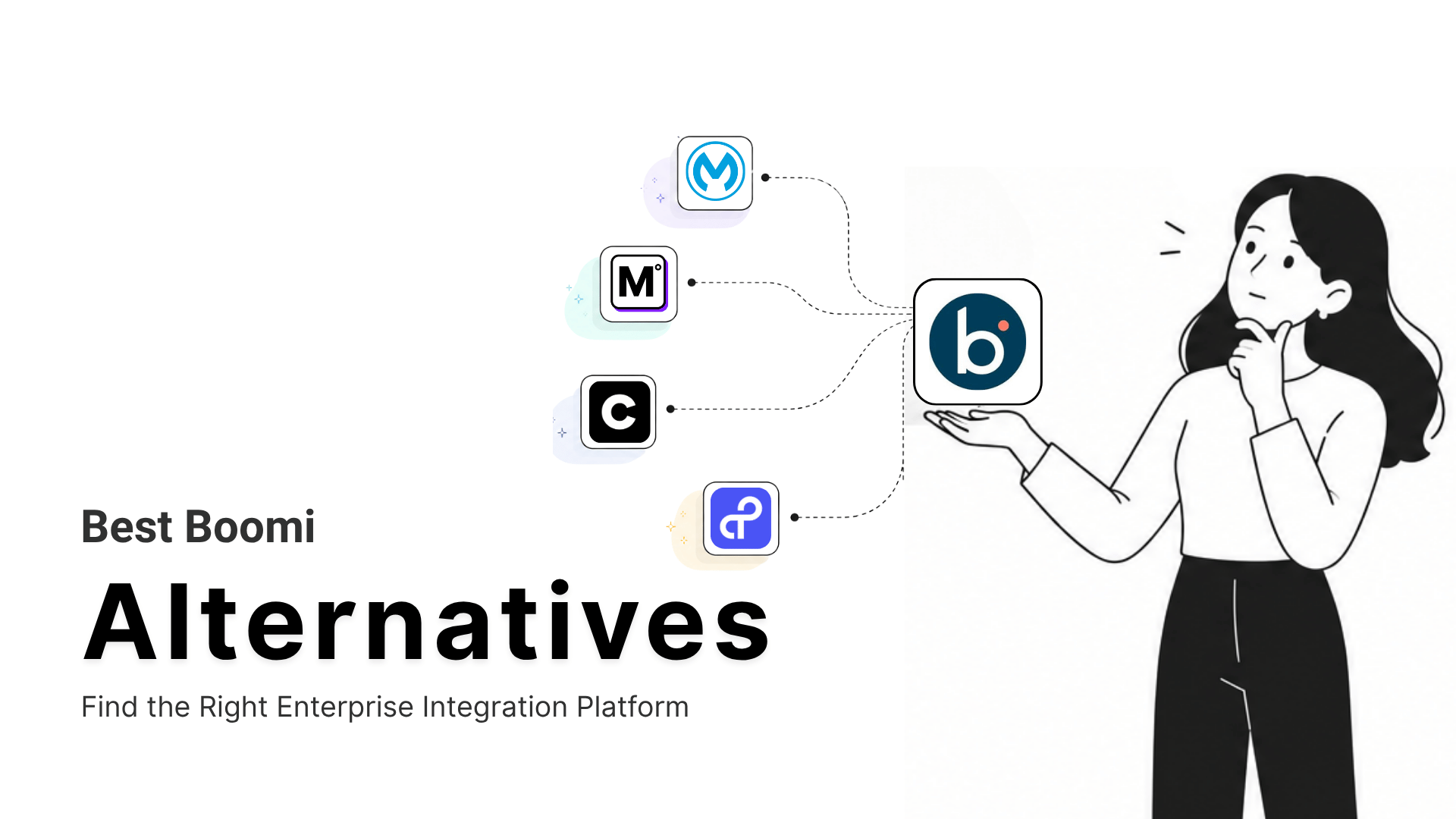
We compared 7 of the best Boomi alternatives based on pricing, integration capabilities, automation depth, and AI agent readiness to help you find the right platform for your use case.
Limitations of Boomi
Boomi is a cloud-native iPaaS built around a visual drag-and-drop canvas and a runtime called an Atom, which runs in the cloud, on-premises or in hybrid setups. The platform covers application integration, B2B/EDI management, API management, data management and agent connectivity.
- Pricing sits behind a sales call: The Integration, API Management, Data Hub and Data Integration editions all require a sales conversation. The only published price is Pay-as-you-Go at $99 a month plus $0.05 per message, and it is currently open only to active trial users.
- Enterprise connectors cost extra on lower editions: On the Integration Professional edition, enterprise connectors are an extra-cost option, so a budget that depends on enterprise application connectors needs a quote.
- The MCP Server connector is still in Early Access: The connector that exposes Boomi processes as MCP tools supports plain HTTP only, without HTTP streaming or STDIO. Boomi Connect, a separate managed service, offers MCP-enabled tools for teams that do not need to expose their own processes.
- Latency-sensitive sync needs testing: Sync vendors such as Stacksync describe Boomi as batch oriented and recommend change-data-capture tools for sub-second bi-directional sync. Event Streams covers event-driven integration, so teams with strict latency needs should test it against their own workload.
These constraints weigh differently by team. A team on a fixed budget meets the pricing gap first, a team with heavy SAP or NetSuite usage meets connector costs, and a team building agents meets MCP timing. Boomi offers a 30-day free trial for testing each against a real workload. The platforms below handle the same three areas in different ways.
How These Boomi Alternatives Were Compared
Pricing, plan names and product claims come from each vendor’s own pricing page, product pages and documentation, checked in October 2026. Where a vendor publishes no price, the entry cites procurement data from Vendr and labels it as a third-party estimate.
- Connector depth for common Boomi systems: Raw connector counts are easy to inflate, so the entries focus on named enterprise systems such as SAP, Salesforce, NetSuite and Workday.
- Pricing visibility: Whether a buyer can find a number before a sales call.
- MCP and AI agent products: What each vendor ships today, with launch dates where the vendor states them.
- Deployment effort: How much a business user can build from templates and how much needs a developer.
- Governance and audit depth: Whether the vendor documents role-based access and audit trails for agent traffic.
Vendors change pricing often, so confirm current terms before signing anything.
Best Boomi Alternatives Compared
The seven platforms below range from API-led enterprise suites and mid-market template tools to an agent tool gateway, and each entry lists what the vendor publishes about pricing and MCP.
1. MuleSoft
MuleSoft’s Anypoint Platform is an integration and API management platform owned by Salesforce, which acquired the company for $6.5 billion in 2018. It treats each connection between systems as a reusable, discoverable API kept in a shared catalog. Teams build an integration once and reuse it across projects. The platform covers application integration and API design and governance. Deployment runs in the cloud, on-premises or in hybrid setups.
Pros
- Anypoint Exchange keeps connectors, templates and API assets in one searchable catalog, so teams reuse integrations across projects
- DataWeave handles data transformation, with Anypoint Studio and Anypoint Code Builder as the design environments
- MuleSoft lists MCP support, Agent Fabric for governing and orchestrating agents, and an AI Gateway among its products
- MuleSoft for Agentforce adds Topic Center to every Anypoint license, and the Agentforce connector is free to download from Exchange, although each execution still uses subscription allowance
- CloudHub 2.0 covers managed cloud deployments and Runtime Fabric covers customer-managed ones
Cons
- Package features and Mule Credit allocations depend on the package selected, and each package routes to a sales conversation, so the $2,000 starting price does not give a full budget
- Pricing is billed annually, and the Pre-Commit buying model requires a $50,000 minimum annual commitment
Pricing
- Starting price $2,000 a month billed annually, paid in Mule Credits
- Buying models Pre-Purchase, Pre-Commit (minimum $50,000 a year) and Unlimited (custom price)
- Free trial 30 days
Use Case
MuleSoft fits large enterprises already running on Salesforce that need governed, reusable APIs and have the budget and in-house expertise to run a premium platform well.
2. Workato
Workato is an enterprise automation and integration platform built around recipes. A recipe is a workflow of triggers, conditions and actions that connects business systems. Business and IT teams build and maintain automation together, so one platform covers both groups. Its Enterprise MCP page cites governed agent access to 12,000+ apps through MCP. The first eight pre-built MCP servers cover communication, productivity, sales and IT operations.
Pros
- Workato released its first eight pre-built MCP servers on February 5, 2026, across communication, productivity, sales and IT operations, with 100+ planned through 2026
- Existing Recipe Functions and Skills convert into MCP servers with zero code, per Workato’s Enterprise MCP page
- Verified User Access means agent actions inherit the authenticated user’s identity, which enforces role-based access control and keeps audit trails
- Searchable logs record every agent request, response and system event
- Claude Desktop, ChatGPT, Workato Genies, Cursor and other MCP-compatible agents connect through one governance layer
Cons
- Workato publishes no price list, and costs depend on task consumption, connector access and platform tier
- Vendr reports that premium connectors for enterprise applications such as SAP, Oracle, Workday and ServiceNow often carry extra licensing fees
Pricing
- Starting price Not published, quote only. Vendr data puts the median at $64,544 a year, with a range of $20,000 to $183,999
- Tiers Standard, Professional, Business and Enterprise
- Free trial Available
Use Case
Workato fits mid-market and large enterprises that need cross-team automation and want pre-built, governed MCP servers now.
3. MCP360
MCP360 is a unified MCP gateway that gives an AI agent access to 100+ external tools through one connection. The catalog covers search engines, SEO and marketing data, ecommerce and app stores, maps and travel, domain lookups, finance data and email verification. Agents connect with an API key or OAuth 2.0. Connection options include the unified gateway, a single server, direct REST and a drop-in .md skill file.
Pros
- Two meta-tools,
search_toolsandexecute_tool, load tools on demand, so adding servers does not bloat the context window - The Custom MCP Builder wraps any REST API with its key into MCP tools, or runs Python or JavaScript logic
- The MCP Marketplace ships prebuilt servers for web scraping, SEO research, email verification, rank tracking and price tracking
- MCP360 works with Claude Desktop, Cursor, VS Code, Windsurf, Cline, n8n and Flowise, and it offers a direct REST API
- SOC 2 Type II, GDPR and ISO 27001 compliance comes with automatic failover when upstream APIs change or break
Cons
- It solves tool access for agents specifically, not full workflow orchestration or the broader iPaaS feature set that Boomi and MuleSoft cover
- The tool catalog expands monthly, which means occasional adjustment as integrations change, a normal tradeoff for staying current but still more upkeep than a static, versioned connector library
Pricing
- Free plan costs $0/month, 100 credits
- Starter is for $16/month billed annually, 2,000 credits
- Professional costs $83/month billed annually, 10,000 credits
- Advanced is for $333/month billed annually, 100,000 credits
Use Case
MCP360 fits teams building AI agents that pull from many external tools in one session, such as SEO research, lead enrichment or email verification.
4. Celigo
Celigo is an integration platform built around prebuilt integration apps and a marketplace of templates. A team starts from a template for a specific job, such as syncing orders between Shopify and NetSuite, and adjusts it. Celigo’s integrations page calls it NetSuite’s largest partner for over a decade. Celigo Ora is a natural-language assistant for building and troubleshooting the platform.
Pros
- Extensive library of 1,000-plus prebuilt connectors covering ERP, CRM, ecommerce, and finance systems, including NetSuite, Salesforce, SAP, and Shopify, per G2’s Celigo reviews page
- A genuine ongoing free plan with two endpoints and one flow, separate from the 30-day trial, to test real integrations before paying anything
- Natural-language flow configuration that lets non-technical users build and maintain integrations without writing code
- Purpose-built integration apps for NetSuite that cut setup time versus building from a generic connector
- Positions itself explicitly as an agentic automation platform, supporting AI-driven workflows under the same governance model as standard integrations
Cons
- Pricing scales with endpoints and flows rather than a flat seat or usage fee, and enterprise annual contracts commonly start around $20,000, according to Automation Atlas’s Celigo overview, with the real number requiring a custom quote
- The data-mapping configuration inside individual flows carries a real learning curve for teams without an existing integration background
Pricing
- Free plan 2 endpoints and 1 flow, continuing after the trial
- Paid editions Standard, Professional and Enterprise, all quote based
- Free trial 30 days
Use Case
Celigo fits NetSuite-centric teams that want business users to build integrations from templates.
5. SnapLogic
SnapLogic is an integration platform that connects applications and data across cloud and on-premises systems. It uses Snaps, which are prebuilt connectors, and covers data integration, application integration and API management. SnapGPT acts as a natural-language assistant across the platform. Enterprise MCP turns its pipelines into tools that agents can call. SnapLogic calls itself the Agentic Integration Company and builds its pricing pitch around predictability.
Pros
- Every package includes unlimited pipelines, data movement and integrations at the same price, with no per-message metering
- The SnapLogic MCP Server reached general availability on July 7, 2026 and gives agents governed access to platform operations
- MCP Builder, generally available since July 1, 2026, turns existing pipelines into tools that agents call through Enterprise MCP
- AgentCreator is an add-on for any package that builds, deploys and orchestrates agents across connected systems
- A Forrester Total Economic Impact study commissioned by SnapLogic reports 181% ROI with payback in under six months
Cons
- AgentCreator, API Management, AI Gateway and other advanced capabilities are add-ons, and premium Snap Packs are sold a la carte
- The MCP Server and MCP Builder only reached general availability in July 2026, so their production track record is short
Pricing
- Starting price Not published, demo required
- Packages Essential, Professional and Enterprise One, all quote based with unlimited data movement
- Free trial None listed
Use Case
SnapLogic fits enterprises that want volume-independent pricing and are building MCP and agent capability now.
6. Tray.ai
Tray.ai, formerly Tray.io, is an integration and automation platform for building workflows with a low-code builder and a code-first option. Tray Build is the drag-and-drop builder and Tray Headless is the code-first one, and both come with every plan. Merlin Agent Builder creates agents, and Agent Gateway for MCP publishes tools for agents to call. Both agent products sit in a separate Agent Development add-on.
Pros
- Agent Gateway for MCP publishes composite MCP tools and exposes 700+ connectors as MCP tools, with access control and observability
- Merlin Agent Builder builds no-code agents with guardrails and audit logs, plus accelerators for IT service management and HR
- Every plan includes 700+ connectors, audit trails, observability, Tray Build and Tray Headless
- The Enterprise plan lists unlimited workspaces, 180-day insights, advanced on-premise connectivity and log streaming
- Tray Headless adds Claude Code and Codex plugins, headless MCP and full API access for teams that work in code
Cons
- Agent Gateway for MCP and Merlin Agent Builder sit in a separate Agent Development add-on that adds cost to the base plan
- Workspaces cap at 3 on Pro and 20 on Team, and only the Enterprise plan lists unlimited workspaces
Pricing
- Plans Pro, Team and Enterprise (unlimited), all quote based
- Agent Development add-on Bundles Agent Gateway for MCP and Merlin Agent Builder
- Typical cost Vendr data puts the median at $37,641 a year, with a range of $18,700 to $96,300
- Free trial Available
Use Case
Tray.ai fits teams in fast-changing environments that want AI agent capability available but are comfortable buying it as a distinct product rather than a default plan feature.
7. Jitterbit
Jitterbit Harmony bundles iPaaS, API management, a low-code App Builder and EDI in one platform. Jitterbit EDI covers ANSI X12, EDIFACT and XCBL standards. Prebuilt connectors cover applications such as Salesforce, NetSuite, SAP, Workday and ServiceNow. Jitterbit ships several AI products, including prebuilt agents and AI assistants. Its site lists agents for sales, HR, knowledge management, competitive pricing and learning.
Pros
- Jitterbit EDI supports ANSI X12, EDIFACT and XCBL standards with 1,000+ prebuilt trading partner connections
- The AskJB assistant and the EDI AI Assistant answer questions in natural language, including searches across trading partners and document types
- App Builder extends the platform into low-code application development for teams that need custom apps
- Jitterbit lists SOC 2 and SOC 3 Type 2, ISO 27001 and ISO 42001 certifications
- Jitterbit’s Marketplace carries prebuilt AI agents from Jitterbit and third parties, so agent options extend beyond its own catalog
Cons
- Premium connectors cost extra, per Vendr, so the mix of applications connected drives the final contract value
- Professional services can represent 20 to 50 percent of first-year cost, per Vendr, and are quoted separately from the license
Pricing
- Starting price Not published, quote only.
- Add-ons API Management is layered on a Harmony contract, and professional services are quoted separately
Use Case
Jitterbit fits mid-to-large enterprises that want integration, API management, EDI and low-code apps on one platform.
Use Case
Jitterbit fits mid-to-large enterprises that want integration, API management, EDI, and low-code app development consolidated under one platform instead of stitched together from separate tools.
Side-by-Side Comparison
Pricing visibility and shipped MCP products vary the most across these platforms, so the table is built around both. Boomi sits in the first row as the baseline.
| Platform | Category | Published Starting Price | Agent and MCP Products | Best For |
|---|---|---|---|---|
| Boomi (baseline) | iPaaS with API and data management | Pay-as-you-Go at $99 per month plus $0.05 per message, open to active trial users. Subscriptions are quote only | Boomi Connect, MCP Registry, AI Gateway | Baseline for comparison |
| MuleSoft | Enterprise API-led iPaaS | From $2,000 per month billed annually, paid in Mule Credits | MCP support, Agent Fabric, AI Gateway | Salesforce-heavy enterprises |
| Workato | Enterprise automation | Quote only, free trial available | Enterprise MCP with pre-built MCP servers | Cross-team automation with MCP in production |
| MCP360 | Agent tool gateway | Free plan with 100 credits, paid plans from $16 per month billed annually | Unified MCP gateway with 100+ tools and a Custom MCP Builder | Agents that need many external tools |
| Celigo | Mid-market iPaaS | Free plan with 2 endpoints and 1 flow, paid editions quote only | MCP Server and Agent Builder on every edition | NetSuite-centric teams |
| SnapLogic | Enterprise iPaaS | Quote only, demo required | Enterprise MCP, SnapLogic MCP Server, AgentCreator add-on | Buyers who want volume-independent pricing |
| Tray.ai | AI-augmented iPaaS | Quote only, free trial available | Agent Gateway for MCP and Merlin Agent Builder in a paid add-on | Teams that need low-code and code-first builders together |
| Jitterbit | Enterprise iPaaS with EDI | Quote only | Prebuilt AI agents and the AskJB assistant | Integration, EDI and low-code apps on one platform |
How to Choose the Right Boomi Alternative
The fastest way to narrow this list is to name the specific thing costing you time or money on Boomi today, then match that constraint to the platform built around solving it.
- Budget predictability matters more than feature count for most buyers:The comparison table above flags which platforms show a real number before a sales call. Everyone else, including Boomi itself, requires a quote to know what you’d actually pay.
- Team composition decides how much a platform’s learning curve really costs: Celigo’s natural-language flows and Jitterbit’s AskJB assistant both let a business user build and adjust integrations directly. MuleSoft and Tray.ai reward teams that already have developers on staff, in exchange for a steeper ramp-up.
- AI agent maturity separates production infrastructure from marketing claims: Workato and SnapLogic both have governed MCP infrastructure live today, not on a roadmap. When the actual gap is tool access for agents rather than full workflow orchestration, MCP360 solves that piece directly without a platform migration.
- An existing tech stack narrows the field before any comparison start: MuleSoft’s native Salesforce depth and Celigo’s NetSuite-first design both outrun general-purpose competitors on their respective home turf.
- Regulated industries need a real audit trail behind every action, not a checkbox integration: Workato, MuleSoft, and Jitterbit all build role-based access and full audit trails into the platform, at the cost of a longer, more sales-driven buying process than the rest of this list.
Pick the factor that’s actually driving your search this week, and build the shortlist around it. That single priority is usually enough to make the call stick.
Frequently Asked Questions
What is an iPaaS platform?
An iPaaS, or integration platform as a service, connects applications, data, and systems across cloud and on-premises environments through prebuilt connectors and visual workflows, instead of custom-coded integrations for every connection.
Why do teams look for alternatives to Boomi?
Boomi’s core constraints push teams to compare alternatives. Nearly every pricing tier sits behind a sales call, premium connectors for SAP and Salesforce cost extra, and its batch-first architecture struggles with real-time sync. Runtime updates can also break live flows without warning, adding maintenance overhead that grows heavier as integrations scale.
How much does Boomi actually cost?
Boomi publishes only one real number: Pay-as-you-Go starts at $99 a month plus $0.05 per message. Every subscription tier above that requires a sales call, and premium connectors for systems like SAP and Salesforce carry their own add-on fees on top of the base platform price.
Is MuleSoft a better choice than Boomi?
MuleSoft fits large enterprises already on Salesforce that need governed, reusable APIs and have the budget for a premium platform. It offers deeper native Salesforce integration and a free MuleSoft for Agentforce add-on, but like Boomi, its pricing sits entirely behind a sales call with no published numbers.
Which Boomi alternative is best for teams building AI agents?
Workato and SnapLogic both ship governed MCP infrastructure in production today, not on a roadmap, making them the strongest picks for agent-heavy workflows. For narrower needs, like giving an agent tool access without a full orchestration platform, MCP360 solves that piece directly and pairs alongside either one.
What is an MCP gateway?
An MCP gateway is a single connection point that gives AI agents access to many external tools without a separate integration for each one. MCP360 is one example, unlocking 100-plus tools through one API key.
Has Boomi added support for AI agents and MCP?
Yes. Boomi Connect and its MCP Registry reached general availability in 2026, and the company closed its acquisition of AI gateway specialist Lunar.dev the same year, folding it directly into Boomi Connect. That timing matters because a few alternatives, like Workato and SnapLogic, already had governed MCP infrastructure running in production before Boomi’s launch.
Conclusion
Integration buying is splitting into two layers. One moves data between business systems, and the other gives AI agents the tools they call, with MCP becoming the shared interface between them. Teams that decide each layer on its own terms can change one later without re-platforming the other.
The most useful preparation costs nothing. Before the next vendor demo, write down which agents need which tools, under which identities, and what must be logged. That one page turns every pitch into a comparable answer and carries over to whichever platform wins. For background on the controls involved, see MCP gateway governance.
Agent tool access can start well before that decision settles. The MCP360 free plan includes 100 credits a month and connects an agent to 100+ tools through one connection, with the Custom MCP Builder available when an internal API needs to become a tool.
Tags

Article by
MitaliAI & Automation | Content Writer
Mitali is a content writer covering AI agents, automation, and no-code tools. Her writing spans the AI landscape, from support and sales automation to MCP integrations and agent workflows, with a focus on practical business use.