



The TL;DR
AI agents can write code, draft responses, and complete multi-step tasks, but they cannot verify live prices, recent product releases, or breaking news unless they are connected to a search tool.
-
• What These Tools Are
AI search tools are APIs and MCP servers that give agents real-time access to the web. Depending on the service, they can return ranked search results, cleaned webpage content, structured data, or a cited answer instead of relying only on the model’s training data.
-
• Why They Matter
The search tool an agent uses affects whether its answers are current, accurately sourced, and affordable to run at scale. It also determines how much additional processing the agent must do before it can use the returned information.
-
• Best AI Search Tools for AI Agents in 2026
This guide compares seven leading AI search tools based on what they return, current pricing verified against official vendor pages, key strengths and limitations, and how each one connects to AI agents through MCP.
An agent that recommends a product, quotes a price, or names who currently runs a company is not reasoning about any of it. It is repeating whatever was true when its training data was collected, with no way to flag that anything has changed since. That gap closes only when the agent can call a search tool mid-task.
Model Context Protocol, known as MCP, gives an agent a standard way to make that call. A growing set of vendors now build search APIs and MCP servers around exactly this need, and they do not solve it the same way. Picking the wrong one means paying for capability the agent never touches, or missing the one capability it actually needed.
This guide compares seven of the current best search engines API tools. We’ll evaluate each one’s strengths, where it falls short, and what it actually costs, checked against each vendor’s own pricing page rather than marketing copy.
Comparing AI Search Tools for AI Agents
Search tools for agents split into three jobs: finding pages, reading their content, and turning what they find into an answer. Some tools do only one of these. Others do all three. MCP360 sits above all of them as a single connection point for whichever ones a given stack actually needs. For a broader view beyond search specifically, 10 essential MCP servers for 2026 covers the wider server landscape.
The table below compares what each tool returns, it’s best use case and MCP support. The sections that follow cover each one in more depth.
| Tool | What It Returns | Best For | MCP Support |
|---|---|---|---|
| Exa | Semantically ranked results with page content included | Research-heavy and conceptual queries | Official |
| Tavily | Cleaned, LLM-ready search results | RAG pipelines and LangChain-style agents | Official |
| MCP360 | Access to 100+ external tools through one gateway | Teams connecting five or more tools to one agent | Native gateway |
| Firecrawl | Search results with full-page extraction | Agents that need to search and read complete pages | Official |
| Perplexity | Raw search results or cited, synthesized answers | Cited research without building a custom RAG loop | Official |
| Brave Search API | Search results from an independent index | Privacy-sensitive and non-Google workloads | Official |
| SerpAPI | Raw multi-engine SERP data in JSON | SEO tooling and multi-engine rank tracking | Official |
1. Exa
Exa is a neural search API built for AI applications. It ranks pages by meaning rather than exact keyword matches, and returns page content in the same call. It ships an official MCP server at mcp.exa.ai/mcp and is available as a native Claude Desktop connector. Exa raised a $250 million Series C in May 2026 at a reported $2.2 billion valuation, with investors including Andreessen Horowitz and Nvidia’s venture arm.
Advantages
- Contents included by default: As of the March 2026 update, results include page text and highlights in the same call, saving a separate fetch.
- Sub-150ms Instant mode: Built for chat apps, voice AI, and coding agents where latency matters most, with deeper modes available when speed can trade for depth.
- Category-specific indexes: A category parameter targets curated indexes, including company profiles with structured fields like funding and headcount.
- Neural, not keyword, ranking: Queries are matched by meaning, so results surface even when the source page never used the same wording.
- Agent tools inside the MCP server: Exa Agent runs multi-step research through the same MCP connection used for search, with no second product required.
Limitations
- Costs scale linearly at volume: There is no discount tier without an enterprise conversation, so a million requests a month runs into the thousands of dollars.
- Default rate limit is 10 requests per second: Multi-agent pipelines running parallel searches reach that ceiling quickly, and raising it means contacting Exa directly.
Pricing
- Free: $0/month
- Search: $7 per 1,000 requests
- Agent: $0.012–$1.00/run
- Contents: $1 per 1,000 pages
- Deep Search: $12–15 per 1,000 requests
- Monitors: $15 per 1,000 requests
Use Case
A research agent asked to find recent work on retrieval-augmented generation gets more relevant results from Exa’s neural ranking than from keyword matching, and gets the page text in the same call, with no second fetch required.
2. Tavily
Tavily is a search API built for AI agent tool use. It returns cleaned, LLM-ready content instead of raw SERP HTML, and it is the default search tool in many LangChain-style RAG pipelines. It ships an official MCP server with search, extract, map, and crawl built in. Tavily reports more than 3 million monthly SDK downloads and counts Fortune 500 companies including IBM among its customers.
Advantages
- Search, extract, map, and crawl in one API: Results feed directly into content extraction without a second vendor or a second tool-calling format.
- Native LangChain and LlamaIndex integrations: Framework support cuts setup to a few lines of code instead of a custom wrapper.
- Optional synthesized answer: An include_answer parameter returns a short answer alongside the raw results, skipping a separate endpoint.
- Remote MCP with OAuth: A client connects to Tavily’s hosted MCP server and authenticates through OAuth, with no local install required.
- Predictable, depth-based credit pricing: A basic search costs 1 credit and an advanced search costs 2, so cost tracks the depth actually chosen.
Limitations
- Search-first, extraction-light: Heavy structured extraction beyond snippets typically still needs a dedicated scraping tool alongside it.
- New ownership under Nebius: The February 2026 acquisition moves Tavily under new ownership. Teams with multi-year dependencies should confirm current roadmap and pricing directly.
Pricing
- Free (Researcher): $0/month
- Pay As You Go: $0.008/credit
- Project: $30/month
- Enterprise: Custom pricing
Use Case
A LangChain agent answering support questions with cited sources runs on basic search at 1 credit per call. On the $30-a-month Project tier, that covers roughly 4,000 basic search calls a month before any overage, with no separate scraping step needed for snippet-level answers.
3. MCP360
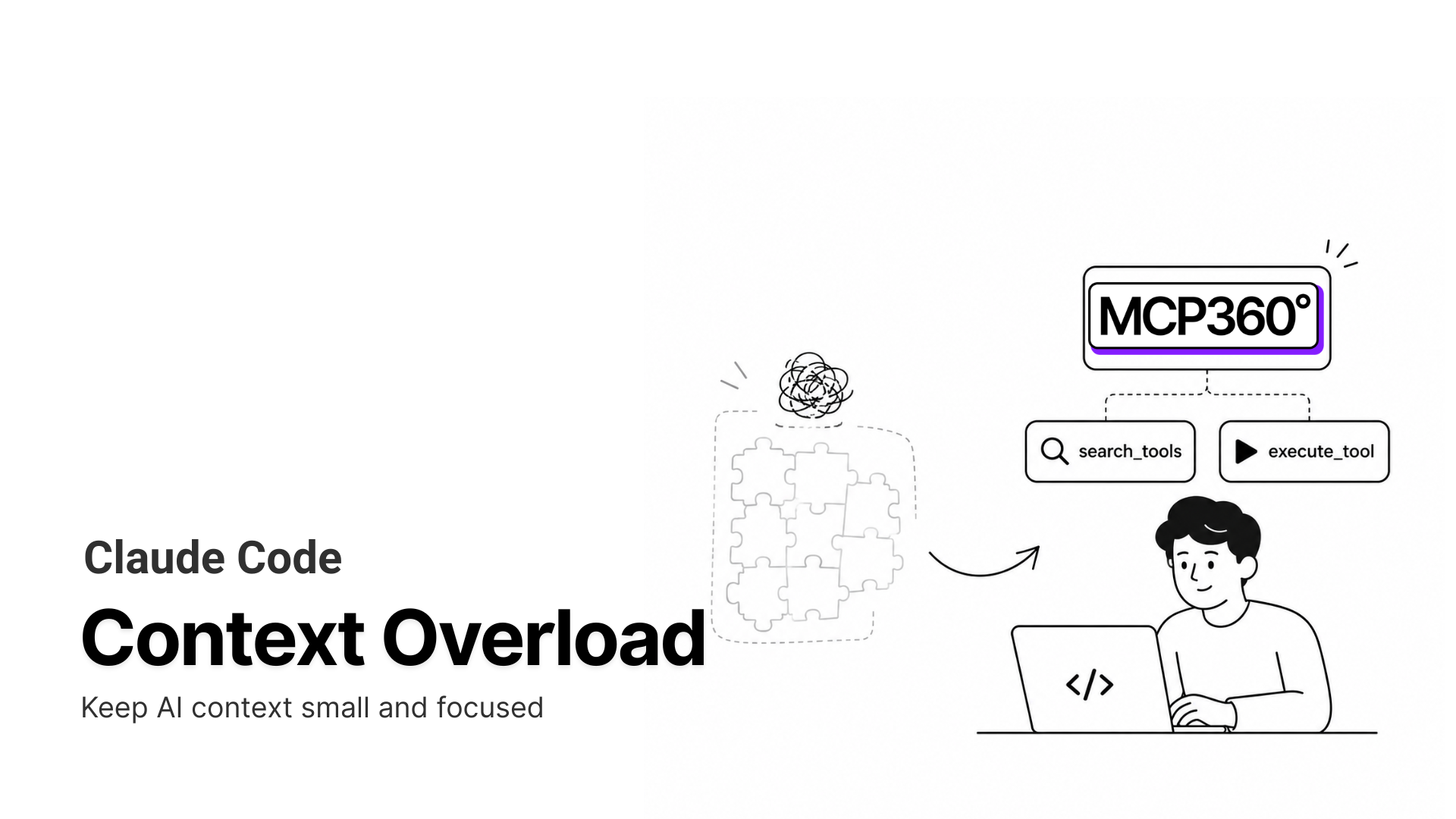
MCP360 is a unified MCP gateway that connects an AI agent to 100+ external tools, including Google Search, web scraping, keyword research, and SERP tracking, through a single configuration entry. Tools load on demand through the search_tools and execute_tool meta-tools, so adding a new server does not grow the agent’s context window. How MCP360’s gateway works covers the underlying architecture in more depth.
Advantages
- Custom MCP Builder: Turns any REST API or data source into an MCP tool, no-code for standard APIs or custom code for anything else.
- One response schema instead of five: One gateway means one tool-calling format and one failure mode, instead of learning every vendor’s API individually.
- Automatic failover: When an upstream API changes or breaks, the gateway routes around it instead of dropping the tool call.
- Enterprise compliance built in: SOC 2 Type II, GDPR, and ISO 27001 certified, removing a review step for regulated teams.
- On-demand tool loading: Tools are discoverable through the meta-tool layer without loading into context up front, so a 100-tool catalog stays token-light.
Limitations
- Overhead for single-tool setups: A team needing only one search API gets a simpler stack from a direct vendor connection.
- Free tier is for testing, not production: 100 credits a month covers evaluation, not a live workload.
Pricing
- Free: $0/month
- Starter: $16/month
- Professional: $83/month
- Advanced: $333/month
Use Case
A team running a research agent that relies on Google Search, keyword research, SERP tracking, and web scraping wires all four into one MCP360 configuration. When a connected vendor restructures its pricing or free tier, as Brave and Perplexity both did in 2026, the agent’s setup does not need to change, because MCP360 owns the routing underneath it.
4. Firecrawl
Firecrawl is a web scraping and search API built for AI agents. It pairs a search endpoint with full-page extraction, so an agent finds and reads a page in one workflow. It ships an official MCP server covering scrape, crawl, map, search, and extract, detailed further in Firecrawl for AI Agents. More than 1.25 million developers use it, and its open-source repository has passed 130,000 GitHub stars.
Advantages
- Measured token savings: Firecrawl’s own benchmark puts clean markdown at roughly 2,788 tokens against 38,381 tokens for the same raw HTML page, a 94% reduction.
- JavaScript rendering by default: Pages that need a real browser to render still return usable content with no extra setup.
- Search plus scrape in one workflow: One provider covers finding a page and reading it, instead of pairing separate tools.
- Keyless free access to core tools: Scrape, search, and interact work on the free tier without an API key, rate-limited but immediate.
- Broad MCP tool set: Beyond the core five, the server also runs an autonomous research agent and recurring page-change monitors.
Limitations
- Credits do not roll over: Standard plan credits expire each billing cycle, except for auto-recharge credits and annual Scale plans.
- Feature multipliers add up quickly: JSON extraction and Stealth Mode consume credits several times faster than a plain scrape.
Pricing
- Free: $0/month
- Hobby: $16/month
- Standard: $83/month
- Growth: $333/month
- Scale: $599/month
- Enterprise: Custom pricing
Use Case
An agent that needs to find and read the top ten pages on a topic chains the search endpoint with the scrape endpoint in one workflow, all inside a single provider’s credit pool, with no second bill for a separate scraping tool.
5. Perplexity
Perplexity offers two developer products under one account, a raw-results Search API and the Sonar model family. Sonar combines search with LLM synthesis and citations in one call. It ships an official MCP server with four tools, and the Sonar API is fully OpenAI-compatible. The developer-facing API is a separate product from the consumer Perplexity Pro subscription, and a Pro plan alone does not include meaningful API access.
Advantages
- A whole pipeline step removed: Sonar skips the step every other tool here requires, running search and synthesis inside the same request.
- Citations included by default: Every Sonar response includes source URLs, useful for an agent that has to show its work.
- OpenAI-compatible endpoint: Sonar accepts requests at the same path OpenAI libraries call by default, so integration means changing one base URL.
- Four purpose-built MCP tools: perplexity_search, perplexity_ask, perplexity_research, and perplexity_reason let an agent match tool depth to the task instead of overpaying for it.
- Tiered Sonar pricing for cost control: Base Sonar, Sonar Pro, and Sonar Reasoning Pro let a team route easy lookups to the lower-cost tier.
Limitations
- Less control over the reasoning path: Sonar decides which sources to cite, so agents needing separate, auditable steps need the Search API plus a separate LLM.
- A per-request fee stacks on top of token cost: Every Sonar call carries a request fee tied to search context size, on top of token cost.
Pricing
- Free tier: $0/month
- Search API: $5 per 1,000 requests
- Sonar: $1 per 1M input tokens / $1 per 1M output tokens, plus a request fee
- Sonar Pro: $3 per 1M input tokens / $15 per 1M output tokens, plus a request fee
Use Case
An agent answering support questions with cited sources calls perplexity_ask through the official MCP server and gets a sourced response in one turn. A broader task, such as comparing five vector databases with citations, fits perplexity_research on the deep research model, at a higher but predictable per-query cost.
6. Brave Search API
Brave Search API runs on Brave’s own independent index rather than reselling Google or Bing data. That independence is why it stayed viable when Microsoft retired the Bing Search API in August 2025. It ships an official MCP server for direct agent integration. Brave counts AWS, Shopify, Snowflake, and Mistral AI among its API customers.
Advantages
- LLM Context endpoint: Returns structured chunks pulled from page content and JSON-LD schemas, built for a model to read directly.
- 30 billion pages at 50 requests per second: The index is maintained internally, a genuinely separate source rather than a re-ranked mirror.
- Query data protections built into every tier: Brave states it cannot identify individual end users on any tier, with full Zero Data Retention reserved for enterprise customers.
- A fully independent index: Brave does not resell Google or Bing results, one of the few options left outside that duopoly.
- Answers endpoint for finished responses: A separate endpoint returns a grounded, synthesized answer through an OpenAI-compatible interface, skipping a second LLM call.
Limitations
- The free tier is now metered: Brave replaced its free tier with $5 in monthly credits in February 2026, about 1,000 queries, and attribution is required to keep the rate.
- Search-only on the core plan: No full-page content extraction, so reading the page still needs a second tool like Firecrawl.
Pricing
- Search: $5 per 1,000 requests
- Answers: $4 per 1,000 queries, plus token costs
- Enterprise: Custom pricing
Use Case
A legal research agent that needs an independent index with strict data handling builds on the LLM Context endpoint. At $5 per 1,000 requests, 20,000 queries a month runs $100, with attribution required on the project’s public site to keep the monthly credit.
7. SerpAPI
SerpAPI is a real-time SERP API that scrapes structured results from Google, Bing, YouTube, Baidu, and roughly a dozen other engines and returns them as JSON, rather than a synthesized AI answer. It ships an official open-source MCP server hosted at mcp.serpapi.com, alongside its own REST API and SDKs.
Advantages
- Multi-engine coverage: One API surface covers a dozen-plus engines, useful for comparing rankings across engines the AI-native tools here do not.
- Legal and compliance framing: U.S. Legal Shield and ZeroTrace privacy modes are documented across every plan, useful for procurement approval.
- Structured schemas per engine: Parameter schemas for every engine are exposed as MCP resources, so an agent finds the right fields without hardcoded logic.
- Open-source server code: The MCP server implementation is public on GitHub, so a team can inspect or self-host it.
- Only successful searches are billed: Cached results and failed requests do not draw down the monthly quota.
Limitations
- Unused searches do not roll over: Uneven monthly usage wastes paid capacity.
- Raw SERP data, not LLM-cleaned: The agent’s own pipeline still needs a parsing step that most AI-native tools in this list skip.
Pricing
- Free: $0/month
- Starter: $25/month
- Developer: $75/month
- Production: $150/month
- Big Data: $275/month
- Enterprise: Custom pricing
Use Case
An SEO monitoring agent tracking a keyword set across Google and Bing at country level runs on SerpAPI’s Production tier for $150 a month, covering 15,000 searches. The output is raw SERP JSON, and the agent’s own pipeline handles ranking extraction and comparison.
Choosing and Connecting the Right Tool
Start with the shape of answer the agent needs to produce, then confirm the operational details before any of these goes into production.
- Semantic or conceptual queries: Exa’s neural ranking finds related pages even when the query and the source do not share the same wording.
- Search plus full-page reading in one workflow: Firecrawl covers both without a second vendor and a second bill.
- A cited, synthesized answer without building a RAG loop: Perplexity’s Sonar models return sourced answers in one call, with the standalone Search API covering retrieval-only work under the same account.
- An independent index outside Google and Bing: Brave is the only major option here that is not reselling either.
- Raw multi-engine SERP data at scale: SerpAPI’s structured JSON across a dozen-plus engines matters more for rank tracking and SEO tooling than for agent-facing answers.
- Predictable per-credit pricing for RAG: Tavily’s flat credit cost per search keeps budgeting simple against token-based billing.
- Five or more tools behind one agent: A single gateway that handles authentication and routing across all of them earns its overhead at that point. MCP360 does this by connecting search, SERP, and scraping tools through one configuration entry.
Before any of these goes into production, confirm three things directly on the vendor’s own page rather than assuming they still hold. What the API logs on each query. Whether the advertised free tier survives real testing load. And what the current terms actually say. Two of the seven tools above changed their free-tier terms within the past six months. If a connection stops working mid-setup, common MCP connection issues covers the usual causes.
Frequently Asked Questions
Why do AI agents need a search tool?
An agent’s training data has a cutoff date. Without a search tool, it cannot check today’s prices, a new release, or breaking news.
What’s the best AI search API for AI agents?
There is no universal best pick. It depends on how much cleanup the agent’s pipeline can handle: Exa, Tavily, and Firecrawl return content already shaped for a model to read, while SerpAPI returns raw data that needs parsing. Teams using several of these can connect them all through MCP360 instead of managing each one separately.
What’s the difference between Exa and Tavily?
Exa ranks pages by meaning, using neural search that finds related content even when the wording differs, which suits research-heavy queries. Tavily returns already-cleaned, LLM-ready snippets built for RAG pipelines and can include a quick synthesized answer. Both ship official MCP servers.
Is there a free AI search API for AI agents?
Yes. Exa gives 20,000 free requests a month, Tavily and Firecrawl each offer 1,000 free credits, and SerpAPI includes 250 free searches. MCP360 also has a free plan for testing tools before committing to a paid tier.
Is SerpAPI legally risky to use?
SerpAPI is currently facing a DMCA lawsuit from Google over its scraping methods, filed in December 2025. A motion to dismiss hearing was held in May 2026, with no ruling confirmed yet. It is not disqualifying on its own, but worth tracking if the agent depends on it long-term.
What’s a good SerpAPI alternative for AI agents?
It depends on why someone is switching. Exa, Tavily, and Firecrawl are strong replacements if the goal is cleaner, model-ready output. None of them match SerpAPI’s coverage of a dozen-plus engines beyond Google and Bing, so a rank-tracking or multi-engine use case may still need SerpAPI directly.
How do I connect multiple search APIs to one AI agent?
Each tool needs its own API key and MCP configuration if connected directly. MCP360 removes that step by routing search, SERP, and scraping tools through a single gateway, so an agent manages one credential instead of five.
Conclusion
Structured, agent-native output is becoming the standard, not a differentiator. More vendors will ship an MCP server or restructure pricing before this list needs another pass.
Every additional search tool brings another API key, another billing cycle, and another point of failure to diagnose when a result stops coming back. At one or two tools, that is manageable. Past four or five, it becomes the kind of overhead that quietly consumes engineering time better spent on the agent itself.
The right tool matches what the agent needs to return today, not the one with the longest feature list. A team chasing semantic, research-grade results reaches for Exa. One that needs to search and read full pages in the same call reaches for Firecrawl. Once the tool count grows past four or five, that is the point to evaluate a gateway like MCP360 or one of the MCP servers built for marketing and SEO teams instead of wiring in a sixth vendor by hand.

Article by
HarsheenMCP & AI Agents | Content Writer
Harsheen is a content writer covering AI agents, automation, and no-code tools. She writes across topics from chatbots and customer experience to MCP and enterprise workflows, showing how real teams adopt AI in everyday operations.