


The TL;DR
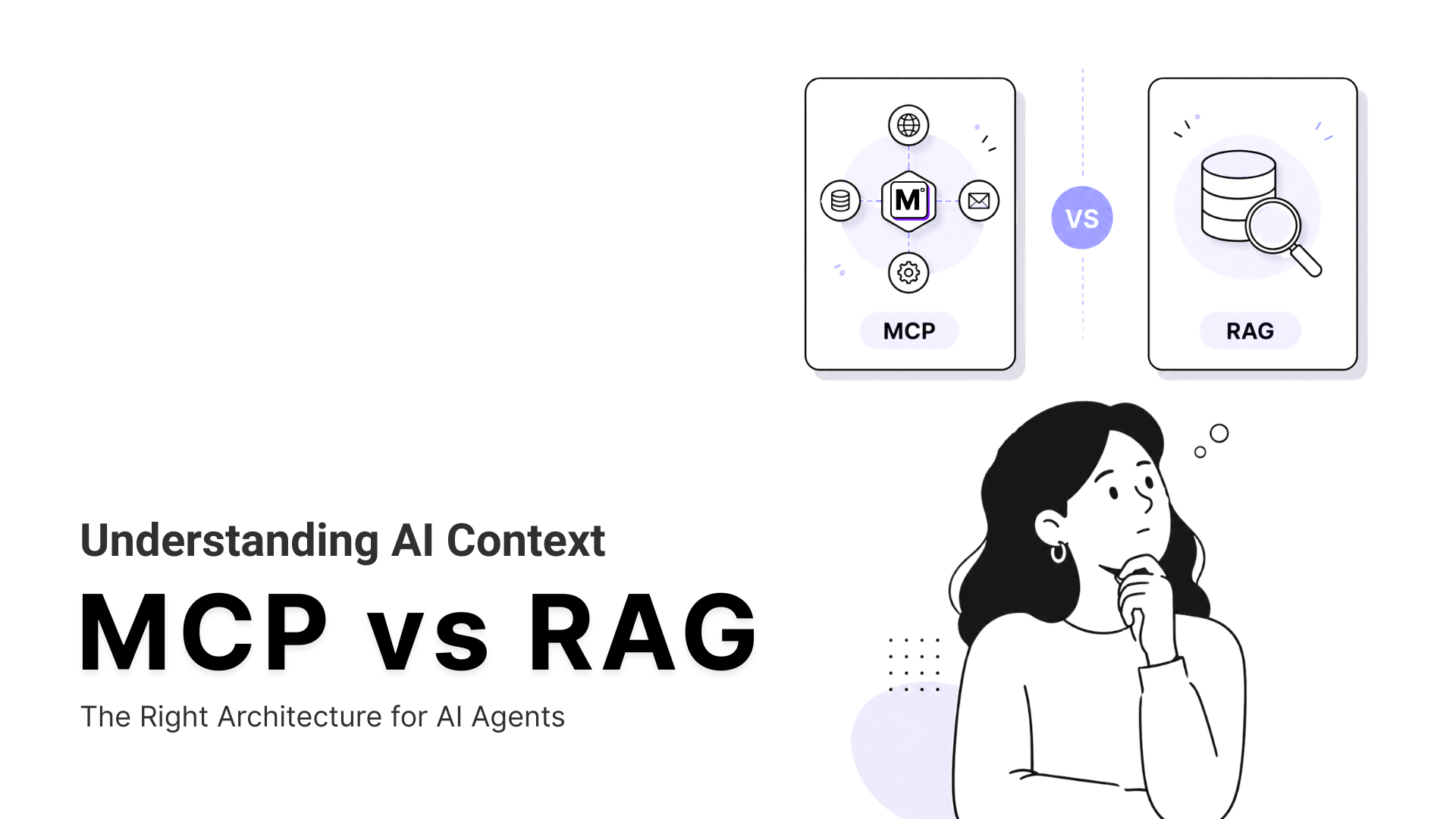
MCP and RAG solve different problems inside the same agent, and most production stacks in 2026 use both rather than choosing one side in the MCP vs RAG debate. MCP also entered the second half of 2026 with its biggest specification revision yet and adoption numbers that challenge claims that the protocol is fading.
-
• Indexed Ahead of Time vs Called Right Now
RAG searches content that has been indexed in advance. MCP calls a live tool when an agent needs current data or needs to write something back to another system.
-
• The Number the Obituaries Left Out
The official July 28 specification release reports close to half a billion MCP SDK downloads per month, a level of adoption that does not fit the idea of a protocol on its way out.
-
• The Overlooked Third Option
A growing body of research applies RAG-style retrieval to MCP’s own tool-selection problem. Instead of treating MCP and RAG as competing approaches, agents can use retrieval to identify the right MCP tools before calling them.
Every “rag vs mcp” search returns the same table. Retrieval for documents on one side, tool calls for live data on the other, use both if you can. That’s accurate, and it’s also every other result on the page. What’s missing from that table is the research that actually changes the calculus.
A 2025 paper found that treating MCP’s tool catalog the same way RAG treats a document index more than triples an LLM’s accuracy at picking the right tool. Anthropic found close to the same result in its own production data months later. That’s not a footnote. It means MCP and RAG aren’t just sitting next to each other in an agent’s stack, at the infrastructure level, they’re the same idea, applied to two different catalogs.
Here’s what MCP and RAG for AI agents each actually do, where 2026’s evidence says each wins, and why that research means most production agents end up needing both.
What Is MCP
Model Context Protocol is an open standard, released by Anthropic in November 2024, that lets an AI model discover and call external tools the moment it needs them. That live-answer property is the whole point. RAG can only search what was captured the last time someone ran an indexing job. MCP gets today’s answer and can write a status update back if the workflow calls for it.
MCP has moved fast since. Anthropic donated it to the Agentic AI Foundation, a Linux Foundation directed fund, in December 2025, backed by Google, Microsoft, AWS, Cloudflare, and Bloomberg. On July 28, 2026, six days before this article was written, it shipped its biggest specification revision yet, a stateless core built around Tasks and MCP Apps as formal extensions.
How MCP Works

An MCP client, built into the host app, connects to one or more MCP servers. Each server exposes tools, a CRM server offers a record search, a filesystem server offers read and write functions, and the model only learns a tool exists once the server tells it. Mid-conversation, the model decides it needs one, calls it through the client, and the server’s answer comes straight back into the same exchange.
The specifics:
- Released November 2024, now stewarded by the Agentic AI Foundation, a Linux Foundation directed fund, since December 2025
- Current specification is 2026-07-28, built around a stateless protocol core
- More than 11,000 active public servers and close to half a billion SDK downloads a month
- Native support in Claude, Cursor, VS Code, ChatGPT, and Gemini, among others
None of that changes what MCP fundamentally does. It changes how reliably it runs at scale, which the “is MCP dying” question later in this piece depends on.
What Is RAG
Retrieval-Augmented Generation takes the opposite approach to the same problem, an LLM that doesn’t know something outside its training data. Instead of calling a live system, RAG searches a library built in advance. Documents get chunked, converted into vector embeddings, and stored in a vector database ahead of time, so the answer is only ever as current as the last time someone ran that job.
How RAG Works

A question comes in, gets embedded the same way the documents were, and the system searches the vector database for the closest matches. Those chunks get combined with the original question into a single prompt, and the model answers from that context instead of its training data alone. Query runs in milliseconds. Ingest runs continuously in the background, fetching, normalizing, chunking, and re-embedding as source content changes. RAG earns its keep on large, stable bodies of text, product docs, runbooks, a policy library, where semantic search beats a keyword lookup and re-indexing hourly would be wasted compute.
The specifics:
- No single vendor. Built on vector databases such as Pinecone, Qdrant, or pgvector, often wired together with a framework like LangChain or LlamaIndex
- Two-part architecture, continuous ingest plus a per-request query path, typically tens of milliseconds
- Read-only by definition, no built-in mechanism to write back to a source system
- Reduces hallucination meaningfully but doesn’t eliminate it, a point worth taking seriously rather than waving away
One peer-reviewed Stanford study found commercial legal-RAG tools, including Lexis+ AI, still hallucinate 17 to 33% of the time despite retrieval. Agentic RAG, the 2026 variant showing up in the same searches as this comparison, wraps that same retrieval in a reasoning loop instead of one pass, but it still can’t write to a live system on its own.
MCP vs RAG at a Glance
The table below turns that distinction into eight concrete properties, not an abstract debate over which acronym wins. Read down a column for whatever specific piece of context you’re placing right now, not across the whole table at once, since most agents end up pulling answers from both sides in the same turn.
| Decision Factor | RAG | MCP |
|---|---|---|
| Where the answer lives | A vector index, built in advance | A live system, queried at call time |
| Freshness | As current as the last sync job | Always current, by definition |
| Typical latency | Tens of milliseconds per query | Sub-second for a local tool, one to several seconds when the call hits an external API |
| Can it write data back | No, read-only by design | Yes, if the tool exposes a write action |
| Setup cost | An ongoing pipeline, chunking, embedding, re-sync | A tool server plus OAuth and schema work |
| Who owns permissions | You, via access-control tags on each chunk | The source system, via the current user’s own credentials |
| Best data shape | Large, slow-changing, unstructured text | Small, targeted, structured, or volatile |
| Failure mode at scale | Retrieval quality drops as the index grows without re-ranking | Tool-selection accuracy drops as the tool count grows without retrieval-based selection |
Permissions are the row worth a second look. RAG puts you in charge of access-control sync. Lag it, and a former employee’s document keeps surfacing months after their access was revoked. MCP hands that job to the source system instead, so access never drifts stale, but a read-scoped tool is one misconfigured server away from write. Neither is safer. They fail in opposite directions.
MCP vs RAG: When Live Data & Write Actions Win
The table is a starting map, not a verdict. MCP wins whenever the answer has to be current at the moment someone asks, or whenever the agent needs to change something rather than just describe it. A handful of concrete cases:
- Checking the live status of a support ticket, an order, or a deployment
- Pulling a customer’s current subscription tier or account balance before answering a billing question
- Creating a ticket, sending a message, or updating a CRM record, any action with a side effect
- Querying inventory, pricing, or availability that changes by the hour
- Anything where a stale answer is worse than no answer at all
RAG cannot help when the question is what’s true right now, no matter how recently the index was refreshed. A five-minute-old index is still five minutes stale, and for volatile data that gap is often unacceptable.
MCP vs RAG: When Retrieval and Scale Win
RAG wins on volume and semantic nuance, the two things a live API call handles badly. A few examples make the pattern concrete.
- A support agent answering “how do I configure SSO” from thousands of help-center articles
- Searching across release notes, past incident reports, and internal wiki pages at once for “what did we change last time checkout latency spiked like this,” a query no single keyword-driven system could piece together on its own
- Grounding legal or compliance answers in a large, mostly static policy library, with the hallucination caveat above firmly in mind
- Any case where the same content gets searched by many different users, so paying the embedding cost once and searching it thousands of times is worth it
MCP search is bounded by whatever the source API already exposes, usually keyword matching plus a handful of filters. RAG search is purpose-built for exactly the fuzzy, cross-source query pattern that keyword APIs choke on. That’s a real, durable advantage, not a footnote.
The Research That Blurs the MCP vs RAG Line
Here’s what almost no comparison piece covers. “MCP vs RAG,” like MCP vs Agent Skills before it, turns out to be a less stable framing than it looks. As the number of tools an agent can call grows, tool-selection accuracy degrades the same way a RAG answer degrades when a context window fills with irrelevant documents. A 2025 paper, RAG-MCP, measured it directly. Stuffing every tool description into the prompt at once collapsed accuracy to 13.62%.
The fix was RAG itself, aimed at the tool list instead of a document library. Embed every tool description, retrieve only the handful relevant to the query, hand the model just those. That single change more than tripled accuracy to 43.13% and cut prompt tokens by over half.
| Method | Tool-Selection Accuracy | Average Prompt Tokens |
|---|---|---|
| All tools loaded at once | 13.62% | 2,133.84 |
| Keyword pre-filtering | 18.20% | 1,646.00 |
| Retrieval-based selection (RAG-MCP) | 43.13% | 1,084.00 |
Anthropic found the same pattern in its own production data. One workflow dropped from 150,000 tokens to 2,000 by having the model discover tools as code instead of loading every schema upfront. A separate Tool Search Tool rollout cut a 50-plus-tool setup from roughly 77,000 tokens to 8,700, an 85% reduction, and lifted Opus 4’s tool-selection accuracy from 49% to 74%.
Loading everything into context, every document chunk or every tool definition, makes a model worse, not better. Retrieval, applied to whichever list is too big to fit, fixes it either way, and that’s the exact problem MCP360’s unified gateway is built around, retrieving only the tools a task needs through search_tools and execute_tool instead of loading all 100-plus at connection time, the same pattern above, now running as infrastructure.
The Numbers Behind MCP’s 2026 Adoption
The skepticism was real. Denis Yarats reportedly told an ASK 2026 audience that Perplexity was stepping back from MCP, and Garry Tan replaced his own MCP setup with a command-line tool. Both accounts, as reported, targeted MCP over stdio specifically, the local, single-process version with no built-in authentication, load balancing, or centralized logging. That’s a narrower claim than “MCP is dying,” and it got flattened into the headline anyway.
Adoption data published alongside the July 28 spec tells a different story. Tier 1 SDKs, TypeScript, Python, Go, and C#, pull close to half a billion downloads a month, with TypeScript and Python each past one billion total. AWS, Cloudflare, Google Cloud, and Microsoft Foundry all framed the new stateless core as removing real operational friction, not propping up a fading standard. Those are the numbers of infrastructure that outgrew its original local-process design, which the July revision was built to fix.
How MCP and RAG Combine Inside a Single Agent Turn
Descriptions of a hybrid agent usually stop at the concept, RAG for knowledge, MCP for live data, without showing what actually happens inside one turn. It comes down to four steps.
Retrieval fires first, or in parallel: The moment a question comes in, a RAG query can run against the vector index, pulling back the closest matching chunks in the tens of milliseconds this piece already covered.
The live call runs alongside it, not after it: Nothing about RAG blocks MCP. A tool call to check an order, a subscription tier, or an inventory count can fire at the same time, so total latency tracks whichever side is slower, not the sum of both.
Both results land in the same prompt: Retrieved chunks and live tool output combine into one context window before the model reasons over either, so it’s reading one assembled picture instead of reconciling two separate answers.
Any write happens last, and only through MCP: Once the model has reasoned over the combined context, a second MCP call executes the action, updating a record, opening a ticket, the one step RAG structurally cannot do.
Every tool or data source added to that loop adds to the context costs measured earlier in this piece. Applying retrieval-based loading to both halves, RAG’s side included, is what keeps a hybrid agent from drifting back into the accuracy problem the RAG-MCP research described.
Which Should You Use
The framing above doesn’t resolve the decision actually in front of you, though. Four signals settle most real cases.
- Write access decides it outright: Anything involving a write, a ticket, an email, an inventory update, needs MCP or a direct API. RAG is read-only by design, full stop.
- A freshness requirement under five minutes rules out indexing: Data that stale is too volatile to index economically. Re-embedding on that cycle is expensive and still leaves a gap where something changed. Fetch it live with MCP instead.
- Fuzzy, cross-source lookups favor retrieval: “Why” and “which of these” questions are RAG’s actual strength. A single structured field, a ticket ID or an account balance, moves faster as a direct tool call than as an index entry.
- Repeat searches across many users justify the embedding cost: Content searched by many different people pays that cost back quickly. Content used once and never again wasn’t worth indexing in the first place, so serve it live instead.
Real agents typically land on different sides of these four signals for different parts of their job. That’s why the pick below is usually a combination, not a single winner.
Pick RAG Alone
- Every question the agent handles is read-only, against content that changes on the order of days or weeks, not minutes
- The same knowledge base gets searched by many different users or sessions, so the embedding cost is paid once and recovered many times over
- There’s no requirement to act on or change anything the agent finds
Pick MCP Alone
- The agent’s job is almost entirely live lookups and actions, checking status, updating records, triggering workflows, against systems that already expose the fields needed through a keyword or ID-based search
- There’s no large body of unstructured reference text that would benefit from semantic search in the first place
- Every answer needs to reflect the current state of a system, not a snapshot from an earlier sync
Run Both Together
- The agent needs to ground answers in a large reference library and also act on live, per-user data, which describes most production support, sales, and operations agents built in 2026
- You’re not sure yet. Most teams that start with one side add the other within the first few months once real usage patterns show up
Combining them pays off beyond simple coverage. RAG’s static index lets an agent cross-check a live MCP answer instead of trusting either blindly, a customer record and a policy document that disagree surface as a conflict, not a silent wrong answer. It also avoids the two expensive mistakes on either side, re-embedding data that goes stale before the next sync, or burning a live call on something that hasn’t changed in months.
A support agent resolving a refund is the common shape of this. It needs a RAG lookup to confirm the policy, an MCP call to read the customer’s actual order history, and a second MCP call to process the refund, a write action RAG can never perform. Running that reliably is mostly the infrastructure and cost question the previous section just walked through, not a new architecture problem.
Frequently Asked Questions
What is the difference between MCP and RAG?
RAG searches content that was indexed in advance, like a document library. MCP calls a live tool the moment an agent needs current data or has to write something back to a system. One retrieves, the other acts.
Can MCP and RAG be used together in the same AI agent?
Yes, and most production agents in 2026 do exactly that. A single turn can run a RAG lookup and a live MCP call at the same time, then combine both results into one prompt. Scaling that reliably is mostly an infrastructure question, which is what MCP360’s unified gateway is built to handle.
Does MCP replace RAG?
No. MCP and RAG solve different problems, indexed knowledge versus live data and actions, so one doesn’t retire the other. Most agents that need both keep running both, routed by what each specific task actually requires.
Is MCP actually losing adoption in 2026?
No. Despite public skepticism earlier in 2026, the official July 28 specification release reported close to half a billion MCP SDK downloads a month, with the TypeScript and Python SDKs each individually past one billion total downloads, numbers that don’t match a protocol in decline.
What is agentic RAG?
Agentic RAG wraps a standard retrieval step in a reasoning loop instead of one pass, letting the system judge whether the first search returned enough or needs a follow-up query. It still can’t write to a live system.
Can RAG write data back to a system, like updating a record?
No, RAG is read-only by design. It can only retrieve and summarize existing content. Any action that changes something, like updating a record or sending a message, needs MCP or a direct API instead.
Why does an AI agent get worse at picking tools as more MCP servers are added?
Loading every tool description into the prompt at once measurably hurts accuracy, one 2025 study found it collapsing to 13.62%. The fix is retrieving only the relevant tools per task instead of loading them all, the same approach MCP360’s gateway applies through its search_tools and execute_tool functions.
How do I decide whether to use MCP or RAG for a specific AI agent feature?
Ask two questions: does the feature need to change something rather than just describe it, and would a five-minute-old answer be wrong? A yes to either points to MCP. If not, and the same content gets searched by many users, RAG usually wins. MCP360’s gateway is built to scale whichever combination the decision lands on.
Conclusion
The winning architecture routes each piece of context to whichever layer actually fits it. The spec-adoption numbers, the RAG-MCP benchmark, and Anthropic’s own token data all point the same direction.
Where this goes next is the more interesting question. Retrieval-based tool loading was a research footnote in May 2025. By July 2026 it was standard practice inside Claude’s own API. Expect that same discipline to show up as a default in most agent frameworks well before 2027, not as an optimization teams bolt on after the first cost spike.
MCP360 already runs on that principle, so an agent scaling past a handful of connected tools doesn’t have to relearn the lesson this piece just walked through. Map what your next agent needs live against what it needs indexed before writing a line of code. That map decides the architecture, not a bet on which side wins next quarter.

Article by
HarsheenMCP & AI Agents | Content Writer
Harsheen is a content writer covering AI agents, automation, and no-code tools. She writes across topics from chatbots and customer experience to MCP and enterprise workflows, showing how real teams adopt AI in everyday operations.