



The TL;DR
Anthropic and OpenAI both reset their flagship lineups within three weeks of each other this July, so a comparison written even a month ago is already describing different models.
-
• The Coding Gap Nearly Closed
Claude Opus 5 and GPT-5.6 Sol now sit within a point of each other on SWE-bench Verified, a gap that ran into double digits a year ago.
-
• Image Generation and Voice Still Split
ChatGPT generates images natively and runs full-duplex voice. Claude reads and describes images but doesn’t create them, and its voice mode still waits its turn to speak.
Claude and ChatGPT have already changed how people write, code, and research, turning tasks that used to take hours into a prompt and a short wait. The harder question is which one to actually rely on, since that answer keeps changing before anyone can act on it.
Search interest in “claude vs chatgpt” spiked to 110,000 monthly searches in March 2026 and settled back to around 33,000 by May, the same pattern every time either company ships a flagship. Both companies shipped again this summer, Opus 5 in late July, GPT-5.6 a few weeks before that.
This comparison reflects what’s live right now, not last quarter’s lineup. What decides this for you has less to do with which model wins this month’s leaderboard than which kind of work you actually do.
Claude vs ChatGPT at a Glance
| Your Recurring Work | Claude | ChatGPT |
|---|---|---|
| Long documents, research synthesis, editing | Projects hold instructions, source files, and related chats together, with RAG expanding capacity up to 10x when a project outgrows the context window | File analysis and reusable custom GPTs support repeatable writing workflows |
| Cited, source-controlled research | Research connects to services like Google Workspace inside a Project | Deep Research lets you scope sources, review an editable plan, and get a cited report |
| Native image creation | Not available. Claude analyzes images and builds diagrams or interactive visuals, but doesn’t generate photos or illustrations | Generates and edits images directly in the chat |
| Repository-level coding | Claude Code, terminal-first, local execution | Codex, cloud-sandboxed by default |
| Connecting outside tools | Remote MCP connectors on every plan, one custom connector on Free | MCP-backed apps, availability depends on plan and workspace |
| Entry paid tier | Pro, $20/month ($17 annual) | Plus, $20/month |
This table reflects documented capabilities as of early August 2026. Both companies change plan packaging and feature availability often enough that it’s worth checking the live pricing pages before subscribing.
What Is Claude
Claude is Anthropic’s family of AI models, available through claude.ai, a desktop and mobile app, Claude Code for terminal-based coding, Claude Cowork for broader work delegation, and a developer API. Anthropic built the product around long-context reasoning and instruction-following from the start, and that focus still shows in where Claude tends to win comparisons today.
Four models are active as of early August:
- Claude Fable 5: The most capable model Anthropic sells to the public. Briefly went offline in mid-June under U.S. export controls before Anthropic restored it on July 1 (Anthropic’s statement).
- Claude Opus 5: Released July 24. Runs as the default model on Claude Max and the strongest option on Claude Pro, priced the same as its predecessor at $5 per million input tokens and $25 per million output tokens (Anthropic).
- Claude Sonnet 5: The default model for Free and Pro plans as of July 1, and Claude Code’s default on Pro seats, taking over from Sonnet 4.6.
- Claude Haiku 4.5: The fast, cheap option, at $1 input and $5 output per million tokens.
On the product side, Claude Code, Claude Cowork, and Claude Design now ship on every paid plan. Anthropic also updated Claude’s voice mode on July 23 to run on Opus, Sonnet, or Haiku instead of the Haiku-only version it launched with a year earlier, adding support for 11 languages and live connections to Gmail, Calendar, and Slack.
What Is ChatGPT
ChatGPT is OpenAI’s consumer and developer product, running on the GPT-5.6 model family since July 9, when OpenAI ended a staged rollout that had limited the models to roughly 20 government-vetted partner organizations (OpenAI). That launch also reshaped how Codex handles MCP connections, which matters for anyone using ChatGPT alongside outside tools. The naming itself changed too, replacing OpenAI’s old “mini” and “nano” tiers with three named models:
- GPT-5.6 Sol: The flagship, built for the hardest reasoning and coding tasks.
- GPT-5.6 Terra: Matches the prior GPT-5.5 flagship at roughly half the cost.
- GPT-5.6 Luna: The fastest and cheapest of the three, priced at $1 input and $6 output per million tokens on the API.
OpenAI ships ChatGPT through the chatgpt.com web app, iOS and Android apps, a desktop app that now merges the old standalone Codex app into one interface, and a developer API. Codex, OpenAI’s coding agent, and ChatGPT Work, a newer agent built to carry out multi-step jobs rather than answer single questions, both launched or expanded this year and now sit inside that same app.
Claude vs ChatGPT Models Compared (2026)
Neither “Claude” nor “ChatGPT” refers to one model anymore. Each name covers a family, and the model actually answering a prompt depends on the plan, the effort setting, and sometimes the task itself, a pattern that extends to every major lab building models for AI agents, not just these two. Here’s how the current Claude and ChatGPT flagships compare on the benchmarks that get cited most often.
| Model | SWE-bench Verified | Terminal-Bench 2 | Arena Elo | API price (input / output per MTok) |
|---|---|---|---|---|
| Claude Opus 5 | 96.0% (BenchLM) | not yet independently benchmarked | 1,484.6 (BenchLM) | $5 / $25 |
| Claude Fable 5 | 95.0% (BenchLM) | 84.3 (BenchLM) | 1,508.6 (FelloAI) | $10 / $50 |
| GPT-5.6 Sol | 96.2% (Vals.ai) | 91.9 (BenchLM) | 1,482.8 (FelloAI) | $5 / $30 |
| Claude Sonnet 5 | not separately ranked in this set | not tracked | 1,461.4 (BenchLM) | $2 / $10 through Aug 31, then $3 / $15 |
| GPT-5.6 Terra | not tracked | not tracked | not tracked | $2.50 / $15 |
| GPT-5.6 Luna | not tracked | not tracked | not tracked | $1 / $6 |
Three things worth pulling out of that table:
- Coding is close to saturated at the top: Opus 5 and Sol land within two-tenths of a point of each other on SWE-bench Verified depending on which tracker you check, a gap inside normal run-to-run variance.
- Raw benchmarks and human preference disagree: Claude Fable 5 sits at the top of the Arena Elo field, the human-preference leaderboard, while GPT-5.6 Sol ranks well down the list despite strong coding numbers. A model can top a coding benchmark and still lose a blind preference test.
- SWE-bench and Terminal-Bench disagree on the winner: GPT-5.6 Sol’s 91.9% beats Fable 5’s 84.3% on Terminal-Bench 2, real command-line work like package management and server configuration, by a wide margin. That matters more than SWE-bench for anyone running an agent against a live terminal instead of a curated issue tracker.
The coding-agent products built on top of these same models add another layer to this, Claude Code runs locally while Codex runs in a cloud sandbox, each with its own security defaults that the model-level benchmarks above don’t capture.
Claude vs ChatGPT Pricing
Both companies charge $20 a month for their standard individual plan, and the resemblance mostly stops once you look at what surrounds that number.
| Tier | Claude | ChatGPT |
|---|---|---|
| Free | $0 | $0 |
| Budget | not offered | Go, $8/month |
| Standard | Pro, $17/month billed annually or $20/month | Plus, $20/month |
| Power (lower) | Max 5x, $100/month | Pro, $100/month (5x usage) |
| Power (higher) | Max 20x, $200/month | Pro, $200/month (20x usage) |
| Team | Standard seat $20/month annual ($25 monthly), Premium seat $100/month annual ($125 monthly) | Business, $20/seat/month annual ($25 monthly, 2-seat minimum) |
| Enterprise | Custom, $20/seat plus usage at API rates | Custom |
Pricing pulled from claude.com/pricing and chatgpt.com/pricing, verified early August 2026.
The three things that actually matter from that table:
- ChatGPT has a real budget tier and Claude doesn’t: Go at $8/month gives a light user more than Free without the full $20 Plus commitment. Claude jumps straight from Free to $17-20.
- The top tiers converge almost exactly: $100 and $200 a month buy roughly the same usage multiplier on both sides, just measured against different baselines.
- On the API, Anthropic runs higher except at one tier: Claude Fable 5 costs $10 input / $50 output per million tokens against GPT-5.6 Sol’s $5 / $30. Opus 5 matches Sol’s $5 input but beats it on output at $25 vs $30. Sonnet 5 is the exception that undercuts the field, priced at $2 / $10 through August 31 as an introductory rate against GPT-5.6 Terra’s $2.50 / $15. Nothing in Anthropic’s lineup touches Luna’s $1 / $6.
Claude vs ChatGPT: Features Comparison
Claude for Coding and AI Agents
- Claude Opus 5 and Fable 5 lead the contamination-resistant SWE-bench Pro leaderboard. OpenAI’s own general-availability launch table puts GPT-5.6 Sol at 64.6% on the same benchmark, well behind Fable 5’s roughly 80%.
- Claude Code’s dynamic workflows can fan a task out across dozens to hundreds of parallel subagents, well past Codex’s cap of eight.
- Opus 5 was specifically built to hold that ceiling at half of Fable 5’s cost, changing the economics of running an agent all day instead of just answering one prompt.
- That lead shows up in enterprise spending too. Menlo Ventures found Anthropic held 40% of the enterprise LLM API market as of its December 2025 report, up from 24% the year before, a shift Menlo attributed directly to Anthropic’s run at the top of coding benchmarks.
A benchmark table can’t see your test suite or your team’s review standards, so treat these numbers as a starting point rather than the final word.
Claude for Long Documents and Research
- Claude’s models handle long documents and multi-step instructions with fewer dropped constraints, a pattern that matches Anthropic’s original design focus.
- Claude Projects let a user control exactly what context is available to a conversation instead of relying on automatic memory across everything.
- When a project’s uploaded files outgrow the context window, Claude automatically switches to retrieval and expands that project’s effective capacity by up to 10x rather than blocking new uploads.
Asked for the same 1,000-word research brief on how AI assistants are changing workplace research and writing, the two tools took different approaches to sourcing. Claude named its sources up front, flagged that it didn’t know which site the piece was for rather than guessing at internal links, and offered a follow-up FAQ deliverable without being asked.
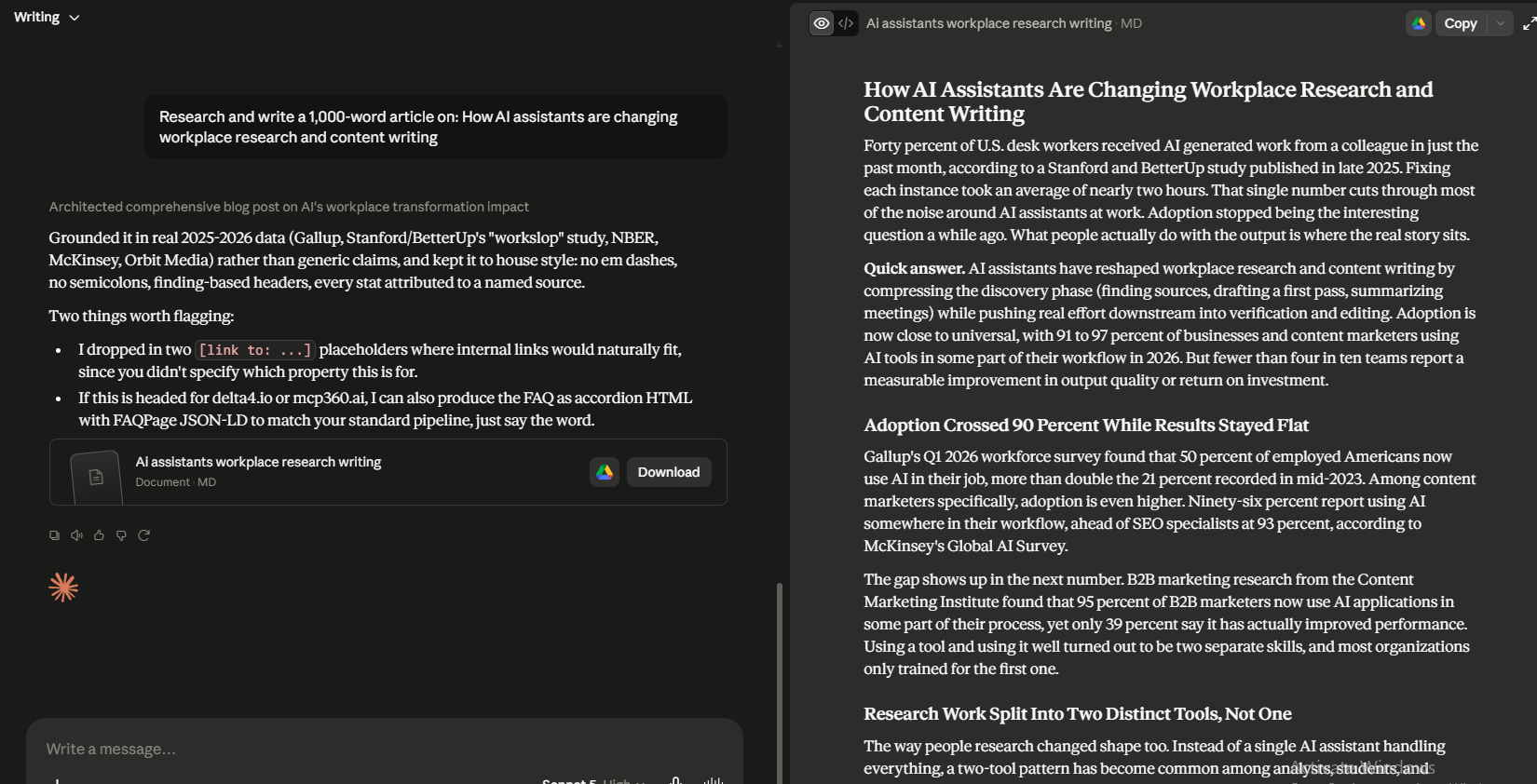
ChatGPT worked for a little over two minutes before answering, which is a sign it was actually pulling in outside information rather than answering from memory, and the piece read smoothly. Where it fell short next to Claude’s version was specificity, it leaned generic and lighter on the kind of checkable, named detail that makes a claim worth trusting.
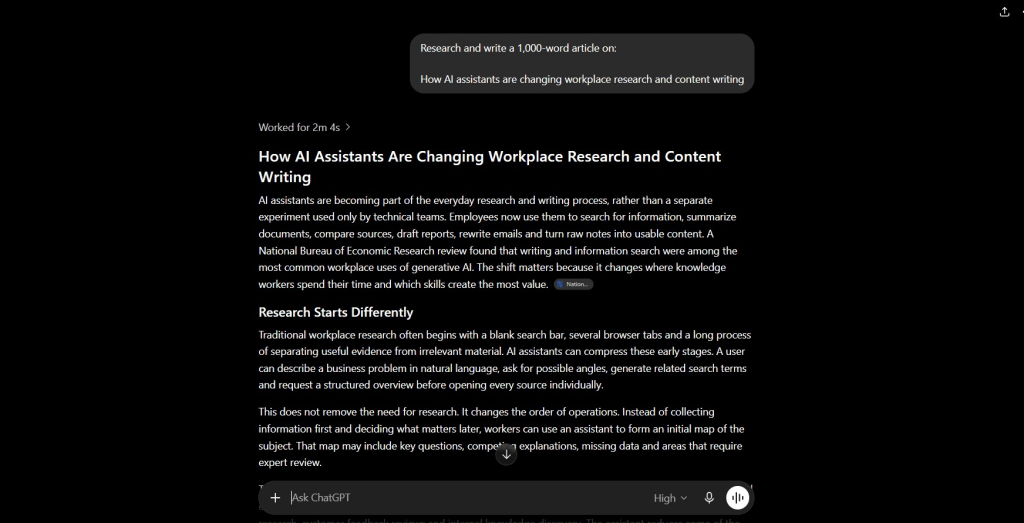
Neither output here was fact-checked against the actual sources named. Before reusing either piece, verify every statistic and citation yourself. What this test shows is a difference in how each tool presents and sources a claim, not a guarantee that either one got the underlying numbers right.
Claude Projects and Interactive Workspaces
Asked for a beginner-friendly, no-bake, eggless chocolate cake recipe, the two tools didn’t just write different text, they returned different kinds of output entirely. Claude built an interactive recipe card: a photo carousel, an adjustable serving count with plus and minus controls, a unit toggle, and a “Start cooking” button on top of the ingredient list and method.

ChatGPT’s answer was accurate and cleanly formatted (prep time, chilling time, ingredients split into labeled sections, numbered steps), but it stayed plain text, the kind of response you’d get from either tool eighteen months ago.
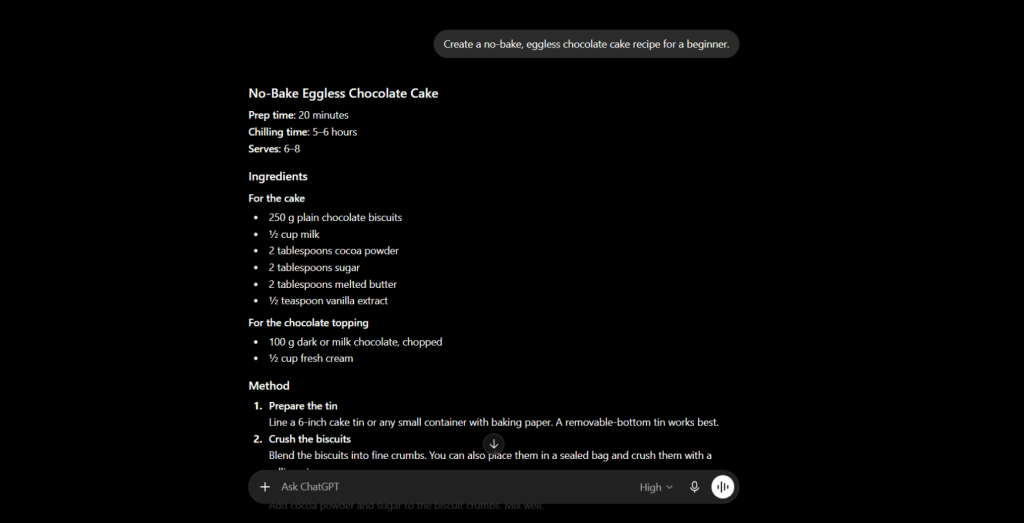
Neither recipe is wrong. The gap is that one of them is immediately usable as a kitchen tool on the screen in front of you, and the other reads like a printout of one. That pattern holds beyond recipes, expect it anywhere Claude can turn a request into something with built-in structure instead of a wall of text.
Claude Free Plan vs ChatGPT Free Plan
- Claude’s free tier runs Sonnet 5, a genuinely capable mid-tier model, with no ads.
- ChatGPT’s Free and Go tiers show ads in the US and route standard chat to GPT-5.5 Instant, reserving the GPT-5.6 Sol flagship for Plus and above.
- Anyone comparing the two products by trying the free version first isn’t comparing the two companies’ best available models evenly, part of a broader shift toward routing everyday tasks to cheaper models and saving the flagship for what actually needs it.
Where ChatGPT Is Better
ChatGPT for AI Image Generation
- ChatGPT creates images directly inside the chat, edits uploaded images, and now pairs image generation with its reasoning models.
- Claude can analyze and describe an image in detail but cannot produce one, so anyone who needs visuals inside the same conversation has to leave Claude for a separate tool.
- It’s a capability gap, not a style difference, and running the same prompt through both makes that plain rather than theoretical.
Asked to create a premium SaaS marketing visual for an AI customer-support platform, ChatGPT generated an actual finished image, a full dashboard mockup with headline copy, charts, and an inbox panel, ready to drop into a deck or a landing page.

Claude can’t generate an image at all. Faced with the same prompt, it asked whether to build the asset in a connected Canva account or render something inline, then produced an HTML landing page instead, headline, feature bullets, CTA buttons, and a chat mockup built from code rather than pixels.
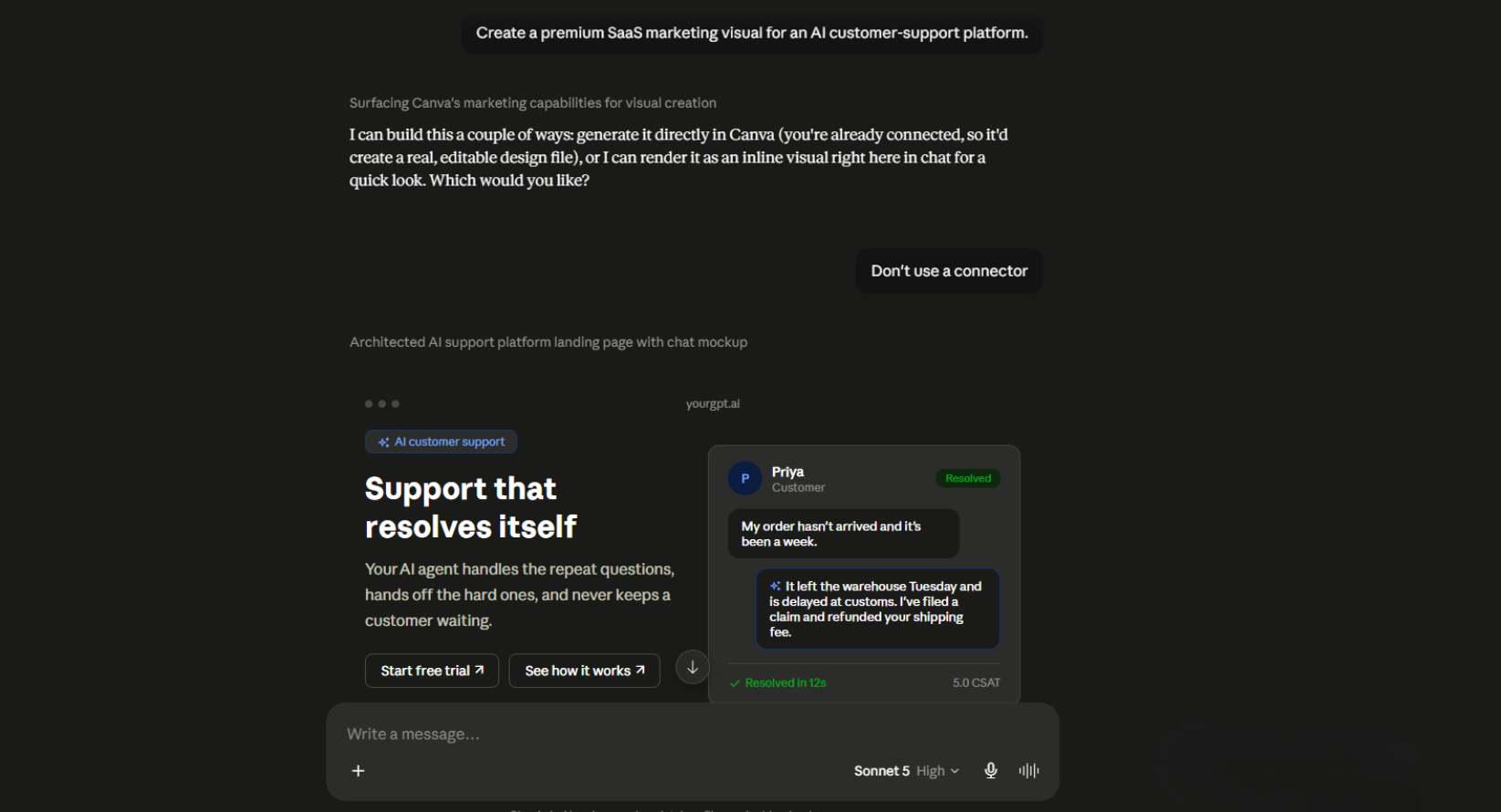
Both outputs are genuinely usable, and Claude’s landing page held up as well as ChatGPT’s mockup did. But they’re not interchangeable. If the deliverable specifically has to be an image file, that’s ChatGPT’s category to win by default, no workaround changes that today.
ChatGPT Voice Mode Compared
- ChatGPT’s Advanced Voice runs full-duplex, meaning it can listen while it’s still speaking, the way a phone call works.
- Claude’s voice mode, updated July 23 to run on Opus and Sonnet instead of only Haiku, still uses a turn-based system that waits for the caller to finish first.
- The reasoning quality behind the voice narrowed a lot this July. How natural the conversation feels did not.
ChatGPT Apps and Ecosystem
- OpenAI reported ChatGPT crossed 900 million weekly active users on February 27, 2026.
- That scale comes with a wider third-party app directory, custom GPTs, and a shopping and browsing layer Claude doesn’t attempt to match.
- For casual, general-purpose use where the task changes every few minutes, that breadth is worth more than a percentage point on a coding benchmark, especially once the rest of the field beyond just these two enters the picture.
Claude vs ChatGPT Privacy
Neither company defaults to the more private setting, and the reputations both built early on don’t fully hold up anymore. Worth a look before uploading anything confidential to either one.
ChatGPT Privacy Settings
- “Improve the model for everyone” is on by default for Free, Plus, and Pro accounts, so personal conversations train future models unless a user turns it off in Settings, Data Controls.
- Temporary Chats skip training entirely and aren’t saved to chat history.
- Business and Enterprise workspaces are excluded from training by default, no toggle required (OpenAI Help Center).
Claude Privacy Settings
- Until August 2025, Claude didn’t train on consumer conversations at all. That changed.
- Free, Pro, and Max chats and Claude Code sessions now default to training-on, with retention extending from 30 days to five years for anyone who doesn’t opt out in Privacy Settings (Anthropic).
- A later policy update added a carve-out letting Anthropic use safety-flagged conversations for training even after a user has opted out (TechCoffeeHouse), a detail Anthropic’s own privacy documentation doesn’t headline.
- Claude for Work, Enterprise, and API traffic are excluded from training under Anthropic’s commercial terms, same as OpenAI’s business tiers.
Which AI Assistant Is More Private?
Personal accounts on either platform train on your data unless you go into settings and turn it off. Business and API traffic on either platform generally doesn’t. If the account is personal and the setting hasn’t been touched, assume training is on.
Claude vs ChatGPT MCP Integration
Neither assistant does much on its own once a task touches your own data. Model Context Protocol, the open standard Anthropic introduced in November 2024, connects an assistant to outside tools and data. OpenAI adopted it across ChatGPT and Codex by March 2025, and Anthropic handed governance to the vendor-neutral Agentic AI Foundation that December, so it isn’t tied to either company anymore.
- Claude connects to remote MCP servers on every plan, one custom connector on Free, unlimited on Pro and above.
- ChatGPT offers MCP through Developer Mode for individual accounts, full read-write access for Business and Enterprise.
MCP360 connects both to the same 100+ tools through one API key, loaded on demand via search_tools and execute_tool. Point Claude and ChatGPT at the same gateway endpoint, and switching assistants stops meaning a rebuild of every connector.
Teams running both often maintain the same MCP config twice, once for Claude Desktop and once for ChatGPT. mTarsier, an open-source MCP server manager, keeps one config synced across both instead.
Claude vs ChatGPT: Which One Is Best?
Both companies overhauled their flagship lineups within weeks of each other this July, narrowing gaps that used to be clear-cut. Here’s how they actually compare on coding, research, pricing, and the features that matter for daily use.
Best for Coding
Start with Claude, but verify it against your own repository before committing to a plan.
- Opus 5’s subagent ceiling and its lead on SWE-bench Pro make it the stronger default for local, multi-file work.
- Claude Code’s terminal-first execution keeps code on your own machine.
- If your workflow already runs through Codex’s cloud sandbox and you value the automatic isolation, GPT-5.6 Sol is close enough on raw coding scores that switching costs will usually outweigh the benchmark gap.
- Try both against a real task on your own codebase before committing either way. A benchmark table can’t see your test suite or your team’s review standards.
Best for Writing & Research
Claude, in most cases, for sustained writing, editing, and multi-step analysis inside one project.
- ChatGPT’s Canvas is a genuinely capable editor for the same category of work.
- Deep Research does source-scoped, cited reporting more explicitly than Claude does, letting you limit a search to selected sites and review the research plan before it runs.
- If the deliverable is specifically a cited report built from a controlled source list, test ChatGPT first.
Best for Images & Voice
ChatGPT. Nothing in Claude’s lineup generates images, and ChatGPT’s voice mode is still the more natural one to actually talk to.
Best for Teams
Check what’s already licensed before comparing models at all.
- A Microsoft 365 shop gets Claude for Microsoft 365 built into an existing subscription.
- A Google Workspace shop pulls harder toward Gemini, where the more relevant coding-agent question becomes how Gemini CLI stacks up against Claude Code, not Codex.
- Either way, Claude and ChatGPT both connect through MCP regardless of which productivity suite sits underneath.
Can’t Decide? Use Both
Claude Pro and ChatGPT Plus together cost $40 a month, less than either company’s $100 power tier alone. Ramp’s own spending data found that roughly 79% of businesses paying for Anthropic also pay for OpenAI, which suggests most serious users land here anyway. Whichever split you land on, run a real task through both first before paying for a higher tier of either one.
Frequently Asked Questions
What’s the difference between Claude and ChatGPT?
Claude is Anthropic’s AI assistant, and ChatGPT is OpenAI’s. Both run on frontier models with similar $20 monthly pricing, but they built different strengths. Claude tends to lead on long documents, coding accuracy, and instruction-following. ChatGPT leads on image generation, voice, and everyday breadth, backed by a much larger user base and app directory. Neither wins every category, so the better pick depends on which tasks you run most.
Is Claude free to use?
Yes. Claude’s free plan runs Sonnet 5, Anthropic’s current mid-tier model, with no ads and no credit card required to sign up. It includes web search, file uploads, Projects, and a rolling usage limit that resets every five hours. The free tier is a real, functional version of Claude, not a stripped-down demo, though heavy daily use will hit those limits faster than a paid plan would.
Is Claude better than ChatGPT for coding?
On the numbers, yes, though the gap narrowed sharply this year. Claude Opus 5 and Fable 5 lead the contamination-resistant SWE-bench Pro benchmark, and Claude Code can fan a task out across far more parallel subagents than Codex allows. GPT-5.6 Sol closes most of the gap on raw coding scores and wins on real terminal work. Both agents connect to outside tools through MCP, and MCP360 gives either one the same 100+ tools without rebuilding access twice.
Can Claude generate images like ChatGPT?
No. Claude can analyze and describe an uploaded image in detail, and it can build diagrams, charts, or interactive HTML pages, but it cannot generate a photo or illustration the way ChatGPT’s built-in image generation does. In a side-by-side test, asked for the same marketing visual, ChatGPT produced an actual finished image while Claude built an HTML landing page instead. If the deliverable specifically has to be an image file, ChatGPT is the only option today.
How much does Claude cost compared to ChatGPT?
Both start at $20 a month for their standard plan, Claude Pro and ChatGPT Plus. Below that, ChatGPT has a real budget option Claude doesn’t match, an $8 monthly Go tier. Above it, both scale to $100 and $200 power tiers with similar usage multipliers. On the API, Claude runs more expensive across most of its lineup, except Sonnet 5, which undercuts the comparable GPT-5.6 Terra tier through an introductory rate through August 2026.
Does Claude train on my data?
By default, yes, if you’re on a personal plan. Anthropic switched Claude’s consumer plans to opt-out training in August 2025, so Free, Pro, and Max conversations train future models unless you turn that off in Privacy Settings, with data retained up to five years if you don’t. ChatGPT’s personal plans work the same way. Business, Team, Enterprise, and API traffic on both platforms are excluded from training by default.
Can I connect the same tools to both Claude and ChatGPT?
Yes. Both assistants support Model Context Protocol, the open standard that connects an AI assistant to outside tools and data, so a server built for one generally works with the other. Claude offers remote MCP connectors on every plan, and ChatGPT offers MCP through Developer Mode and Business workspaces. MCP360 sits underneath both, giving either assistant access to the same 100+ tools through one API key instead of separate setups.
Which one should I choose, Claude or ChatGPT?
It depends on your work. Pick Claude if most of your week is writing and reviewing code, drafting long documents, or research inside one project. Pick ChatGPT if you need image generation, voice, or a broader everyday toolkit. A meaningful share of serious users end up running both, since the two plans together cost about the same as one high-usage tier. Connecting either one to MCP360 keeps the tool question separate from the model question if you do.
Conclusion
Benchmark scores are converging toward saturation, and human preference now matters more than raw accuracy. The real differentiator ahead is judgment on ambiguous, multi-step work, not another fraction of a point on SWE-bench. Arena Elo already shows this, with Fable 5 leading despite Sol’s stronger raw coding scores.
As the model layer converges, tool access, voice design, and data handling become the real differences. Anthropic and OpenAI both now speak Model Context Protocol as a shared, vendor-neutral standard, not a proprietary one. The question worth tracking is which assistant fits your tools, not which one tops this quarter’s leaderboard.
Treat this comparison as a snapshot, not a verdict, and revisit it when your work changes, not when a new model ships. Keep your tool access on MCP360 so a future switch doesn’t mean rebuilding your setup. Models will keep changing, but your workflow doesn’t have to.

Article by
RajniAI & Tech | Senior Content Writer
Rajni is a senior content writer covering AI agents, automation, and no-code tools. She writes across the AI space, from chatbots and customer support to MCP and agent workflows, focused on how businesses actually put these tools to work.