


The TL;DR
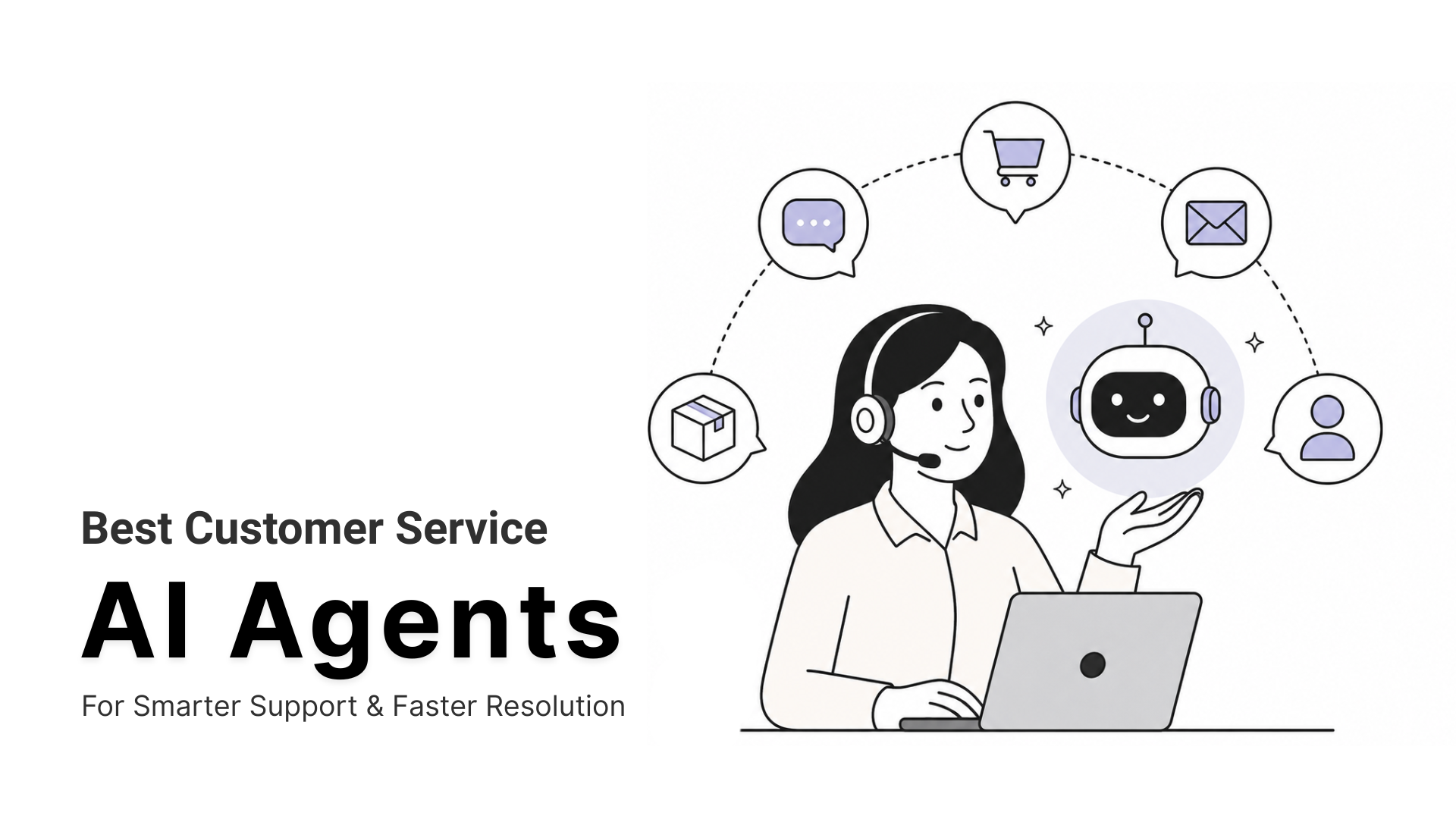
AI agents for customer service now go beyond answering questions, reading order histories, issuing refunds, and rescheduling appointments inside the conversation itself.
-
• A Consolidating Market
Salesforce has agreed to acquire Fin, formerly Intercom, and Zendesk has already folded Forethought into its own platform. Three of the ten platforms in this guide changed ownership or public status in 2026 alone.
-
• Billing Models Are Shifting
Six of the ten platforms in this guide now bill by resolution or conversation instead of a flat seat, which changes the real monthly cost more than the sticker price does.
-
• 10 Platforms Compared on Evidence
This guide checks action depth, billing model, and channel fit against each vendor’s own pricing page where one exists, and says so plainly where one doesn’t.
AI agents for customer service are already running in production across support, sales, and operations. They read order histories, issue refunds, reschedule appointments, and escalate to a human when needed, without constant oversight. But picking one this year also means picking a moment in a market that keeps shifting under buyers’ feet.
Salesforce agreed in June 2026 to acquire Fin, the company formerly known as Intercom, and plans to fold its agent technology into Agentforce. Zendesk closed its own acquisition of Forethought two months earlier and rebuilt its AI stack around what it now calls the Resolution Platform. Pricing is moving just as fast: six of the ten platforms in this guide now bill by resolution or conversation instead of a flat seat.
This blog checks all ten on what they actually do, what they cost, and who each one fits, from full-stack platforms built for support, sales, and operations together, to focused tools built for one channel or one team size.
What Is an AI Agent for Customer Service?
An AI agent for customer service resolves conversations. A scripted chatbot answers from a fixed set of rules and stops there. An AI agent reads intent in natural language, pulls account or order data, and, on the stronger platforms, changes something in a connected system to close the loop.
A support chatbot tells a customer where to find the returns policy. An AI agent checks the order, confirms it qualifies, starts the refund, and updates the ticket, in the same conversation.
The Core Components of a Modern Customer Service Agent

- Knowledge grounding: connects to help docs, FAQs, and policies so answers stay grounded instead of improvised.
- Intent and context understanding: reads what the customer needs, plus order history, plan type, or a prior open issue.
- Action execution: writes back to CRMs, order systems, and billing platforms during the conversation.
- Escalation logic: hands off to a human with full context once a case falls outside what the agent should resolve alone.
- Channel coverage: works across chat, WhatsApp, email, and voice from one system, replacing a separate tool per channel.
- Observability and QA: logs and resolution tracking so a team can see what the agent did and catch mistakes early.
How We Evaluated These Platforms
“Evidence over marketing copy” only means something if the evidence is specific. Six criteria decided both the ranking and what made each entry’s Features and Limitations lists.
- Action execution: Can the agent write back to a CRM, order system, or billing platform, or does it only read and reply? Zendesk, Salesforce, and Fin built proprietary connectors for this. YourGPT uses native MCP support instead, without building a custom connector from scratch.
- Channel coverage: Which channels does the agent actually run on, and does that match how it’s marketed? A vendor claiming “omnichannel” that turns out to be chat and email only gets flagged as a Limitation instead of credited as a strength.
- Pricing transparency: Does the vendor publish real numbers, or does pricing require a sales call? Unpublished figures get labeled as third-party estimates instead of confirmed numbers. AI agent pricing has shifted enough in 2026 that flat and usage-based rates aren’t directly comparable without doing the math.
- Workflow flexibility: Can the platform handle branching logic, conditional escalation, and multi-step tasks, or only a single linear conversation flow? This is the gap between Freshworks Freddy AI and Tidio, which lean conversational, and YourGPT or Salesforce Agentforce, built around configurable workflow logic.
- Human handoff: Does the agent hand off with full context intact, or does the customer repeat themselves to a human? Every platform here claims context-preserving handoff. This guide checked what mechanism each vendor actually documents.
- Team and company fit. The platform that’s overkill for a five-person team can be underpowered for an enterprise contact center. Each Best For line weighs team size and technical capacity alongside feature count, which is why the ranking runs from full-stack platforms toward specialists instead of strictly by capability.
Each criterion is checked against the vendor’s own pricing and product pages where one exists, with source links inline, and any vendor-only claim is stated as such instead of passed off as confirmed.
Best AI Agents for Customer Service in 2026
The platforms below run from full-stack systems built to handle action, sales, and support together, toward specialists built for one job done well. Each is evaluated on action depth, billing transparency, and fit for the team size it targets.
| Platform | Primary Use | Best For | Ideal Teams |
|---|---|---|---|
| YourGPT | No-code AI agents for support, sales, and operations | Fast, no-code deployment with real backend actions | Support, sales, and ops teams wanting no-code setup |
| Fin (formerly Intercom) | Outcome-billed autonomous support agent | Mature, multichannel AI agent with public pricing | Product-led SaaS support teams |
| Zendesk AI Agents | AI folded into an existing Suite ticketing platform | Larger teams already running Zendesk | Enterprise support teams standardized on Zendesk |
| Salesforce Agentforce | Native agent building on live Salesforce data | Enterprises deep in the Salesforce stack | Salesforce-committed enterprise teams |
| Freshworks Freddy AI | AI layered onto Freshdesk ticketing | Mid-market teams wanting a lower entry price | Mid-market support teams |
| Kustomer | CRM-first agent built around one customer timeline | DTC and B2C brands | Mid-market to enterprise B2C teams |
| Gladly | Loyalty-first agent replacing tickets with one conversation | Premium retail and DTC brands | Enterprise retail and DTC brands |
| Yellow.ai | Broad omnichannel and voice agent platform | Global enterprises needing voice and many languages | Large, global enterprise teams |
| Tidio (Lyro) | Budget AI agent for ecommerce live chat | Small ecommerce teams on a tight budget | Small Shopify and WooCommerce teams |
| CXWizard | Multimodal WhatsApp and Instagram sales/support agent | SMBs selling and supporting over messaging apps | Small, messaging-first SMB teams |
1. YourGPT

YourGPT is a no-code platform for building AI agents for customer support, sales, and operations. Its agents can answer questions and take actions such as updating orders, managing bookings, changing CRM records, and triggering backend workflows.
The platform supports omnichannel engagement across websites, WhatsApp, Slack, Messenger, Instagram, LINE, email, and voice, while keeping conversation context in one system. Teams can train agents on websites, documents, and FAQs, then use AI Studio for conditional logic, API calls, and custom code.
PhoneAI supports inbound and outbound calls in 100+ languages, while the multi-model playground lets teams compare models from OpenAI, Anthropic, Google, and xAI before deployment.
Features
- Executes actions such as order updates, bookings, and CRM changes
- Runs across web chat, WhatsApp, Slack, Messenger, Instagram, Line, email, and voice from one system
- No-code builder trains agents on existing docs, FAQs, and website content
- Multi-model testing compares OpenAI, Anthropic, Google, and xAI models before launch
- Native MCP integration connects agents to outside tools and live data sources
Limitations
- Free trial period is short given the setup time some teams need
- Advanced workflows in AI Studio take configuration time to get right
- Branding removal and advanced analytics sit behind the Advanced tier
Pricing
- Essential: $39/month, billed annually
- Professional: $79/month, billed annually
- Advanced: $349/month, billed annually
- Enterprise: custom pricing
Figures confirmed directly against the live pricing page this session. Annual billing runs $39/$79/$349, and monthly billing is $59/$129/$499 for the same three tiers, respectively.
Best For
Teams that want no-code AI agents handling support, sales, and operations across chat, WhatsApp, email, and voice, priced on a flat monthly plan with a 7-day free trial.
2. Fin (formerly Intercom)

Fin rebranded from Intercom in May 2026, capping a multi-year shift from a messaging platform toward an AI-first company. Weeks later, on June 15, 2026, Salesforce signed a definitive agreement to acquire Fin for approximately $3.6 billion, expected to close around Salesforce’s fiscal fourth quarter of 2027.
Fin’s AI Agent resolves customer queries across live chat, email, WhatsApp, SMS, phone, and Slack, built on the company’s proprietary Apex model. Salesforce’s own announcement cited an average resolution rate of 76% across Fin’s customer base, a figure the company reported itself and one this guide could not independently verify. Fin can also run standalone on top of an existing helpdesk including Zendesk, HubSpot, Freshworks, and Salesforce.
Features
- Resolves queries across chat, email, WhatsApp, SMS, phone, and Slack
- Standalone deployment on top of Zendesk, HubSpot, Freshworks, or Salesforce
- Proprietary Apex model built for support conversations
- Shared inbox, help center, and workflow automation included in the base platform
- Proactive messaging and onboarding tools for product-led teams
Limitations
- Seat and outcome costs stack quickly at higher ticket volumes
- Roadmap and packaging carry uncertainty while the Salesforce acquisition is pending
- Complex backend automation is thinner than platforms built around a dedicated workflow builder
Pricing
- Essential: $29/seat/month, billed annually
- Advanced: $85/seat/month, billed annually
- Expert: $132/seat/month, billed annually
- Fin AI Agent: $0.99 per outcome, billed on top of seats. Qualification, a separate Fin-for-Sales outcome type, runs $9.99
- Standalone (non-Intercom helpdesk): $49/month base, includes 50 resolutions, then $0.99 per additional outcome
Best For
SaaS and product-led teams that want a mature, multichannel AI agent with public, outcome-based pricing, and can tolerate roadmap uncertainty during a pending acquisition.
3. Zendesk
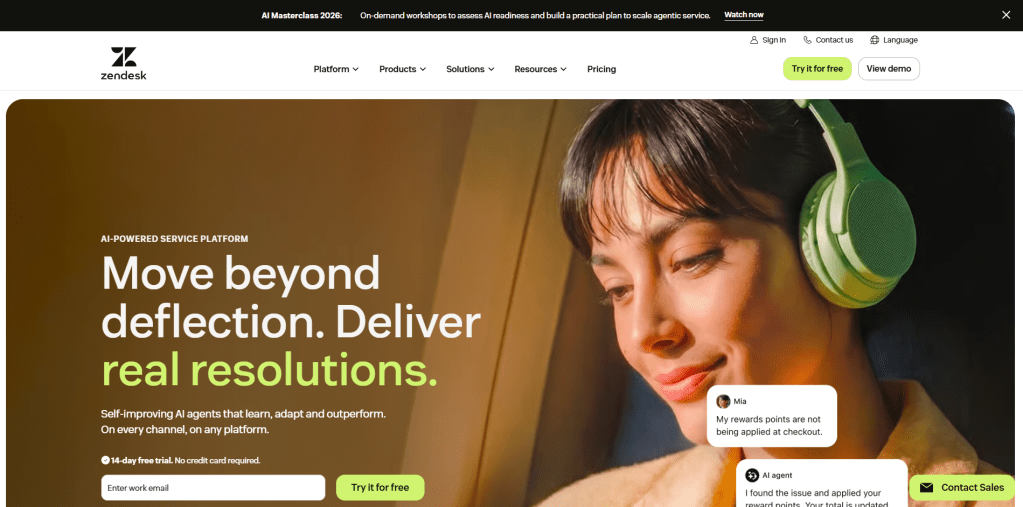
Zendesk bundles its AI Agents directly into every Suite and Support plan, billed on “Automated Resolutions,” a unit counted only when the AI resolves a conversation without human escalation. Zendesk completed its acquisition of Forethought, an AI agent platform that previously supported companies including Upwork, Grammarly, and Datadog, on March 26, 2026.
The acquired technology now sells as “Forethought AI Agents by Zendesk.” At its Relate conference in May 2026, Zendesk introduced the Resolution Platform, which it says was trained on roughly 20 billion ticket interactions, a figure from Zendesk itself that hasn’t been independently audited.
Features
- AI Agents included in every Suite and Support plan, billed by automated resolution
- Forethought AI Agents by Zendesk add self-improving automation on any channel or stack
- Intelligent triage classifies and routes tickets automatically
- Copilot add-on gives human agents proactive drafting and next-step suggestions
- Action Builder connects multi-step workflows across Zendesk and outside systems
Limitations
- Per-resolution overage pricing is not published, which complicates budgeting
- Add-ons such as Copilot, quality assurance, and workforce management stack on top of seat costs
- Total cost can climb well above the advertised seat price at production volume
Pricing
- Support Team: $19/agent/month, billed annually
- Suite Team: $55/agent/month, billed annually
- Suite Professional: $115/agent/month, billed annually
- Copilot add-on: $50/agent/month
- Automated Resolutions: an allowance is included per plan, then overage is reported around $1.50 to $2.00 per resolution. Zendesk does not publish this rate, so treat it as a third-party estimate
Best For
Larger support teams already running Zendesk who want AI folded into an existing Suite plan over a separate purchase.
4. Salesforce Agentforce
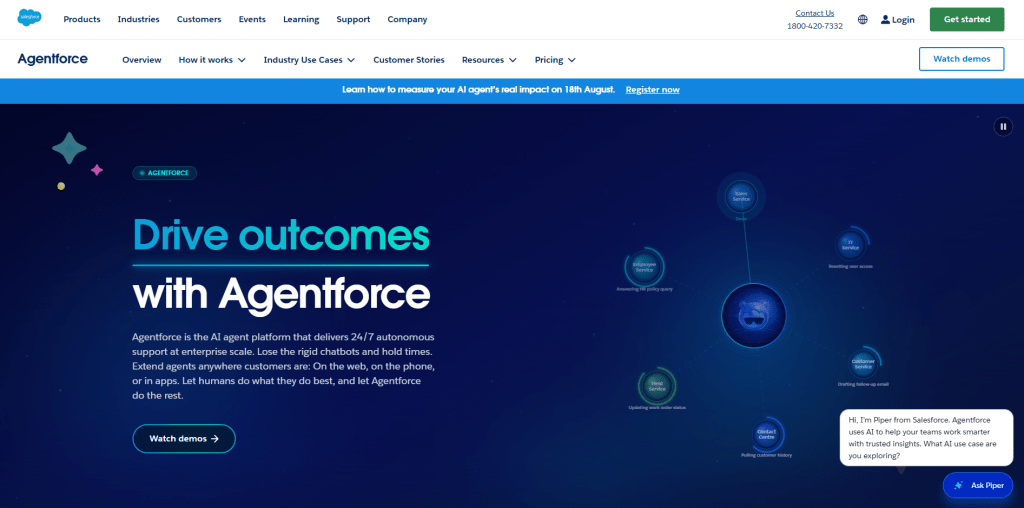
Agentforce is Salesforce’s own agent platform, distinct from Fin even as the two are set to sit under the same company once the Fin acquisition closes. Agents built in Agentforce read and act on live Salesforce data, including Service Cloud cases and order history.
Account records stay governed through the Einstein Trust Layer. Pricing runs on three models, confirmed on Salesforce’s own pricing page and its published Flex Credits Rate Card: Flex Credits, a per-conversation option, and per-user licenses.
Features
- Agent Builder and Prompt Builder for building agents without a separate coding project
- Native access to Salesforce CRM, Service Cloud, and Data Cloud records
- Einstein Trust Layer for data governance across connected model providers
- Choice between Flex Credits, per-conversation, and per-user pricing models
- Digital Wallet dashboard for usage tracking across orgs and teams
Limitations
- Full value depends on an existing, well-configured Salesforce deployment
- Pricing has changed several times since launch, complicating long-term budgeting
- Flex Credits and Conversation pricing cannot run in the same org at once
Pricing
- Salesforce Foundations: free with Enterprise Edition and above, includes 200,000 Flex Credits. That allowance started at 100,000 when Foundations launched in May 2025 and has since increased
- Flex Credits: $500/100,000 credits. Standard action: 20 credits ($0.10). Voice action: 30 credits ($0.15)
- Conversation pricing: $2/conversation for customer-facing agents
- Agentforce add-on: $125-$150/user/month for unlimited employee usage
- Agentforce 1 Editions: from $550/user/month
Best For
Enterprises already running Salesforce that want AI agents built natively on CRM and Data Cloud, over a standalone tool bolted onto a different stack.
5. Freshworks Freddy AI (Freshdesk)

Freddy AI is Freshworks’ umbrella brand across its Freshdesk ticketing product, split into two paid pieces on two separate billing meters. Freddy AI Copilot assists human agents with reply drafting and summarization for $29 per agent per month, available only on Pro and Enterprise plans.
Freddy AI Agent is the customer-facing bot, billed by session. The first 500 sessions come free as a one-time allowance, then further sessions cost $49 per 100 on classic Freshdesk email, confirmed directly on Freshworks’ own pricing page.
Features
- Resolves customer queries by email and, on Freshdesk Omni, by web chat
- Freddy AI Copilot drafts replies and summarizes tickets for human agents
- Freddy AI Studio lets teams build and customize AI agent flows
- Skills-based routing and prebuilt analytics dashboards at higher tiers
- Broad third-party integration marketplace across CRM, ecommerce, and productivity tools
Limitations
- Freddy AI Agent and Copilot are unavailable on the entry-level Growth plan
- Session pricing differs sharply between classic Freshdesk and Freshdesk Omni
- AI costs at meaningful volume often exceed the seat price by a wide margin
Pricing
- Freshdesk Growth: $19/agent/month, billed annually
- Freshdesk Pro: $55/agent/month, billed annually
- Freshdesk Enterprise: $89/agent/month, billed annually
- Freddy AI Copilot: $29/agent/month add-on, Pro and Enterprise only
- Freddy AI Agent: 500 sessions included once, then $49 per 100 sessions on classic Freshdesk email
Best For
Mid-market support teams that want AI layered onto an established, lower-cost helpdesk over an enterprise price tag.
6. Kustomer

Kustomer organizes every interaction, chat, email, voice, and social, into one continuous customer record instead of separate tickets. Meta acquired the company in November 2020 for roughly $1 billion, closed the deal in February 2022.
It then spun back out as an independent company in May 2023, backed by original investors Battery, Redpoint, and Boldstart. Kustomer raised a further $30 million Series B led by Norwest in August 2025.
Features
- Resolves queries across chat, email, and social from a unified customer timeline
- Procedures enforce deterministic business rules inside generative AI flows
- AI Agents for Reps summarize conversations and suggest next steps for human agents
- Business rules and workflow automation built around CRM-style customer records
- Omnichannel messaging across chat, email, text, and voice
Limitations
- No published pricing and no self-serve signup, which slows early evaluation
- Annual-only contracts with an eight-seat minimum exclude very small teams
- AI billed per engaged conversation, even when the outcome is a human escalation
Pricing
- Enterprise: reported around $89/user/month, eight-seat minimum, annual billing. Kustomer does not publish list prices
- Ultimate: reported around $139/user/month, annual billing
- AI Agents for Customers: $0.60 per engaged conversation
- AI Agents for Reps: $40/user/month add-on
- Voice, SMS, and WhatsApp usage billed separately, pay-as-you-go
Best For
DTC and B2C brands that want AI built around a single customer timeline, priced and packaged for mid-market and larger teams over a self-serve start.
7. Gladly

Gladly replaces the ticket model with what it calls one lifelong conversation per customer, spanning voice, chat, SMS, email, and social in a single thread.
Sidekick, its AI agent, resolves issues end to end or hands off to a human with the full history intact. The platform sits at the premium end of the market, with named customers including Nordstrom, Crate & Barrel, Ulta Beauty, TUMI, Breeze Airways, and Bombas.
Features
- Sidekick AI agent resolves conversations end to end or hands off with full context
- Single lifelong conversation model replaces traditional ticket queues
- People Match routes each conversation to the most suitable available agent
- In-chat payments and assisted shopping for retail and DTC use cases
- Voice, chat, SMS, email, and social unified in one timeline
Limitations
- Core enterprise plans stay quote-only, with seat minimums that price out small teams
- AI usage billed per conversation adds cost on top of already premium seat pricing
- Built specifically for retail and B2C, with a weaker fit for B2B or ticket-based IT support
Pricing
- Hero: reported around $180/agent/month, ten-seat minimum, annual billing. Gladly does not publish list prices
- Superhero: reported around $210/agent/month, larger seat minimum
- Sidekick AI: reported around $0.60 per AI conversation on core plans
- Small-business plan (new in 2026): $120/seat/month plus $1.50 per AI resolution, or a capped spend option, confirmed on both Gladly’s own Shopify App Store listing and third-party pricing trackers
- 30-day free trial including 100 AI interactions on the small-business plan
Best For
Premium retail and DTC brands that prioritize a personal, loyalty-driven customer experience over pure ticket deflection.
8. Yellow.ai

Yellow.ai is a broad conversational and agentic AI platform spanning more than 35 channels and 135 languages, with Nexus Vox, a dedicated enterprise voice AI product, and an Orchestrator LLM that manages multi-intent conversations without manual training.
The platform gives teams a choice of more than 15 underlying language models and lists on both AWS Marketplace and Salesforce AgentExchange. The company has also announced plans to go public through a $550 million merger with Bluerock Acquisition Corp (Nasdaq: BLRK).
Features
- Orchestrator LLM manages multi-intent, goal-based conversations without manual training
- Nexus Vox delivers dedicated enterprise voice AI with low-latency, multi-turn calls
- 35+ channel coverage spans web, WhatsApp, Messenger, Instagram, Telegram, and IVR
- Choice of 15+ underlying LLMs instead of a single fixed model
- 150+ prebuilt connectors, listed on AWS Marketplace and Salesforce AgentExchange
Limitations
- No published list pricing, and every deployment requires a sales conversation
- Implementation is described as engineering-heavy once past initial bot creation
- Pending public listing adds a layer of corporate uncertainty for long-term buyers
Pricing
- Free: $0. One AI agent, two seats, 500 chat sessions/month, then $0.99 per resolution
- AWS Marketplace Basic: reported around $10,000/12 months
- AWS Marketplace Standard: reported around $25,000/12 months. Yellow.ai does not publish this rate, so treat both AWS Marketplace figures as third-party estimates
- Enterprise: custom quote, scaled to channel count, conversation volume, and implementation scope
- Full deployments with voice and high channel volume commonly run well above marketplace list prices
Best For
Global enterprises that need voice AI and deep multilingual coverage across dozens of channels, with the technical capacity to support a heavier implementation.
9. Tidio (Lyro)
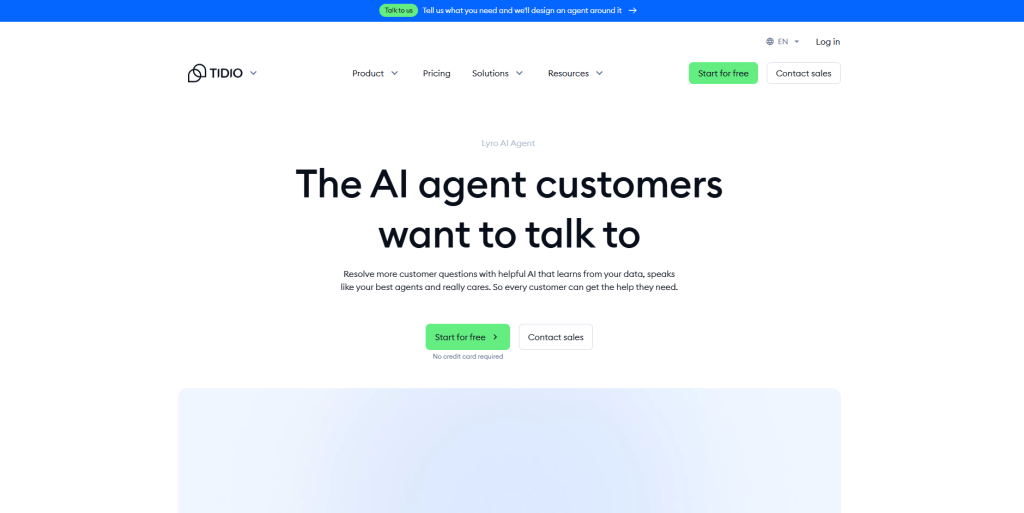
Tidio pairs a live chat and helpdesk platform with Lyro, its AI agent, and Flows, a rule-based chatbot builder, each billed on a separate meter. The free plan includes 50 one-time Lyro conversations to test the AI before paying anything.
The pricing structure is public, which puts Tidio ahead of most quote-only enterprise tools on this list, though it spreads across three separate quotas: billable human conversations, Lyro AI conversations, and Flow triggers. Tidio reports more than 300,000 businesses using the platform, with particular strength on Shopify, WooCommerce, and BigCommerce stores.
Features
- Lyro AI Agent trains automatically from website content and a connected knowledge base
- Flows builder automates rule-based chatbot sequences without AI usage
- Unified inbox spans website chat, email, Facebook Messenger, and Instagram
- Multilingual, natural-language responses without manual scripting
- Human handoff preserves conversation context when Lyro cannot resolve an issue
Limitations
- Three separate billing meters make total monthly cost hard to predict in advance
- Ten-seat cap on self-serve plans limits growing teams
- No voice channel support
Pricing
- Free: $0. 50 conversations/month, up to 10 seats, one-time 50-conversation Lyro trial
- Starter: $24-$29/month for 100 conversations
- Growth: $49-$349/month, scaling up to 2,000 conversations
- Plus: from $749/month, custom volume and a dedicated success manager
- Lyro AI Agent add-on: $32-$39/month for 50 additional AI conversations, scaling with volume
Best For
Small ecommerce and service businesses that want a working AI agent on a limited budget, and can track three billing meters instead of one flat number.
10. CXWizard
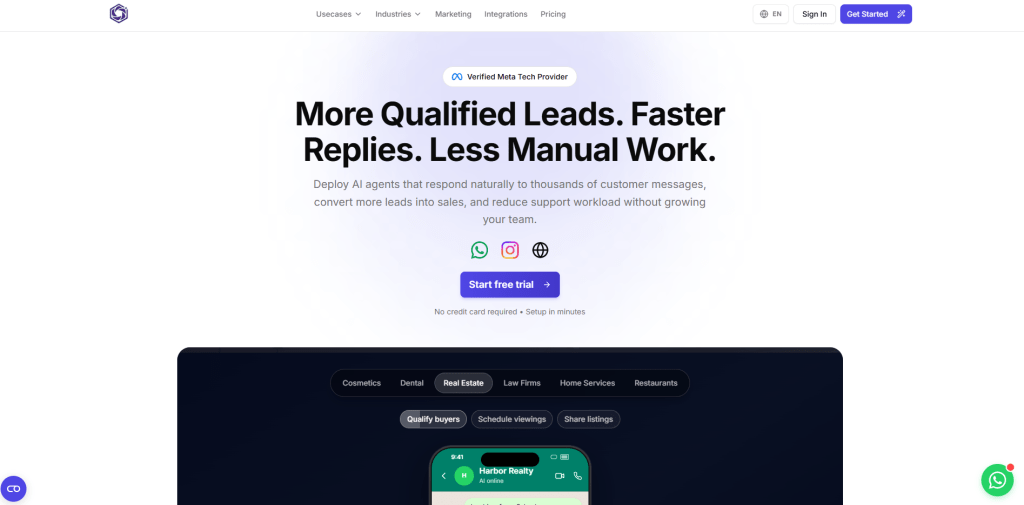
CXWizard is an AI sales and support platform designed for businesses that want to automate customer interactions while maintaining a personal customer experience. Its AI agents can manage conversations across WhatsApp, Instagram, and web chat, understand multimedia content such as photos, documents, and voice messages, and provide intelligent responses around the clock.
With a shared multichannel inbox, escalation insights, zero markup on WhatsApp messaging campaigns, and onboarding support included, CXWizard helps organizations improve customer service efficiency and capture more revenue from inbound conversations.
Features
- Multimodal understanding of text, photos, voice notes, PDFs, and receipts
- Unified inbox across WhatsApp, Instagram Messenger, and website chat
- Combines lead qualification, sales conversations, and support in one agent
- Direct integrations with Shopify and appointment tools such as Calendly
- Human handoff with escalation insights and full context when a conversation needs a person
Limitations
- Narrow channel focus compared with full omnichannel suites on this list
- Newer platform with a shorter public track record than established competitors
- Not built for large-team ticketing, skills-based routing, or complex enterprise workflows
Pricing
- Hobby: $40/month, or $32/month billed annually. 1,000 message credits
- Starter: $100/month, or $80/month billed annually. 10,000 message credits
- Pro: $290/month, or $232/month billed annually. 20,000 message credits
- Enterprise: custom pricing for high-volume teams
- Free onboarding support and a 14-day free trial, no credit card required. WhatsApp messaging costs pass through from Meta at standard rates with no added markup, confirmed on CXWizard’s own pricing page
Best For
Small and medium businesses selling and supporting customers primarily over WhatsApp and Instagram. A poor fit for larger teams needing broad channel coverage or complex escalation paths.
How to Choose the Right AI Agent for Customer Service
Choosing the right AI agent for customer service depends on conversation volume and channel mix more than a feature checklist.
- Match the platform to what resolution actually requires: A workload where resolution means changing something in a system, an order edit or an account update, needs a platform built for action: YourGPT, Fin, Zendesk AI Agents, Salesforce Agentforce, Kustomer, Gladly, and CXWizard all write back to connected systems. Freshworks Freddy AI, Yellow.ai, and Tidio lean more on conversation and routing.
- Reduce avoidable tickets first: For ecommerce and consumer brands, warranty, registration, product documentation, and claims can create unnecessary support volume. Platforms like Dyrect handle these post-purchase interactions separately, reducing the number of tickets that reach AI or human agents.
- Match the platform to where customers already message: A business getting most inbound volume on WhatsApp needs YourGPT or CXWizard, since a tool centered on web chat and email will miss that volume. Phone-heavy support should weight Yellow.ai or YourGPT’s PhoneAI well above the rest of this list, since voice coverage is thin elsewhere.
- Run the billing math before comparing sticker prices: Per-resolution pricing (Fin, Zendesk, Kustomer, Gladly) can outgrow a flat plan fast: at 2,000 AI-handled conversations a month, per-resolution fees alone can land between $1,200 and $4,000 on top of seats. A flat plan (YourGPT, Tidio’s base tiers, CXWizard) trades some flexibility for predictable cost, but exceeding a credit or session cap triggers overage or a forced upgrade.
- Ask every vendor to demonstrate resolution during the demo: The test is the same for all ten: show the agent updating a real record in the system while everyone watches. A platform that can’t do that live is a deflection tool wearing resolution-tool marketing.
- Consider long-term platform risk: Vendor ownership and product direction can change, so build reevaluation checkpoints into longer contracts and understand how much control you retain over integrations. MCP gateway governance is one useful way to think about connection-layer control.
Frequently Asked Questions
What counts as an AI agent for customer service, versus a basic chatbot?
An AI agent for customer service understands intent in natural language and can take real actions across connected systems, such as updating an order or issuing a refund. A basic chatbot follows scripted rules or answers from a fixed knowledge base, and stops once it has replied, leaving any actual resolution to a human agent.
Can AI agents for customer service actually resolve issues, or only respond to them?
The strongest platforms, including YourGPT, Fin, and Zendesk AI Agents, connect directly to CRMs, order systems, and billing platforms and complete the task itself, whether that’s issuing a refund or updating an account. Weaker tools stop at answering the question correctly and still leave the actual resolution to a human agent.
How much does an AI agent for customer service cost in 2026?
Pricing runs from flat plans under $50 a month to enterprise contracts worth tens of thousands a year, with usage-based billing in between that scales with volume. The billing model matters as much as the sticker price, since per-resolution fees can outgrow a flat plan once volume grows.
Does a business need a full CX suite, or can an AI agent run on an existing helpdesk?
Several platforms, including Fin and Freshworks Freddy AI, run as a standalone AI layer on top of an existing helpdesk such as Zendesk or Salesforce, so no migration is required to start using them. Others, such as YourGPT, are built as complete systems from the start and expect to run as the primary platform.
What changed with the Fin and Forethought acquisitions in 2026?
Salesforce agreed in June 2026 to acquire Fin, formerly Intercom, for roughly $3.6 billion, and plans to fold it into Agentforce once the deal closes. Zendesk completed its own acquisition of Forethought in March 2026 and now sells that technology as Forethought AI Agents by Zendesk.
Is a WhatsApp-first platform like CXWizard suitable for a large support team?
CXWizard is built for small and medium businesses running sales and support mainly through WhatsApp, Instagram, and website chat, with a shared inbox and lightweight setup. Larger teams that need formal ticketing, skills-based routing, or broad omnichannel coverage across voice and email are better matched to Zendesk, Kustomer, or YourGPT instead.
Do these AI agents need MCP to work?
No. Most platforms, including Zendesk, Salesforce Agentforce, Fin, and Kustomer, reach outside systems through their own built-in integrations, which cover most real workflows without MCP. YourGPT is the exception, connecting through native MCP support instead of a closed integration list.
Can one AI agent cover multiple channels at the same time?
Most platforms in this guide support multiple channels from a single agent, though how broad that coverage actually is varies a lot between them. YourGPT, Zendesk, and Yellow.ai cover the widest range, including voice, while Tidio and CXWizard focus on a smaller, more deliberate set of messaging and chat channels instead.
Conclusion
The AI customer service market in 2026 has become production infrastructure, the kind of layer a business depends on daily. It has moved well past the experimental add-on stage. The strongest platforms here connect to real systems, resolve conversations end to end, and hold up at volume, while ownership across the category keeps shifting under buyers’ feet.
The right choice depends on what a team runs today. YourGPT fits teams that want one no-code platform covering conversation, backend action, and voice without per-resolution billing. Teams already committed to Zendesk, Salesforce, or Freshworks often get more value staying inside that platform’s own AI layer, and small, messaging-first businesses are better served by Tidio or CXWizard than by an enterprise suite built for a different scale of team.
Before choosing a platform, check action depth, billing model, and channel fit against actual ticket data, and weigh how exposed the vendor is to the ownership churn reshaping this category. That combination decides the outcome far more than any demo does.
Tags

Article by
RajniAI & Tech | Senior Content Writer
Rajni is a senior content writer covering AI agents, automation, and no-code tools. She writes across the AI space, from chatbots and customer support to MCP and agent workflows, focused on how businesses actually put these tools to work.