


The TL;DR
MuleSoft still leads on enterprise governance, but its AI features increasingly run through Salesforce’s own credit system, a dependency most buyers researching MuleSoft alternatives only discover once the bill arrives.
-
• Where the Real Costs Hide
Rarely the connector library. Forced runtime upgrades with no unified tooling, non-linear vCore sizing, and DataWeave’s single-vendor lock-in add up faster than any feature comparison shows.
-
• Four Categories of Alternatives, Not One Replacement
Boomi, Workato, and SnapLogic replace the governance layer. Apigee and Kong replace the API gateway core alone. MCP360 replaces the job of giving an agent tool access. Celigo replaces the cost structure.
-
• What Changed in 2026
Every enterprise alternative on this list shipped native MCP support within the last ten months, closing the head start MuleSoft’s Agent Fabric held a year ago.
MuleSoft earns its reputation honestly. Anypoint Platform has spent nearly two decades as the integration backbone for enterprises running hundreds of systems, and its API-led connectivity model is still the reference point competitors get measured against. For a Fortune 500 company connecting a dozen ERPs to a CRM under strict governance rules, that track record is worth paying for.
That description doesn’t fit most teams. A mid-size company adding its first AI agent, or an IT team tired of vCore sizing that runs on non-linear AWS burstable credits, runs into a different reality. Proprietary DataWeave transformations lock work to certified specialists, MuleSoft’s newer AI features now draw on Salesforce’s own credit system, and the bill climbs every time usage grows, regardless of how much value it delivers.
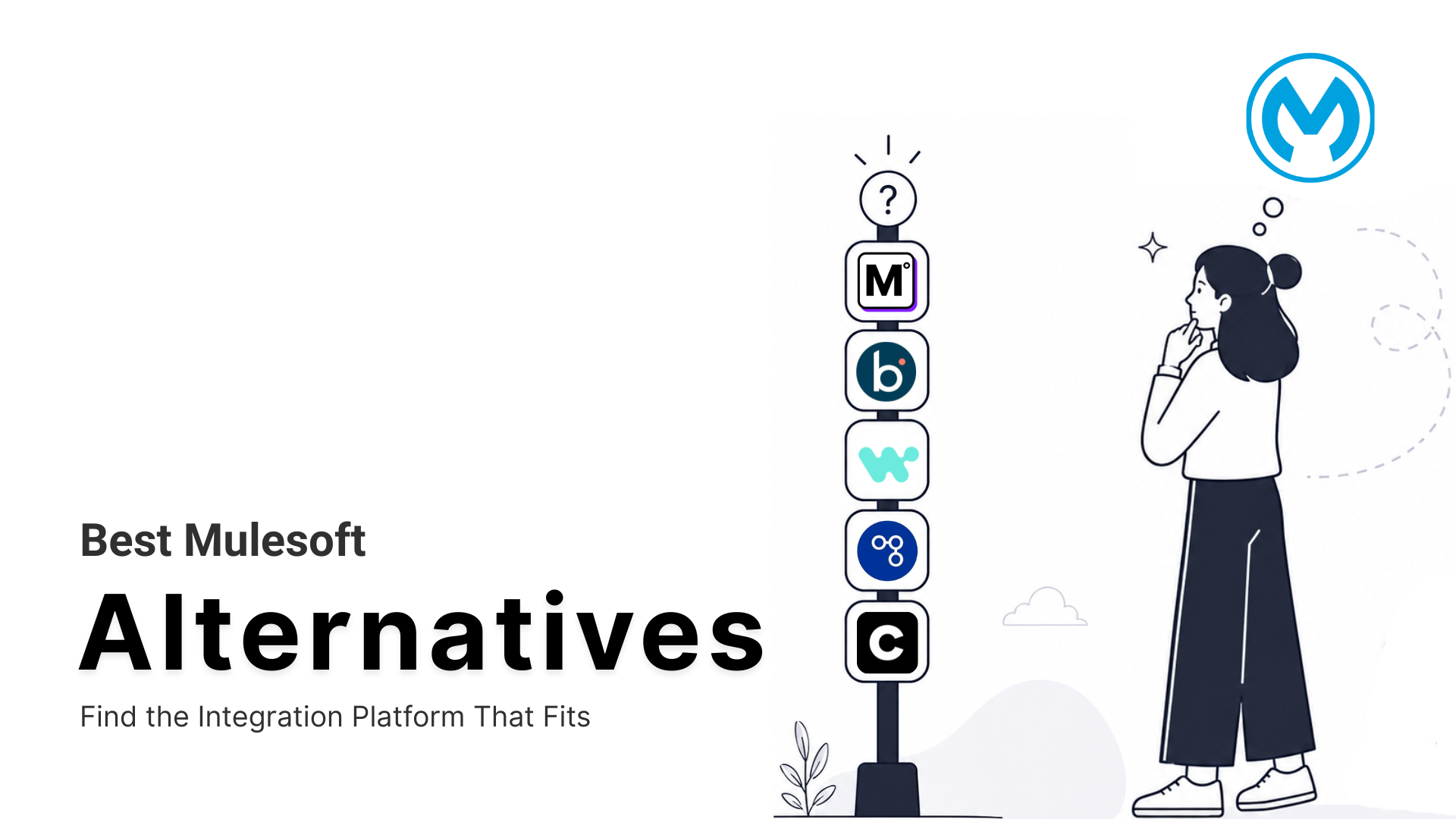
This guide compares seven MuleSoft alternatives, what each one solves, where it still falls short, how each handles AI agent access through MCP, and what it costs as of August 2026.
Limitations of MuleSoft
MuleSoft Anypoint Platform is Salesforce’s enterprise integration and API management solution, built around hybrid connectivity, governed API lifecycles, and, as of 2026, an Agent Fabric layer that extends the same governance model to AI agents. That range is real, and it’s the reason most MuleSoft competitors get measured against it rather than the other way around. It’s also exactly why teams outside the largest enterprises keep running into the same handful of constraints.
- Pricing has no public number to plan against: MuleSoft has historically priced on vCores, compute units that loosely map to CPU capacity, and is shifting new customers toward a consumption model measured in flows and messages. Either way, the number only appears after a sales conversation, and annual bills for mid-size to large estates typically run a few hundred thousand dollars to seven figures.
- Worker sizing runs on a credit system most teams have never had to plan around: CloudHub workers deploy on AWS EC2 burstable instances, which earn compute credits during idle periods and spend them under load rather than mapping to a fixed CPU count, complicating capacity planning before a team even commits to a tier.
- Forced runtime upgrades are one of the platform’s most common complaints: G2 reviewers specifically flag the lack of a unified, automated upgrade path across CloudHub, Private Cloud Edition, and Gov Cloud, turning each version migration into its own costly project.
- DataWeave creates single-vendor developer lock-in: Every transformation and routing rule written in MuleSoft’s proprietary DataWeave language only runs on MuleSoft’s runtime, and certified DataWeave developers add roughly $120,000 to $180,000 a year in specialist headcount on top of the platform license.
- AI features increasingly depend on Salesforce’s own infrastructure: an enterprise reviewer on Gartner Peer Insights specifically flagged the added overhead of provisioning Salesforce credits just to stand up MuleSoft’s newer AI functions, a dependency that has nothing to do with the integration work itself.
None of this makes MuleSoft the wrong choice for a regulated enterprise running complex, multi-system integrations. It does explain why teams evaluating AI agent workflows in 2026 increasingly test two or three lighter alternatives before renewing.
How We Evaluated These MuleSoft Alternatives
Four filters decided what made this list, spanning enterprise governance platforms, pure API gateways, and a mid-market iPaaS tool.
- Real production usage, not a pilot or a roadmap promise: every platform here is running in production today, not announced as a future capability.
- Pricing that resolves to an actual number: verified against a live vendor page or a dated, sourced third-party pricing dataset, never a guess.
- Limitations sourced from platform constraints, not marketing copy: every limitation traces to documentation, a review platform, or a dated announcement, never a competitor’s comparison page.
- MCP support noted specifically, since it’s the fastest-moving differentiator in this category through 2026: where a platform doesn’t support MCP, that’s stated plainly too, not glossed over.
- No overlap with another platform’s job: where two platforms solved the same problem the same way, only one made the cut, which is why this runs to seven and not seventeen.
The table below breaks down how all seven stack up before the full profile of each one that follows.
Side-by-Side Comparison
This table covers what most comparisons skip, what a real deployment costs to start, how deep the governance actually runs once an agent is calling tools in production, and whether the platform runs on infrastructure you control.
| Platform | Category | Deployment Model | Realistic Entry Cost | Governance Depth | Best For |
|---|---|---|---|---|---|
| MCP360 | MCP tool gateway | Cloud-hosted only | $16/mo, 100 Credits per month | Gateway-level (SOC 2/GDPR/ISO on every tier, no built-in RBAC) | Broad tool access without an integration project |
| Boomi | Enterprise iPaaS | Hybrid, self-hosted Atom available | $99/mo + usage, enterprise custom | Enterprise (RBAC, audit trail, agent-aware tool registry) | Regulated enterprises extending an existing Boomi footprint |
| Workato | Enterprise iPaaS | Cloud-hosted, on-prem agent for internal systems | $25K–$500K+/yr, no self-serve | Enterprise (full RBAC and audit log on every MCP call) | IT-governed automation at scheduled-task volume |
| SnapLogic | Enterprise iPaaS | Hybrid, on-prem Groundplex available | Custom quote only, no public floor | Enterprise (Policy Manager, still building track record) | Early adopters wanting MuleSoft-grade governance |
| Apigee | API gateway (Google Cloud) | Cloud, or Apigee hybrid on-prem | $2,500/mo+ subscription, or pay-as-you-go | Enterprise (Google Cloud IAM, MCP layer still Preview) | Teams already standardized on Google Cloud |
| Kong | API gateway | Self-hosted OSS or managed Konnect | Free OSS, or ~$100/mo per additional AI model (5 included on Konnect Plus) | Enterprise on Konnect, OSS lacks RBAC/audit out of the box | Teams already running Kong for API traffic |
| Celigo | Mid-market iPaaS | Cloud-hosted only | ~$14,706/yr median, per Vendr | Mid-market (error dashboards, no agent-specific audit layer) | NetSuite/ecommerce teams optimizing for cost, not agents |
Best MuleSoft Alternatives Compared
The seven platforms below split into three groups. Enterprise iPaaS competitors built for the same governed, high-volume workloads MuleSoft handles today, pure API gateways that replace MuleSoft’s core without the broader workflow layer, and a gateway built specifically for fast agent tool access.
Each one is evaluated against what actually pushes teams off MuleSoft, pricing transparency, implementation speed, and whether AI agent access was designed in or bolted on afterward.
1. MCP360
MCP360 is a unified MCP gateway that gives an AI agent access to external tools through a single integration instead of wiring up each service individually. Two meta-tools handle discovery and execution, so an agent loads only what a given task needs, and token use stays flat as the catalog grows. Where MuleSoft bundles API governance, transformation, and connectivity into one platform, this treats tool access as its own separable layer.
That separation matters most for teams that don’t need MuleSoft’s full governance stack, just reliable, broad tool access instead of raw API calls managed one at a time.
Features
- Single connection covering 100+ tools across search, SEO, scraping, maps, and data API categories, surfaced on demand so context use stays flat
- No-code Custom MCP Builder for wrapping any REST API, or writing custom JavaScript or Python, under the same key and billing
- Works with Claude, Cursor, and any MCP-compatible client without per-tool setup
- Prebuilt marketplace covering keyword research, web scraping, SEO audits, and external data APIs
- Automatic failover when an upstream API breaks or changes, so one vendor outage doesn’t take the whole toolset down
Limitations
- Not built for single-tool setups: value scales with how many external systems an agent needs to reach, so a narrow, single-integration use case may not need a full gateway
- Catalog changes require periodic review: new tools are added monthly, which means occasional adjustment as integrations evolve
Pricing
- Free: $0/month, 100 credits
- Starter: $16/month billed annually, 2,000 credits
- Professional: $83/month billed annually, 10,000 credits
- Advanced: $333/month billed annually, 100,000 credits
Use Case
The clearest fit is an agent doing research or data aggregation across a dozen sources in one session, where a single gateway beats building each connector by hand.
2. Boomi
Boomi is an enterprise iPaaS built around AtomSphere, a cloud design environment where integrations are built once and deployed to a runtime engine called an Atom. Private-equity owned by Francisco Partners and TPG since 2021, it competes directly for the same large-enterprise integration budget MuleSoft targets, and has moved quickly to fold agent tooling into its core platform rather than selling it as an add-on.
That speed shows in how fast new capability reaches production, often released as Tech Preview first rather than held back for a formal launch cycle.
Features
- Native MCP support across the Enterprise Platform through API Control Plane, Agent Designer, and an MCP Server currently in Tech Preview
- Boomi AgentStudio for full-lifecycle AI agent management, connecting agents directly to Snowflake queries, ServiceNow APIs, and existing Boomi processes
- MCP-compatible tool registry that tracks versions, ownership, and usage policies across Boomi and third-party MCP servers
- Atom and Molecule runtime options for single-node or clustered self-hosted deployment, useful where data residency rules apply
- Boomi AI Gateway for policy enforcement, cost controls, and observability across agent tool calls
Limitations
- No public pricing anywhere: every subscription tier routes to a sales conversation, and pay-as-you-go starts around $99 a month plus usage, so a real number takes negotiation, not a signup
- Connection-based licensing drifts upward: cost scales with endpoint count and data volume, and overage runs $117 per gigabyte once a plan’s allotment is exceeded
Pricing
- No public subscription pricing
- Pay-as-you-go: From $99/month plus usage
- Subscription and Enterprise tiers: Custom pricing
Use Case
Regulated enterprises already running Boomi for ERP or CRM integration get agent tool access without adding a second vendor to the security review.
3. Workato
Workato is an enterprise iPaaS built around recipes, automated workflows made of triggers and actions, that added Enterprise MCP in October 2025. It targets the same IT-governed buyer MuleSoft does, with every action traceable to a user and a role, a governance model that buyer already expects from anything touching production systems.
That continuity is deliberate. Workato would rather extend a decade of recipe logic to agents than build a separate, lighter product, a tradeoff this site’s Workato alternatives guide covers on its own terms.
Features
- 26+ production-ready Enterprise MCP servers spanning communication, CRM, ITSM, and productivity systems, with more added monthly
- Any existing Workato recipe can be exposed as a custom MCP server without duplicating the logic elsewhere
- Role-based access control, rate limiting, and full audit logging applied to every MCP tool call
- Recipe-based workflow engine with built-in error handling and retry management
- A public status page with historical uptime data, plus regional data residency options including the US and EU
Limitations
- Task-based billing scales with agent call volume: a recipe step, a processed record, and a rerun job all count as tasks, and an agent probing a system before acting can generate more tasks in one session than a scheduled recipe runs in a week
- Recipe jobs time out around 90 minutes: long-running or multi-step agent work that waits on slower upstream systems gets interrupted mid-run
Pricing
- No published rate card
- Platform edition fee plus usage fee, confirmed through Workato’s own pricing documentation
- Independent pricing analyses put annual contracts anywhere from $25,000 to over $500,000 depending on recipe volume and connected systems
Use Case
The IT team that already trusts Workato’s audit trail for scheduled automation should extend it to agents, budgeted for the task-volume jump in advance.
4. SnapLogic
SnapLogic is an iPaaS built around a visual, low-code pipeline designer, marketed as the “Agentic Integration Platform” after a run of MCP-focused releases through mid-2026, aimed at the same enterprise buyer MuleSoft has served for over a decade.
This specific trio shipped inside days of each other, though SnapLogic’s MCP work actually started a year earlier, in July 2025. Whether the 2026 wave reflects a head start or catch-up is honestly too early to say.
Features
- SnapLogic MCP Server turns any existing pipeline into a callable MCP tool without rebuilding it from scratch
- MCP Builder generates MCP servers from existing integrations, OpenAPI specs, or API management services through guided templates
- SnapCode extends governed integration work directly into AI coding environments, with Claude Code supported at launch
- 1,000+ prebuilt Snaps across SaaS and legacy systems, with a Policy Manager for authentication, authorization, and traffic shaping
- AgentCreator for building agents and assistants inside the platform, with OpenAI and Gemini support added during 2026
Limitations
- No published pricing: Business and Enterprise packages both route to a custom quote, so budget planning starts with a sales conversation
- The MCP tooling is genuinely new: most of it, MCP Server, MCP Builder, and SnapCode, shipped between May and July 2026, so community patterns and long-term track record are still forming
Pricing
- No public price list
- Business and Enterprise packages: Custom pricing
Use Case
Enterprises willing to be an early adopter, in exchange for governance depth close to MuleSoft’s own, get the newest tooling in this category months ahead of slower competitors.
5. Apigee
Apigee is Google Cloud’s API management platform, acquired by Google in 2016 to compete directly with MuleSoft’s Anypoint Platform for the same enterprise API governance budget. Google added MCP support in December 2025, folding agent tool discovery into the same API hub already used for design, security, and analytics.
That governance depth comes wrapped in one of the more opaque pricing structures on this list, per-call charges, per-environment fees, and subscription tiers that compound in ways the sticker price doesn’t show upfront.
Features
- Turns existing APIs into MCP tools through API hub’s discovery proxies, no code changes or new servers to deploy
- Cloud API Registry and Agent Registry integration sync MCP tool metadata automatically for agent discovery
- Full API lifecycle management, design, security policies, analytics, and monetization, in one platform
- Deep IAM-based access control shared with the rest of Google Cloud, useful for teams already standardized there
- 60-day evaluation tier for testing before committing to a subscription or pay-as-you-go plan
Limitations
- MCP support is still in Public Preview: the API hub’s MCP discovery proxies and Agent Registry sync are both labeled Public Preview as of mid-2026, meaning the governance model can still change before general availability
- The quoted price rarely matches the invoice: per-call, per-environment, and per-proxy-deployment charges layer on top of the subscription fee, and teams routinely find their actual bill several thousand dollars above the quoted tier
Pricing
- Evaluation: Free for 60 days
- Pay-as-you-go: $20/million calls (standard proxies), $100/million calls (extensible proxies), plus per-environment and per-region fees
- Subscription Standard: From roughly $2,500/month
- Subscription Enterprise: $8,000–$25,000/month depending on volume and add-ons
Use Case
Teams already standardized on Google Cloud, with IAM and BigQuery already in the stack, get MCP-ready APIs without adding a new vendor to the environment.
6. Kong
Kong built its reputation as the API gateway sitting in front of microservices, not as an iPaaS competing for MuleSoft’s workflow business. Kong AI Gateway extends that same gateway layer to govern LLM, MCP, and agent-to-agent traffic, launched as a dedicated Enterprise MCP Gateway in January 2026.
That positioning matters for teams already running Kong. Adding MCP governance means extending infrastructure already in production, not standing up a new platform beside it.
Features
- Kong AI Gateway governs LLM, MCP, and agent-to-agent traffic through the same plugin layer used for standard API management
- Generates MCP servers directly from existing APIs and governs how agents discover and call them
- Kong Gateway OSS is free to self-host, with a large plugin library for auth, rate limiting, and traffic control
- Semantic caching, prompt injection protection, and budget controls available at the AI Gateway layer
- Kong Konnect adds a managed control plane, developer portal, and analytics on top of the open-source core
Limitations
- Extra models cost more than the base plan suggests: Konnect Plus bundles up to five LLM models, but independent pricing analyses put each additional model at roughly $100 a month, since Kong doesn’t publish a clean per-model rate beyond that bundle
- Self-hosting demands real operational overhead: the open-source core requires managing Nginx, PostgreSQL, and data plane nodes directly, plus Lua for custom plugin logic, none of it included in the free download
Pricing
- Kong Gateway (OSS): Free, self-hosted
- Konnect Plus: Per gateway per month, 1 million requests included, $200 per additional million, capped at 10M/month
- Konnect Enterprise: Custom pricing, removes portal and API limits
- AI Gateway: Up to 5 LLM models included on Konnect Plus, roughly $100/month per model beyond that, per third-party pricing analysis
Use Case
Teams already running Kong for standard API traffic get MCP and LLM governance added to infrastructure they operate already, instead of standing up a separate AI gateway.
7. Celigo
Celigo is a mid-market iPaaS built around integrator.io, aimed squarely at NetSuite, Shopify, and Salesforce-centric operations rather than the broad enterprise estates MuleSoft typically serves, the ecommerce and ERP workloads that always felt oversized on MuleSoft’s enterprise pricing.
Its pitch is total cost of ownership over governance depth. Pricing runs on endpoint and flow entitlements instead of MuleSoft’s compute and message volume, landing meaningfully lower for mid-market buyers.
Features
- Integrator.io low-code flow builder purpose-built for NetSuite, Shopify, and ecommerce-heavy application stacks
- Prebuilt quickstart templates that can be configured, duplicated, or modified without custom development
- Built-in error management dashboards for tracking and resolving failed flows
- Data transformation and mapping layer for reshaping records as they move between connected systems
- Order processing automation for ecommerce and NetSuite operations, cutting manual reconciliation, with guided onboarding that gets a first integration running without a dedicated implementation project
Limitations
- No native MCP or AI agent layer: unlike every other platform on this list, Celigo doesn’t currently expose flows as MCP tools, so agent access needs a separate layer built on top
- Pricing stays behind a custom quote: median buyers pay around $14,706 a year per third-party deal data, but there’s no public rate card to check that against upfront
Pricing
- No public price list
- Custom quote based on endpoint and flow entitlements
- Median annual spend of roughly $14,706, per Vendr transaction data
Use Case
A NetSuite-centric ecommerce team migrating off MuleSoft purely to cut cost, with no agent project on the near-term roadmap, is exactly who this serves.
How to Choose the Right MuleSoft Alternative
Five factors decide this faster than a feature-by-feature scan. Weigh them in this order.
- Category over hype: The entire governance layer, an audited, multi-system integration estate, only has three real answers: Boomi, Workato, or SnapLogic. The API gateway core alone, without MuleSoft’s broader workflow layer, points at Apigee or Kong. Broad, fast tool access for a single agent points at MCP360. Lower cost with less enterprise weight points at Celigo.
- The actual trigger behind the evaluation: A MuleSoft renewal calls for a governance-depth comparison against Boomi, Workato, or SnapLogic, the only three carrying equivalent weight. A pure API management need, without the workflow automation MuleSoft bundles in, calls for Apigee or Kong instead. An AI agent project with no integration budget attached is a different trigger entirely and doesn’t need an enterprise platform solving a problem that doesn’t exist yet.
- Whether the pricing model matches how the workload runs: task-based billing (Workato) punishes an agent that checks before it acts. Consumption-based billing (Boomi, Celigo) punishes data volume instead. Per-call billing (Apigee, Kong) punishes traffic volume regardless of whether a human or an agent generated it. Credit-based billing tracks closest to how agent tool calls actually behave.
- Who’s actually building and maintaining it: Apigee and Kong assume a team already comfortable with API management and DevOps practices. Boomi, Workato, and SnapLogic are built for integration specialists working in a low-code environment. The tool gateway and Celigo need the least specialized skill to get running.
- Whether the timeline can absorb a Preview-labeled dependency: Boomi’s MCP Server and Apigee’s MCP layer are both still labeled Tech Preview or Public Preview, which means the interface can still change before general availability. A project on a hard deadline sits safer on Workato, SnapLogic, or Kong, where the relevant capability is already GA.
Weigh those five in order, and the shortlist narrows itself before a single demo call gets booked.
Security and Compliance Considerations for MuleSoft Alternatives
MuleSoft’s buyer has always been the team that gets asked who approved this before does it work. That question doesn’t disappear once an agent enters the picture, and the honest answer varies more across this list than any pricing page suggests.
- Self-hosted keeps the vendor out of the trust equation entirely: Boomi’s self-hosted Atom runtime and Kong’s open-source Gateway put credential storage and access control in your hands, at the cost of owning every control a managed platform would otherwise handle. That control matters most where credentials move away from static API keys toward per-user auth or workload identity, since who holds that layer shapes what a breach actually exposes.
- Managed platforms shift that question to vendor trust, and the tier decides how much: Workato logs every MCP call under full RBAC by default, while Boomi’s MCP Server and Apigee’s MCP discovery proxies are both still labeled Tech Preview or Public Preview, and Kong gates its AI Gateway audit logging behind Konnect Enterprise. MCP360 is the exception here, applying SOC 2 Type II, GDPR, and ISO 27001 across every plan, including Free.
- For finance, healthcare, and government, RBAC and audit depth still decide it: Workato, Boomi, SnapLogic, and Apigee’s IAM-based governance all extend the same model to agent tool calls that they already apply to human-triggered workflows.
That’s not a checklist to rule a platform in or out. It determines what your team is responsible for once an agent is live in production, worth settling before committing to a tier, not after.
Frequently Asked Questions
What are the best MuleSoft alternatives in 2026?
The strongest MuleSoft alternatives split into three groups. Boomi, Workato, and SnapLogic match MuleSoft’s governance depth. Apigee and Kong replace its API gateway core without the extra workflow layer. MCP360 covers the job of giving an AI agent broad tool access, while Celigo suits mid-market teams prioritizing cost over governance.
Why do companies look for alternatives to MuleSoft?
Most teams start looking once the bill or the skill requirement becomes the real bottleneck. MuleSoft’s vCore pricing has no public number, DataWeave locks work to certified specialists earning $120,000 to $180,000 a year, and forced runtime upgrades add unplanned cost on top.
Is Boomi cheaper than MuleSoft?
Boomi publishes a starting price, $99 a month plus usage, while MuleSoft’s number only appears after a sales call. Boomi still adds overage charges of $117 per gigabyte once usage exceeds the plan.
Does MuleSoft support MCP (Model Context Protocol)?
Yes. MuleSoft’s Agent Fabric and MCP Server turn existing APIs into agent-callable tools, but that layer sits on top of architecture built for scheduled, human-designed flows. Boomi, Workato, SnapLogic, Apigee, and Kong all shipped native MCP support within the last year too, and MCP360 was built as an MCP gateway from the start.
What’s the difference between MuleSoft and Apigee?
Both are API management platforms, but Apigee is Google Cloud’s own, priced from roughly $2,500 a month for its Standard subscription. MuleSoft bundles a broader workflow and transformation layer that Apigee doesn’t include.
Which MuleSoft alternative is best for connecting AI agents to tools?
MCP360 fits that specific job best. It’s a unified MCP gateway that gives an agent access to 100+ external tools through one integration, instead of the broader governance platform MuleSoft sells. Teams doing research or data aggregation across a dozen sources in one session get more value from a single gateway than from wiring up each connector individually.
Can I migrate away from MuleSoft easily?
It depends on which piece of MuleSoft’s job you’re replacing. Swapping the governance layer for Boomi, Workato, or SnapLogic takes real integration work. But if the goal is just AI agent tool access, MCP360’s free plan gets a working answer in under an hour, no migration project required.
Who are MuleSoft’s biggest competitors?
Boomi, Workato, and SnapLogic compete most directly on enterprise governance. Apigee and Kong compete on API gateway capability alone. Celigo competes on cost for mid-market teams that don’t need MuleSoft’s full weight.
Conclusion
Every platform here answers one specific piece of MuleSoft’s job, and that’s exactly what most 2026 buyers were actually shopping for. The governance-heavy ones already have their three answers. Everyone else needed a lighter API gateway or fast agent tool access.
That timing advantage won’t last. Once MCP becomes table stakes, staying ahead won’t come from having it. The winners will make governance invisible instead of bolted on, and price agent tool calls the way agents actually behave.
Run one integration that mirrors the real workload, ideally one an agent calls a dozen times in a session, on MuleSoft and the alternative on your shortlist. Watch the bill, not the demo. If agent tool access is the actual problem, MCP360’s free plan gets a real answer in under an hour, no sales call required.

Article by
HarsheenMCP & AI Agents | Content Writer
Harsheen is a content writer covering AI agents, automation, and no-code tools. She writes across topics from chatbots and customer experience to MCP and enterprise workflows, showing how real teams adopt AI in everyday operations.