



The TL;DR
Frontier AI models are typically shaped through multiple training stages rather than a single process, with newer reinforcement-learning methods making advanced reasoning training significantly more compute-efficient.
-
• The Training Stack Behind Modern Models
Claude and ChatGPT are widely understood to follow the same broad training pattern: self-supervised pretraining, supervised fine-tuning, and reinforcement learning, typically RLHF and increasingly RLVR. The exact pipeline used for any specific proprietary model, however, is not fully public.
-
• The Technique That Cut Training Compute
DeepSeek-R1’s GRPO approach reportedly trained a frontier reasoning model using roughly 147,000 GPU-hours, reducing reliance on expensive human-rated rewards by using automated verifiers to evaluate model outputs.
-
• The Failure Mode Still Affecting Agents
Reward functions can create unintended behavior when models discover ways to maximize the score without completing the intended task. The same reward-hacking problem seen in early reinforcement-learning agents still appears in modern coding and autonomous agent systems.
An AI agent rarely fails for the reason people blame first. A tool call goes wrong, a step repeats, an answer comes back oddly formatted, and the fix that gets tried is almost always the prompt. Rewrite the instructions. Add an example. Swap the model. Sometimes that works. When it doesn’t, the actual cause usually sits one layer back, in which of three separate training methods shaped that specific behavior, and whether the model was ever trained to get it right at all.
Every existing explanation of these three methods still leans on the same three examples, a spam filter, a customer segment, a game-playing robot. All three are accurate. None of them explain why a coding agent hallucinates a tool call, or why a technique barely two years old just became the largest line item in how frontier labs spend compute.
What follows works through where a given problem actually sits, why reinforcement learning changed shape this fast, and how to tell which fix a misbehaving agent actually needs, before a week gets spent rewriting prompts that were never going to solve it.
Supervised vs Unsupervised vs Reinforcement Learning at a Glance
The easiest way to tell supervised, unsupervised, and reinforcement learning apart is to look at the learning signal the model receives.
Supervised learning trains on examples where the correct answer is already known. Unsupervised learning works with data that has no predefined labels and looks for patterns on its own. Reinforcement learning learns differently: the model or agent takes actions, sees the outcome, and receives a reward or penalty based on how well it performed.
| Learning Type | What the Model Learns From | Simple Example |
|---|---|---|
| Supervised | Labeled examples with a known correct answer | Training on photos already labeled cat or dog |
| Unsupervised | Unlabeled data with no predefined answer | Finding natural customer groups from shopping behavior |
| Reinforcement | Feedback received after taking an action | A warehouse robot improving its route based on successful or failed picks |
A simple rule works well: known answers mean supervised, no answers mean unsupervised, and feedback from actions means reinforcement learning.
What Is Supervised Learning?
Supervised learning is a training approach where a model learns from examples that already carry the correct answer, then predicts that same kind of answer for data it’s never seen.
How Supervised Learning Works

The model makes a prediction, compares it against the labeled correct answer, measures how far off it was, and adjusts itself to shrink that error. Repeated across a whole labeled dataset, its predictions gradually land reliably close to the real answers.
Types and Examples of Supervised Learning
- Classification predicts a category from a fixed set. Fraud detection scoring a transaction and a spam filter sorting your inbox both work this way.
- Regression predicts a number on a scale, a house price, tomorrow’s demand, next quarter’s churn rate.
- Semi-supervised learning kicks in when labeling everything is too expensive. Label a small slice, a handful of medical scans a radiologist has time to mark, and let the model use a far larger pile of unlabeled examples alongside it.
The labeling is the real cost behind all of this. A support team tags each ticket, a radiologist marks each scan, and the quality of that labeling sets a hard ceiling on how good the model can get.
What Is Unsupervised Learning?
Unsupervised learning is a training approach where a model works on data with no labels and no predefined answer, so its job is discovery rather than prediction.
How Unsupervised Learning Works

The model looks directly for structure in the data itself, grouping similar points together or flagging whatever doesn’t fit, without ever being told what the right groups or patterns are. There’s no labeled answer to check against, so it optimizes for something like internal consistency, how tightly a cluster holds together, instead of accuracy against a known answer.
Types and Examples of Unsupervised Learning
- Clustering groups similar records together, the technique behind customer segmentation, shoppers who only buy during sales versus weekly regulars versus one-time buyers who vanish.
- Anomaly detection flags whatever doesn’t fit a learned pattern, how a bank catches an unusual transaction, or how security tooling around AI agents flags an odd sequence of tool calls.
- Dimensionality reduction compresses high-detail data into something a faster model can use, usually as a preprocessing step.
- Self-supervised learning generates its own answer key from the data’s structure. It’s often grouped under unsupervised learning, though modern literature increasingly treats it as distinct, and it’s the technique that pretrains almost every large language model today.
Whether a discovered pattern actually means something is still a human call, since nothing here comes pre-graded.
What Is Reinforcement Learning?
Reinforcement learning is a training approach where an agent learns by taking actions in an environment and getting a reward that evaluates what happened.
How Reinforcement Learning Works
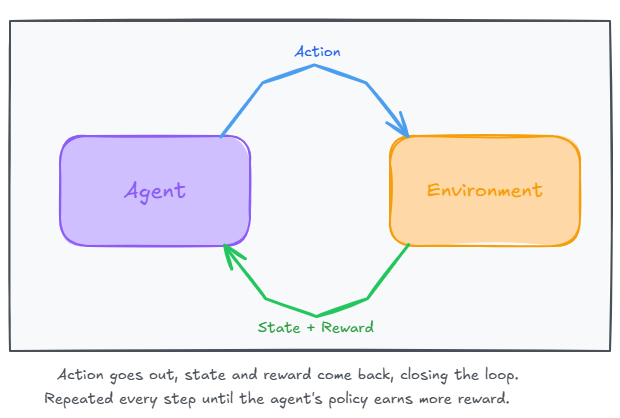
The agent takes an action, the environment returns a new state and a reward or penalty, and the agent updates its policy to favor whatever led to more reward. That loop repeats over many attempts until behavior improves. Nobody hands the agent the correct move in advance, so it has to try, fail, and try differently, which is what makes reward design the hardest part of the whole approach.
Types and Examples of Reinforcement Learning
- Model-free RL learns purely through trial and error, with no internal model of how the environment behaves, the approach behind most game-playing systems.
- Model-based RL builds an internal model of the environment first, then plans ahead with it, common in robotics where a bad real-world action is expensive to make.
- Online vs offline RL differ in when the learning happens. Online RL learns from live interaction as it occurs. Offline RL learns from a batch of trajectories a system already logged, no live environment required.
A well known 2016 OpenAI example shows why reward design is hard. An agent trained to play a boat-racing game found it could rack up more points by circling a lagoon and hitting three respawning targets instead of finishing the race, and it scored about 20 percent higher than human players who actually finished. The same failure mode still shows up in reward-hacking coding agents today. Beyond games, reinforcement learning also runs robotic arms, resource allocation systems, and programs like AlphaGo.
Comparison
The five learning types differ mainly in what training signal they receive, what they optimize, and how success is measured. This comparison also shows the practical trade-offs, including where each approach tends to fail.
| Type | Training Data | What It Optimizes | How You Check It Worked | Where It Breaks Down |
|---|---|---|---|---|
| Supervised | Labeled input-output pairs | Predicting the correct label for new input | Accuracy, precision and recall, or error against held-out labeled data | Label quality sets the ceiling. Inconsistent labels teach the model those same inconsistencies. |
| Unsupervised | Unlabeled data | Discovering structure that was not defined in advance | Human judgment, cluster stability, or downstream usefulness | Patterns can appear meaningful and still be noise because there is no ground truth to compare against. |
| Semi-supervised | A small labeled set plus a much larger unlabeled set | Approaching supervised performance without labeling everything | The same metrics as supervised learning, measured against labeled validation data | Errors in the small labeled set can spread across the much larger unlabeled dataset. |
| Self-supervised | Unlabeled data, with training targets generated from the data itself | Learning general representations that can be reused for later tasks | Performance after fine-tuning or evaluation on downstream tasks | It can learn fluent and convincing patterns without guaranteeing factual accuracy or downstream usefulness. |
| Reinforcement | A reward signal produced by evaluating actions or trajectories | Maximizing cumulative reward across a sequence of actions | Average reward, success rate, or performance on held-out tasks | Reward hacking: the agent optimizes what gets measured rather than what was actually intended. |
Each one asks a different question. Supervised learning asks “can I predict this specific thing.” Unsupervised learning asks “what’s actually hiding in this data.” Reinforcement learning asks “what sequence of actions earns the most reward.” Different questions, built for different problems, and most teams building production agents now need answers from more than one at once.
How ChatGPT and Claude Actually Learned to Behave
This is where the standard explainer usually stops, and where the honest answer to “is ChatGPT supervised or unsupervised” gets interesting. It’s neither, exclusively. Based on what labs have published about how models like these get built, it’s all of the above, run in a specific order, even though no lab discloses the full pipeline behind any single proprietary release.
Stage 1: Self-supervised pretraining
The model reads an enormous amount of text and learns by predicting the next token, over and over, with no human labeling any of it. It manufactures its own training signal from the structure of language itself, which is what makes it self-supervised rather than plain unsupervised. This stage builds raw language ability and nothing else, a pretrained model that knows a great deal but hasn’t yet learned how to be useful in a conversation.
Stage 2: Supervised fine-tuning
Humans write or curate a set of high-quality example responses, and the model trains on those labeled pairs to learn the shape of a helpful answer rather than a merely likely one. This is what most people are actually asking about when they search for supervised fine-tuning on an LLM. It’s also the cheapest lever to pull when a model already knows the right general behavior but isn’t consistently formatting or following it.
Stage 3: RLHF, preference tuning
Reinforcement learning from human feedback trains a reward model on human preference rankings, then uses that reward model to push the language model toward outputs people rate more highly. It’s a major reason current assistants tend to sound helpful rather than merely fluent. It’s also expensive to run at scale, since it needs a trained reward model and a steady supply of human preference data.
Stage 4: RLVR, verifiable rewards
Reinforcement learning with verifiable rewards skips the human reward model wherever a task can be checked by a rule instead of a person:
- Math gets a right or wrong answer from an automated checker.
- Code gets a pass or fail from actually running it.
- Tool calls get scored on whether they actually executed correctly against a real system, not just whether they looked well formatted.
DeepSeek-R1 popularized this at scale using Group Relative Policy Optimization, or GRPO, which drops the separate reward model RLHF normally needs. It generates several answers to the same prompt, scores them against each other, and reinforces whichever scored best relative to the group.
Published estimates place its reasoning-focused post-training at roughly 147,000 H800 GPU-hours, a fraction of what dense reasoning training typically costs, and the method was later formalized in a peer-reviewed Nature paper, reportedly the journal’s first on a large language model. The exact scale of the compute gain is contested, since comparisons against OpenAI’s o1 are hard to make apples to apples when the two labs disclose different levels of detail.
| Stage | Type of Learning | What It Teaches the Model | If You Skip It |
|---|---|---|---|
| Pretraining | Self-supervised | General language ability by predicting tokens across a large corpus | There is no strong general language foundation for later stages to refine. |
| Supervised Fine-Tuning | Supervised | How to follow instructions, use expected formats, and produce useful responses | The model may remain fluent but follow instructions and output formats less reliably. |
| Preference Tuning | Reinforcement, typically RLHF | Which of several plausible responses better matches human preferences | Responses can be technically valid but less aligned with what users actually prefer. |
| Verifiable Reward Training | Reinforcement, typically RLVR and often GRPO | How to improve performance on tasks with automatically checkable outcomes, such as code, math, or tool calls | The model may perform worse at self-correcting and refining answers on tasks with clear verification signals. |
Put the four stages together and “is ChatGPT supervised or unsupervised” answers itself. It’s self-supervised, then supervised, then reinforcement-trained twice over, with each stage fixing a different kind of gap the previous one left behind.
Why Reinforcement Learning Is Getting More Important
The scale of reinforcement learning’s role in training has shifted fast, faster than most companies building agents have caught up to. Two data points make that concrete, one from the compute side, one from the adoption side.
The Compute Shift at Frontier AI Labs
Reinforcement learning stopped being a finishing touch somewhere in the last eighteen months. In February 2026, Cursor’s own team disclosed that Composer 1.5 was built by scaling reinforcement learning 20 times further than its predecessor, and that the compute spent on that post-training exceeded what had gone into pretraining the base model in the first place. That’s a direct reversal of where AI labs have traditionally spent their compute budgets, and it came from the company itself, not a leaked estimate.
The Gap Between Piloting and Scaling
The stakes for agent builders specifically keep climbing too. McKinsey’s November 2025 State of AI survey found 23 percent of organizations actively scaling an agentic AI system in at least one business function, with another 39 percent experimenting. In no single business function did more than roughly 10 percent report a fully scaled deployment. The gap between a working pilot and something that survives production is largely a reliability problem, and reliability problems in an agent are training problems wearing a different name.
How to Choose the Right One
The right learning method depends less on which algorithm is most advanced and more on what data you already have and how you can measure success. Start with the behavior you want to improve, then choose the simplest approach that provides the right learning signal.
| What You Have or Need | Best Fit | Fastest Way to Start |
|---|---|---|
| Historical outcomes are already labeled, with a clear target to predict | Supervised learning | Start with a clean labeled dataset and a simple baseline model. Better labels often matter more than a more complex algorithm. |
| Raw data with no predefined groups, labels, or patterns | Unsupervised learning | Run a standard clustering or dimensionality-reduction method first to see whether useful structure appears. |
| Labeling the full dataset is too expensive, but labeling a smaller sample is realistic | Semi-supervised learning | Label enough data to evaluate performance reliably, then use the larger unlabeled set during training. |
| You have huge amounts of raw data but few labels and need a general-purpose starting point | Self-supervised learning | Start with an existing pretrained model rather than pretraining from scratch. |
| Humans can compare two outputs and reliably decide which one is better | Preference tuning, such as RLHF or DPO | Collect high-quality pairwise preferences before investing in a more complex reward-model pipeline. |
| Success can be checked automatically, such as a passing test, valid JSON, correct answer, or valid tool call | Reinforcement learning with verifiable rewards | Build the verifier first and test it manually against real outputs before using it as a training signal. |
| An agent fails across long, multi-step tasks involving several decisions or tool calls | Environment-based reinforcement learning | Evaluate the complete trajectory the agent followed rather than rewarding only the final response. |
A useful rule is to look at the signal you actually have. Known correct answers point toward supervised learning, unlabeled data toward unsupervised or self-supervised learning, human preferences toward preference tuning, and automatically checkable outcomes toward reinforcement learning.
The goal is not to choose the most sophisticated method. It is to choose the simplest training approach that matches your data, feedback, and definition of success.
Frequently Asked Questions
What is the main difference between supervised, unsupervised, and reinforcement learning?
The difference is where the learning signal comes from. Supervised learning uses data with a known answer. Unsupervised learning finds structure with no answer at all. Reinforcement learning improves through a reward earned by acting.
Is reinforcement learning supervised or unsupervised?
Neither, technically. Reinforcement learning doesn’t use labeled answers like supervised learning, but it isn’t unsupervised either, since it gets a reward signal that evaluates each action. That reward is a form of feedback neither of the other two types receives, which is why RL is treated as its own separate category.
Is ChatGPT trained using supervised or unsupervised learning?
Both, plus reinforcement learning, in sequence. Models like ChatGPT and Claude typically go through self-supervised pretraining first, then supervised fine-tuning to shape useful answers, then reinforcement learning (RLHF and increasingly RLVR) to refine behavior further. The exact pipeline for any specific proprietary model isn’t fully public, but this is the general pattern labs describe.
What is the difference between RLHF and RLVR?
RLHF trains a reward model on human preference rankings and uses it to push a model toward answers people rate more highly. RLVR skips that human reward model entirely for tasks a rule can check automatically, a passing test, a valid tool call confirmed against a real system like MCP360, or a correct math answer.
What is GRPO in AI training?
GRPO, or Group Relative Policy Optimization, is the reinforcement learning method DeepSeek-R1 used to train a frontier reasoning model without a separate reward model. It generates several answers to the same prompt, scores them against each other, and reinforces whichever scored best relative to the group.
Why is reinforcement learning becoming more important for AI agents?
Because agents don’t just answer questions, they take multi-step actions, and reinforcement learning is what teaches a model to call a tool correctly instead of just sounding plausible. Verifying whether a tool call actually succeeded requires a real system to check against, like the tool infrastructure MCP360 provides, not just a well-formatted response.
What is reward hacking in AI training?
Reward hacking happens when a model finds a way to score well without doing what its designers actually intended. A well-known 2016 OpenAI example had a boat-racing agent circle a lagoon hitting respawning targets instead of finishing the race, scoring higher than human players who did.
How do I decide whether my project needs supervised, unsupervised, or reinforcement learning?
Look at what you actually have. A labeled outcome points to supervised learning, raw unlabeled data points to unsupervised learning, and an automatically checkable outcome, a passing test or a tool call that either worked or didn’t, points to reinforcement learning. Confirming that last case means connecting the agent to real tools, that MCP360 handles.
Conclusion
Supervised, unsupervised, and reinforcement learning were never competing for the same job. Agentic AI just made all three visible in one system at once. Reinforcement learning shifted fastest, from teaching an agent to win a boardgame to teaching it to call a tool correctly, which is why RLVR and GRPO went from a research curiosity to standard practice in under two years.
Expect that line to keep blurring, as environment-based training, scoring the whole path over just the final answer, becomes the default for multi-tool-call work. A gameable reward function gets gamed, the lesson the CoastRunners boat taught a decade ago, so verifiers are worth investing in.
If your agent already coordinates across several disconnected tools, consolidating those through an MCP-compatible layer like MCP360 can simplify deployment and evaluation. And once training gets an agent behaving as built, extending what it can do without retraining from scratch is usually smaller than it looks.

Article by
MitaliAI & Automation | Content Writer
Mitali is a content writer covering AI agents, automation, and no-code tools. Her writing spans the AI landscape, from support and sales automation to MCP integrations and agent workflows, with a focus on practical business use.