



The TL;DR
Cerebras-speed inference changes the maths behind every agent loop, but the benefit varies depending on where a workflow actually loses time.
-
• The Number That Matters
Cerebras is running OpenAI’s fastest model at several times standard GPU speed, creating a large enough difference to change what an agent loop can complete within a single response.
-
• Who Actually Gets It
Standard-speed Sol became available to everyone in July, but access to the faster inference lane remained limited to a much smaller group of users.
-
• The Bottleneck Speed Alone Does Not Fix
A second feature launched alongside Sol to reduce tool round trips rather than raw generation time. Understanding which bottleneck affects a workflow determines whether either upgrade is worth pursuing.
An agent works through a task in stages. It plans the next step, calls a tool, reads the result, and repeats the cycle until the task is complete or the workflow hits a blocker. Each stage depends on the model generating more tokens, and for most of the past two years, inference speeds stayed within a fairly narrow range. That was quick enough for a chat response, but still slow enough to make a twenty-step agent run feel like watching a progress bar.
GPT-5.6 Sol moves one side of that equation. Running on Cerebras wafer-scale hardware, OpenAI’s flagship model generates tokens at up to 750 a second, a jump large enough that developers testing it are already rewriting how they think about what an agent loop can do in real time.
The harder question is what that speed buys a team building on the Model Context Protocol, where round trips and schema overhead often cost more wall-clock time than token generation does.
GPT-5.6 Sol, Terra, and Luna Release Timeline and Pricing
GPT-5.6 arrived in two separate stages, and that distinction determines what the Cerebras speed number changes for a given team.
From Preview to General Availability
OpenAI previewed the family on June 26, 2026 as three durable capability tiers rather than one model with a dial. Sol is the flagship. Terra is balanced, competitive with GPT-5.5 at half the price. Luna is the fastest and cheapest of the three.
The preview was gated behind a review coordinated with the U.S. government, tied to Sol’s cyber capabilities. OpenAI’s own launch materials describe a limited preview for a small group of trusted partners whose participation was shared with the government, without naming a headcount. Multiple outlets, including TechCrunch and The Next Web, independently reported that cohort at roughly 20 organizations, each individually approved. OpenAI said only that broader availability would follow in the coming weeks.
That kind of government-coordinated review sits alongside a broader wave of scrutiny hitting AI infrastructure this year, including the NSA and CISA hardening rules now reshaping the MCP spec itself. Different protocol, same instinct. Capable systems increasingly get treated as something that needs vetting before broad reach, rather than a launch a lab simply announces.
Broader release landed on July 9, 2026. Standard-speed Sol, Terra, and Luna reached general availability across ChatGPT, Codex, and the API that day, alongside a separate feature called Programmatic Tool Calling that matters just as much for MCP-based agents as the speed jump does.
The Cerebras deployment is a separate track entirely from that general availability. In the same June 26 announcement, OpenAI confirmed it is launching Sol on Cerebras wafer-scale hardware at up to 750 tokens a second in July, and its post still states that access will initially be limited to select customers while capacity expands. Standard-speed Sol is open to anyone with an API key. The 750 tok/s lane is not. That gap between “available” and “available at 750 tok/s” is the detail most coverage of this launch has left out.
Pricing by Tier
Per-million-token pricing has held steady since the June 26 preview.
| Tier | Input (per 1M tokens) | Output (per 1M tokens) | Positioning |
|---|---|---|---|
| Sol | $5.00 | $30.00 | Flagship model for the hardest agent and coding tasks |
| Terra | $2.50 | $15.00 | Balanced model for everyday production workloads |
| Luna | $1.00 | $6.00 | Fastest and most affordable model for high-volume tasks |
No separate rate has been published for the Cerebras-hosted lane. It sits on top of standard Sol as a premium capacity tier, so expect it to price above the $5/$30 standard rate rather than below it. That’s an inference from how premium inference capacity usually gets priced, not a confirmed number.
Sol’s launch also raised questions about what a stronger model means for Codex’s existing MCP integration, separate from the speed question below.
With the release mechanics and pricing established, the more useful question is what the 750 tok/s figure does to an agent loop’s math.
How Faster Inference Changes Agent Loops
The number matters because of how agent loops accumulate time, not because 750 sounds impressive on its own. A person reading a chat reply cannot tell the difference between 60 tokens a second and 600. An agent chaining tool calls can, because every extra second at each step gets paid again at the next one.
What a Five-Turn Loop Costs in Seconds
Byteiota, a tech outlet that covered the launch closely, ran the arithmetic against roughly 70 tokens a second, the throughput most frontier models get on standard GPU clusters.
| Turn Size | ~70 tok/s (GPU) | 750 tok/s (Cerebras) |
|---|---|---|
| 1,000-token turn | ~14 sec | ~1.3 sec |
| 3,000-token turn | ~43 sec | ~4 sec |
| 5-turn loop, 3,000 tokens per turn | ~3.5 min | ~20 sec |
A single planning step at 3,000 tokens, reasonable for a code review or a research summary, drops from 43 seconds to 4. Stretch that across a five-turn loop and the difference is three and a half minutes versus twenty seconds. That gap is the line between an agent a developer waits on and one they run inline with their own work.
The same compounding shows up outside this specific launch. Anthropic’s own engineering research on multi-agent systems found that agents consume roughly four times more tokens than standard chat, a figure that climbs to roughly fifteen times for multi-agent systems coordinating through subagents. GPT-5.6 Sol’s own ultra mode follows that same pattern when it splits work across parallel subagents. Faster token generation doesn’t remove that scaling problem. It changes how expensive each unit of it is, which puts real pressure on the underlying economics of running agents at volume.
Raw speed is not the only variable that moved with this release. Teams already splitting work across subagents run into the same coordination tradeoffs no matter which model sits underneath, and a faster Sol doesn’t remove the need to think through how those subagents share context.
How Cerebras Delivers 750 Tok/s
The 750 tok/s figure comes from OpenAI directly. Most of what explains how it’s achieved does not, and keeping those two categories separate matters for anyone deciding how much weight to put on the deeper technical claims circulating since launch.
Why Wafer-Scale Hardware Is Faster
Cerebras’s Wafer-Scale Engine 3 is a single chip spanning roughly 46,225 square millimeters, about 50 times the surface area of a typical GPU die, with on-chip memory bandwidth Cerebras rates at 21 petabytes a second. Standard GPU clusters lose time moving data between chips and external memory during inference. Keeping computation on one large substrate cuts most of that movement out. That’s the published mechanism behind why wafer-scale inference runs faster than a GPU cluster on the same weights.
That capacity has a real limit, though. On-chip SRAM is fast but small relative to a frontier model’s weights, so heavy KV caching, the technique models use to avoid recomputing earlier context, has to be handled carefully on this kind of hardware rather than applied the way it would be on a GPU with large external memory.
What OpenAI Has Not Confirmed
Independent analysts have floated specifics about how Sol fits onto this architecture, including estimates that the model spans 70 to 100 wafers with roughly one network layer per wafer, at somewhere around three trillion total parameters. None of that comes from OpenAI or Cerebras.
Treat any specific wafer count or parameter figure attributed to this deployment as outside technical speculation built from public benchmarks and chip specs, not a confirmed architecture. The companies involved haven’t published one.
The hardware explains why 750 tok/s is physically achievable. It doesn’t explain why an agent loop needs that speed. The second lever in this release addresses that question.
Programmatic Tool Calling and Agent Loop Latency
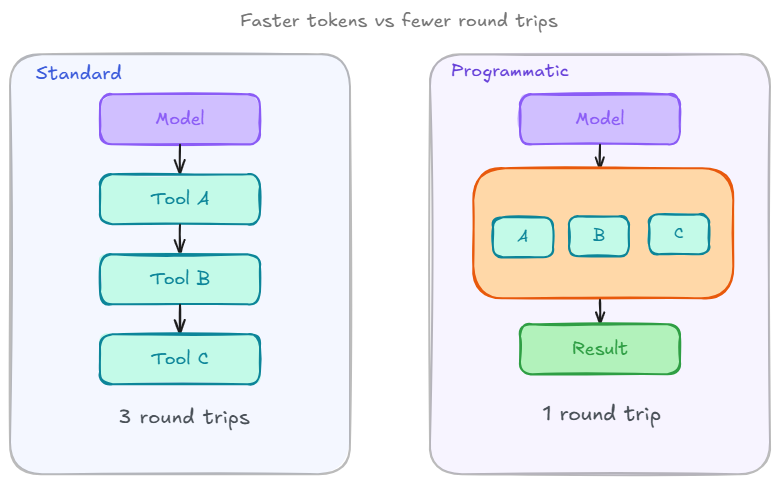
Raw token speed solves half of an agent loop’s latency problem. The other half is the round trip itself. The network hop to the model, the tool execution, the result coming back into context before the next step can start. A faster model does not touch that half. GPT-5.6 shipped a second feature aimed directly at it.
How Programmatic Tool Calling Works
Programmatic Tool Calling lets the model write JavaScript that orchestrates multiple tool calls, loops, and conditionals inside a sandboxed runtime, instead of returning one tool call per round trip for an application to execute and feed back. Per OpenAI’s own developer documentation, the generated code runs in an isolated V8 environment with no network access, so the security boundary a team already reasons about with standard function calling doesn’t move.
Round trips add up fast in a live MCP session. Every tool call and its response typically costs several hundred milliseconds to a few seconds depending on network conditions and how the server responds, and that overhead sits entirely outside whatever the model itself is doing. A connection that stalls or times out costs even more, and a workflow with ten or twenty sequential calls pays that tax every single time. A faster model leaves all of that in place.
Why It Matters for MCP-Based Tool Calls
For Model Context Protocol builders specifically, eligible MCP tools can be called from inside a program once their allowed_callers setting includes “programmatic,” per OpenAI’s documentation. A workflow that used to mean ten sequential round trips can become one program that calls all ten and returns a single structured answer.
That’s a different fix from Cerebras’s speed jump. The two combine rather than compete. One shortens the wait inside each generation. The other shortens the number of generations a loop needs.
The timing lines up with a broader shift already underway in how MCP handles multi-step sessions. Server authors adapting to the 2026-07-28 stateless spec are solving a related problem from the protocol side, cutting the state a client has to carry between calls rather than cutting the calls themselves.
What Faster Inference Means for MCP
The impact of either improvement depends on where a workflow actually spends its time. A loop weighed down by oversized tool schemas will gain little from Cerebras-speed inference because token generation was not the limiting factor in the first place.
Schema overhead is the clearest example. Benchmarks comparing identical tasks run through MCP servers against the same tasks run through a command-line interface have found MCP consuming up to 32 times more tokens for the same operation, largely because an unfiltered connection loads every tool schema at session start whether the task needs it or not. That overhead adds cost and latency a faster model cannot fix.
MCP360 solves that specific problem by loading tool definitions on demand instead of dumping the full catalog into context on every request. A session that needs three tools out of a hundred available only pays for three, regardless of which model is generating the tokens behind it. That’s the kind of infrastructure that turns a speed jump like Cerebras’s into real wall-clock savings, instead of having it absorbed by orchestration overhead sitting underneath the model. Model speed and system overhead are separate variables, and the second is the one worth fixing before chasing Cerebras access.
Checklist Before Adopting Cerebras Inference
Confirm the following before assuming 750 tok/s changes anything for a specific agent:
- Profile the bottleneck: Check whether a specific loop’s time goes to token generation, tool execution, or round-trip overhead before betting on a faster model to fix it.
- Load tool definitions on demand: Loading the full catalog up front instead of only what a step needs adds schema overhead a faster model cannot fix.
- Test on read-only tools first: Programmatic Tool Calling is days old as a pattern, and a schema ambiguity in generated code becomes a repeated bug rather than a single bad call.
- Route by task, not by habit: Interactive, user-facing steps are where a 750 tok/s lane earns its keep. Batch pipelines and overnight jobs will not notice the difference.
A gateway like MCP360, built to load only the tools a step needs rather than the whole catalog on every request, is the kind of infrastructure that lets a speed jump like this one show up in wall-clock time instead of being absorbed by orchestration overhead sitting underneath the model. Model speed and system overhead are separate variables, and the second is the one to address before pursuing Cerebras access.
Who Can Access GPT-5.6 Sol on Cerebras Today
The access restriction has not changed since the timeline above. The practical question now is what a team can do about it. Cerebras exposes an OpenAI-compatible endpoint, so a team that does get access can migrate an existing OpenAI SDK client by pointing it at a different base URL, not by rebuilding the integration.
Most teams’ realistic move right now is preparation, not migration. Confirm a workflow’s actual bottleneck, adopt Programmatic Tool Calling where the tool set is stable and read-heavy, and keep the tool layer lean, so that whenever the Cerebras lane opens more broadly, it lands on a loop that was already built to use it. That prep work matters regardless of which model ends up running the loop, since Sol is unlikely to stay the only frontier option worth benchmarking against.
That broader opening has a rough shape already. OpenAI’s own announcement of the partnership confirms 750MW of Cerebras capacity coming online in multiple tranches through 2028, and Cerebras’s IPO filing discloses an option to expand that to 2GW by 2030. The “select customers” gate widens on that contractual schedule, not on OpenAI’s discretion.
The advantage also looks likely to stay close to OpenAI for that stretch. Cerebras has agreed not to sell its wafer-scale capacity to a named OpenAI competitor for the length of the deal, a restriction co-founder Andrew Feldman confirmed to TechCrunch without confirming which company it targets. The obvious candidate is Anthropic, though Cerebras has stopped short of saying so on the record. Feldman also described the restriction as temporary, tied to the company’s current capacity rather than a permanent policy.
Frequently Asked Questions
What is an AI agent loop?
An AI agent loop is the repeating cycle an AI system runs to complete a task. It plans a step, calls a tool, reads the result, and repeats until the task finishes or it gets stuck. Each cycle waits on the model to generate tokens, so the loop’s total time is the sum of every step’s model response time plus whatever the tools themselves take to run. A faster model shortens each step, and that saving multiplies across the loop.
How many tokens per second is considered fast for an AI agent?
Most production AI models generate somewhere between 40 and 150 tokens a second on standard GPU hardware, fast enough for a single chat reply but slow enough to add up across a multi-step agent. Specialized hardware like Cerebras wafer-scale chips can push a frontier model past 700 tokens a second, which matters far more in an agent loop that chains many model calls than it does in a one-off chat reply.
How fast is GPT-5.6 Sol on Cerebras?
GPT-5.6 Sol runs at up to 750 tokens a second when served on Cerebras wafer-scale hardware, according to OpenAI’s own launch announcement. That compares with roughly 70 tokens a second for the same model on standard GPU clusters. As of this writing, that Cerebras-hosted speed tier remains limited to select customers while OpenAI expands capacity, separate from the general availability of standard-speed Sol since July 9, 2026.
What is the difference between GPT-5.6 Sol, Terra, and Luna?
Sol, Terra, and Luna are the three capability tiers OpenAI shipped together as GPT-5.6, not three versions of one model. Sol is the flagship, priced at five dollars input and thirty dollars output per million tokens, built for the hardest agent and coding tasks. Terra targets everyday production work at roughly GPT-5.5 quality for half the price. Luna is the fastest and cheapest tier, meant for high-volume, simpler steps in a workflow.
Is GPT-5.6 Sol available on Cerebras yet?
Standard-speed GPT-5.6 Sol has been generally available through the API since July 9, 2026. The Cerebras-hosted version running at up to 750 tokens a second is separate and remains limited to select customers, with OpenAI expanding capacity over time. Teams without Cerebras access can still use standard Sol today, and migrating once access opens means pointing an existing OpenAI SDK client at a different base URL, not rebuilding the integration.
Does Programmatic Tool Calling work with MCP tools?
Yes. GPT-5.6’s Programmatic Tool Calling lets the model write code that orchestrates multiple tool calls in one pass instead of one round trip per call, and eligible MCP tools can be included once their allowed_callers setting includes programmatic, per OpenAI’s documentation. That can turn ten sequential MCP tool calls into a single program, which matters for teams routing tool calls through a gateway like MCP360, since it cuts round trips rather than generation time.
Will faster inference fix a slow AI agent?
Not necessarily. Faster token generation only helps the part of an agent loop spent waiting on the model to respond. If a workflow is actually slow because of tool-schema bloat or round-trip overhead, a faster model will not fix it. Profiling where a specific loop’s time goes, generation, tool execution, or round trips, matters more than assuming speed solves everything. Gateways that load tool definitions on demand, such as MCP360, address the overhead a faster model cannot touch.
When will GPT-5.6 Sol’s Cerebras speed be available to everyone?
OpenAI has not published an exact date. The underlying Cerebras partnership is a phased, multi-year rollout running through 2028, with a disclosed option to expand further by 2030, so the select-customers limit is expected to widen gradually rather than open all at once. Teams can prepare now by keeping their tool layer routed through a gateway like MCP360, so switching to a faster model later does not mean rebuilding how tools get called.
Conclusion
Treat 750 tokens a second as a preview, not a destination. Cerebras built its business serving open-weight models like Llama and DeepSeek, not closed frontier models from labs like OpenAI, Anthropic, or Google. GPT-5.6 Sol breaks that pattern, and it won’t be the last flagship model to do so.
AWS has already paired its own chips with Cerebras hardware, and Nvidia answered by acquiring Groq outright. Expect the fast-inference market to look crowded within a year or two, with providers competing on tokens per second the way they once competed on benchmark scores.
The smarter choice is a tool layer that remains useful regardless of which model leads on speed this quarter. Measure where each agent loop spends its time, load tool definitions only when needed, and build the infrastructure to absorb the next inference leap. Then, whichever provider ships it, the performance gain arrives on a stack that is already ready to use it.
Tags

Article by
MitaliAI & Automation | Content Writer
Mitali is a content writer covering AI agents, automation, and no-code tools. Her writing spans the AI landscape, from support and sales automation to MCP integrations and agent workflows, with a focus on practical business use.