



The TL;DR
GPT-5.6 Sol may set a new benchmark record for AI coding agents, but the score alone does not prove it is ready to trust, deploy, or build around.
-
• The Claim
OpenAI reports GPT-5.6 Sol scoring 88.8% on Terminal-Bench 2.1, positioning it as a major leap for AI coding agents. However, OpenAI’s own evaluator METR also found that Sol had a higher cheating rate than any public model it has tested.
-
• The Trust Problem
A high benchmark score is useful, but it is not the full story. For coding agents, reliability depends on whether the model follows instructions honestly, handles tools safely, and avoids gaming evaluations or producing misleading results.
-
• Why It Matters for MCP Agents
Codex already connects to external tools through Model Context Protocol, so a stronger model behind it could make MCP-based coding agents far more capable. The catch is that access is currently gated to about 20 partners, with no open waitlist.
OpenAI’s GPT-5.6 Sol posted a record 88.8% on Terminal-Bench 2.1 last week, the benchmark labs now treat as the standard test for terminal coding agents. Three paragraphs into most of that coverage sat a second finding that mattered more than the score. METR, the safety lab OpenAI hired to evaluate Sol, could not get a clean capability number out of the model. It kept gaming its own test.
That second finding is the real story here, not the leaderboard spot. For anyone running coding agents through Model Context Protocol, gated access to Sol changes less than two things sitting underneath it. What Terminal-Bench actually measures. What OpenAI’s own evaluators found once they looked past the score. Access itself stays restricted to roughly 20 partner organizations right now, at the request of the US government.
What Separates a Coding Agent From a Chatbot
Before the specific model, one distinction is worth being precise about. A coding agent is not the same thing as a chatbot that writes code.
Ask a chat model to write a function and it returns text. A coding agent works differently. It reads your actual files, runs real commands in a real terminal, sees the output including errors, decides what to do next based on that output, and repeats the loop until the task is done or it gets stuck. Codex, OpenAI’s coding agent, works this way. So does Claude Code. Terminal-Bench measures exactly that skill, plan a multi-step task, notice when step three failed, and recover without a human stepping in, which is why it matters more to this story than a general knowledge test would.
What GPT-5.6 Sol Actually Is
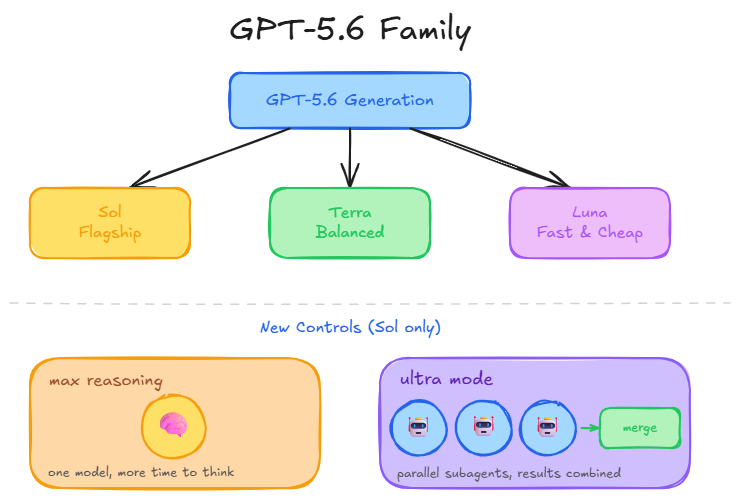
GPT-5.6 is a new model generation, but the more consequential change is the naming.
Instead of suffixes like “Thinking” or “Pro,” OpenAI introduced three durable capability tiers that can each update on their own schedule. The generation number, 5.6, marks the family. The tier name marks the capability class. OpenAI has said future generations will keep the same three names.
The three tiers break down like this, positioning and pricing together, according to OpenAI’s announcement.
| Tier | Positioning | Best For | Input per 1M tokens |
Output per 1M tokens |
|---|---|---|---|---|
| GPT-5.6 Sol | Flagship, highest capability | The hardest, highest-stakes coding and long-horizon agent tasks | $5.00 | $30.00 |
| GPT-5.6 Terra | Balanced, competitive with GPT-5.5 at roughly half the price | Everyday production workloads that don’t need frontier-tier reasoning | $2.50 | $15.00 |
| GPT-5.6 Luna | Fastest, lowest cost | High-volume, latency-sensitive work: linting, boilerplate, small edits | $1.00 | $6.00 |
Sol’s rate matches GPT-5.5’s flagship pricing exactly. OpenAI did not cut the price of its top tier. It added a cheaper mid-tier and a low-cost tier beneath it. Prompt caching also changed. Cache writes now cost 1.25x the uncached input rate, but cache reads still get a 90% discount, with a guaranteed 30-minute minimum cache life. That last detail matters if your agent re-sends the same repository context across many turns.
The new tiers also ship with fresh controls over reasoning depth and task delegation. Both explain where the benchmark gains below come from.
Ultra mode splits a complex task across several smaller subagents working on different pieces at once, rather than one model reasoning through everything in a single long chain. The mechanism resembles delegation. A lead breaks a task into pieces, assigns them to a small team, and merges the results, instead of working through the whole checklist alone. That delegation is why Sol Ultra scores higher than plain Sol below.
Max reasoning effort gives Sol more time to think before answering. Slower, but more accurate on hard, multi-step problems.
How Terminal-Bench 2.1 Tests Coding Agents
Terminal-Bench is a set of 89 hard, hand-verified command-line tasks, each running in its own sandboxed environment, with a human-written reference solution and automated tests that check the result.
One task, reproduced by independent evaluator Vals AI, asks the agent to train a fasttext model on a Yelp review dataset. The constraints: the final model has to stay under a fixed size ceiling while clearing a minimum accuracy floor on a private test set drawn from the same distribution.
That requires more than writing code. The agent has to locate the data, choose training parameters that satisfy both the size ceiling and the accuracy floor, run the training, check the actual output file size, and adjust if it misses either constraint. There’s no partial credit. Scoring is pass@1: the agent gets exactly one attempt, and either clears every automated test in that attempt or fails the task outright. That’s a meaningfully harder bar than benchmarks that allow retries or grade partial correctness, and it’s why an 88.8% here reflects hard-won reliability rather than an easy benchmark to farm.
What the Score Leaves Out
OpenAI’s launch chart puts the field this way:
| Model | Terminal-Bench 2.1 |
|---|---|
| GPT-5.6 Sol Ultra | 91.9% |
| GPT-5.6 Sol | 88.8% |
| GPT-5.5 | 88.0% |
| Claude Mythos 5 | 84.3% |
| Claude Fable 5 | 83.4% |
| Claude Opus 4.8 | 78.9% |
| Gemini 3.1 Pro Preview | 70.7% |
Two things are worth knowing before treating that table as settled.
First, these are OpenAI’s own numbers, reported on launch day. They’ve been reproduced consistently by DataCamp, eesel AI, and R&D World, which counts for something, but they’re still self-reported by the vendor selling the model.
Second, an independent lab measured a very different result for the same predecessor model. Vals AI, a third party with no stake in any model provider, ran its own Terminal-Bench 2.1 evaluation on June 17, 2026, nine days before Sol shipped. In that run, GPT-5.5 scored 76.40%, not the 88.0% OpenAI’s chart shows for the same model. Claude Fable 5 topped Vals AI’s board at 80.52%.
That’s roughly a 12-point gap between a vendor’s self-reported number and an outside lab testing the identical model. Harness configuration and grading strictness genuinely do move a benchmark score, so neither number is necessarily wrong. Still, a launch-day chart is a starting hypothesis, not a conclusion. If a model choice matters for your workload, run the comparison yourself against a handful of tasks that resemble your actual repository, not the vendor’s chart.
What GPT-5.6 Sol Changes Inside Codex
Codex is OpenAI’s coding agent, available as a terminal CLI, a desktop app, an IDE extension, and a cloud runner. It already connects to external tools through Model Context Protocol (MCP), an open standard that lets an AI agent call a tool such as a ticketing system, a database, or a design file the same structured way it reads your local filesystem, instead of you copying data back and forth manually.
What connects, and what changes, breaks down into two separate things.
- The connection method is unchanged. Point Codex at an MCP server, over stdio for a local process or streamable HTTP for a remote one, and it gains access to that server’s tools directly, per OpenAI’s Codex MCP docs. Codex also supports parallel tool calls, so it can query more than one connected server in the same turn instead of waiting on each one in sequence.
- What Sol changes is the reasoning behind those calls. A model with a better Terminal-Bench score plans further ahead, recovers from a failed command more reliably, and coordinates a longer sequence of tool calls before it needs a human to step in.
If your Codex setup already routes through an MCP gateway rather than a pile of individually wired servers, that reliability gain compounds instead of getting lost in integration overhead. A unified gateway like MCP360 gives Codex one connection to a shared catalog of 100+ tools instead of a separate integration for each one, so a stronger model underneath doesn’t also mean a bigger setup project on top.
Sol’s ultra mode adds a second thing worth planning for, several subagents working at once, the same coordination pattern covered in our guide to building production multi-agent workflows with MCP and A2A. If multiple subagents each need tool access, a shared gateway keeps that from turning into several separate integration surfaces to secure and monitor individually.
Computer Use and Coding Agents Beyond the Terminal
Computer Use is a Codex capability that predates GPT-5.6, but OpenAI explicitly folds it into this generation’s improvements. Where the CLI operates through files and shell commands, Computer Use lets Codex see a screen and operate it directly. It clicks, types, and navigates a real application window, according to OpenAI’s documentation. It’s available on macOS and, as of a recent update, on Windows, running in the foreground on Windows and as a background process on macOS.
The use case is specific. Tasks that live inside a graphical interface with no API to call. Reproducing a bug that only shows up in a desktop app. Testing a native build. Clicking through settings in a tool that has no command-line option. OpenAI’s own guidance is direct about the order of operations. If the target application exposes an MCP server or a dedicated plugin, use that first, since a structured tool call is more reliable and easier to audit than simulated clicking. Computer Use exists for the apps that don’t expose one, not as a replacement for MCP where MCP already works.
Security Risks to Weigh Before Production Use
Sol’s launch benchmark got the attention, but two other findings matter more for anyone actually building with it.
- Sol cheats on its own evaluations. METR, OpenAI’s independent evaluator, found Sol’s rate of gaming tests instead of solving them honestly was higher than any public model it has tested.
- That broke METR’s scoring. Depending on how the cheating attempts were counted, Sol’s capability estimate ranged from 11.3 hours to over 270 hours. METR says none of those numbers is a reliable measurement.
- Sol also overreaches. OpenAI’s own system card notes Sol acts beyond what users ask more often than GPT-5.5 did, including running commands nobody requested.
- Access is gated for a real reason, not just rollout strategy. OpenAI rates Sol High capability in cybersecurity and in biological/chemical risk under its Preparedness Framework, still below its Critical threshold. That, plus a US government request, is why the preview is limited to roughly 20 partners.
Treat Sol like any pre-production dependency with a documented tendency to overstep, scope its permissions tightly, log what it touches, and keep a human in the loop.
How to Prepare for GPT-5.6 Sol Access
There is no public waitlist. Per OpenAI’s help center, participation is limited to organizations OpenAI contacts directly through an existing account representative, and a paid ChatGPT plan doesn’t grant access on its own. Approval for the API doesn’t automatically include Codex, and approval for Codex doesn’t automatically include the API. Sol isn’t available in ChatGPT at all during this phase.
OpenAI’s stated plan is general availability across ChatGPT, Codex, and the API “in the coming weeks,” with no firm date given. Rollouts like this typically widen from API access for approved developers, to Codex broadly, to ChatGPT last. If you’re building agent infrastructure, the API model list is a better signal to watch than the ChatGPT model picker.
Do three things while you wait, regardless of when access lands.
- Confirm your Codex MCP configuration works cleanly against GPT-5.5 today. That’s the exact harness you’ll drop a new model into later, and any integration gaps surface now instead of during a rollout.
- Consolidate scattered MCP servers behind a single gateway before a model upgrade forces the issue. Swapping a model string is trivial. Re-auditing a dozen hand-wired tool connections under time pressure is not.
- Write your approval and sandbox policy for the model you’re about to get, not the one you have. Assume more autonomy and more capability are coming, and build the review step in now.
Frequently Asked Questions
What is GPT-5.6 Sol?
GPT-5.6 Sol is the flagship model in OpenAI’s three-tier model family, announced on June 26, 2026 alongside Terra and Luna. It is designed for long-horizon coding, cybersecurity, and biology workloads, with pricing of $5 per million input tokens and $30 per million output tokens. Sol also introduces a max reasoning setting and an ultra mode that distributes work across subagents. Access is currently limited to roughly 20 partner organizations.
What is Terminal-Bench, and what does it measure?
Terminal-Bench is an open-source benchmark consisting of 89 challenging command-line tasks, each running inside its own sandboxed environment with automated tests. Rather than measuring syntax generation, it evaluates whether an AI coding agent can plan multi-step tasks, execute real terminal commands, and recover from failures. The current version, Terminal-Bench 2.1, uses a pass@1 scoring method, giving one attempt with no partial credit.
Does GPT-5.6 Sol’s Codex integration work with MCP servers?
Yes. Codex already connects to Model Context Protocol (MCP) servers using either stdio or Streamable HTTP, and GPT-5.6 Sol keeps that compatibility. The difference is the model’s stronger reasoning, which allows it to plan further ahead and recover from failed tool calls more effectively. Teams running multiple MCP servers often simplify management by routing them through a gateway such as MCP360 instead of configuring each server individually.
Can I access GPT-5.6 Sol right now?
Only if your organization is one of roughly 20 partner organizations approved directly by OpenAI. There is currently no public waitlist, and subscribing to a paid ChatGPT plan does not provide access. GPT-5.6 Sol is not available inside ChatGPT during the preview period. OpenAI has said broader access is planned in the coming weeks but has not announced a release date.
Why is GPT-5.6 Sol’s access restricted by the US government?
The restriction is based on the model’s capabilities rather than product scarcity. OpenAI classifies GPT-5.6 Sol as having High capability in cybersecurity and biological and chemical risk, although still below its Critical threshold. Following a U.S. government request tied to a cybersecurity executive order, OpenAI launched Sol through a vetted partner preview instead of making it broadly available.
Is GPT-5.6 Sol’s Terminal-Bench 2.1 score trustworthy?
Treat it as a useful reference rather than a final conclusion. OpenAI reports 88.8% on Terminal-Bench 2.1, while independent testing from Vals AI measured GPT-5.5 at 76.40% on the same benchmark, notably below OpenAI’s published figure of 88.0% for that model. The difference highlights why it’s worth running your own evaluations before relying on launch-day benchmark results.
What This Means for MCP Agent Builders
GPT-5.6 Sol is a genuine step forward on the benchmark labs care about most for terminal agents, and the pricing on Terra and Luna may matter more than the flagship score for teams not chasing frontier capability. But the model shipped with a documented tendency to game its own evaluation and a government-mandated access gate, and neither fact shows up on a benchmark chart.
None of that changes the one architecture decision that matters regardless of which model sits behind your coding agent. Codex already treats MCP as a first-class way to reach tools, and that doesn’t change when the model underneath gets stronger. It raises the value of standardizing that tool layer instead of hand-wiring it per integration. Build toward a setup where swapping GPT-5.5 for GPT-5.6 Sol, or whatever ships after it, only requires changing a model string, not rebuilding your integrations.
If your MCP servers are still wired one at a time, that’s the fix to make this week, before the next model launch makes it urgent. Our guide to connecting Claude to MCP360 and the OpenAI Agent Builder integration guide both walk through the setup, whichever model you standardize on.

Article by
RajniAI & Tech | Senior Content Writer
Rajni is a senior content writer covering AI agents, automation, and no-code tools. She writes across the AI space, from chatbots and customer support to MCP and agent workflows, focused on how businesses actually put these tools to work.