


The TL;DR
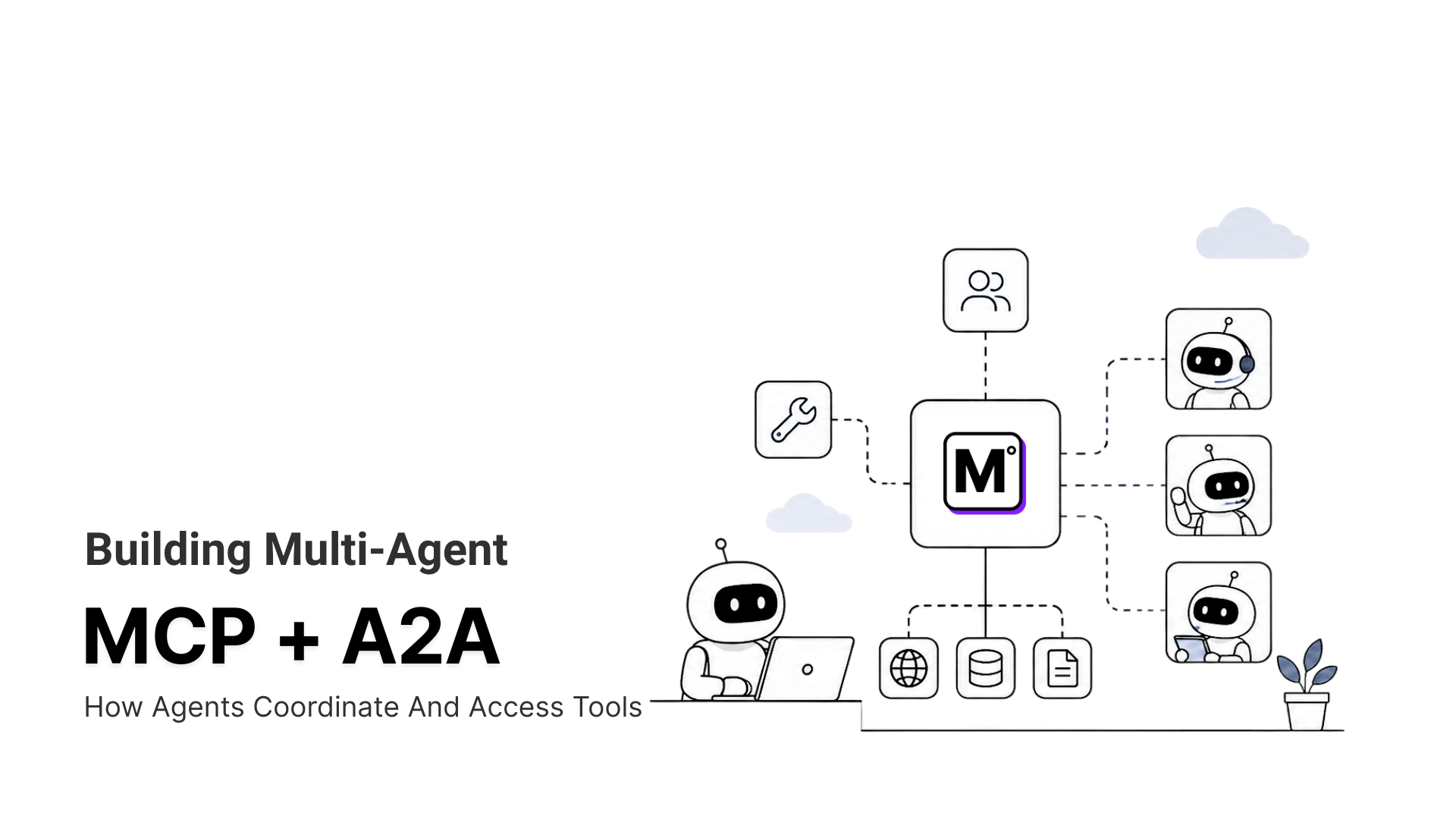
MCP and A2A solve two different layers of a multi-agent system: one for tools, one for agent-to-agent coordination. Together, they form a complete production architecture.
-
• Two Protocol Layers
MCP is the vertical layer that connects each agent to tools, APIs, and data sources. A2A is the horizontal layer that connects agents to each other so they can delegate tasks, pass results, and collaborate across workflows.
-
• How They Work Together
In production, an orchestrator coordinates workflows over A2A between agents, while each individual agent uses MCP to access its own tools. Shared tool gateways like MCP360 can standardize tool access across all agents.
-
• What Production Needs
With protocols now stabilizing, the focus shifts to secure execution, observability, and tracing across distributed agent calls. A2A (a Linux Foundation standard) introduces signed Agent Cards in v1.0 to enable trust between agents.
A single agent in one context window handles one job well. Summarize a log, draft a reply, call an API, return an answer. The trouble starts the moment a workflow grows a second step that touches a different system.
Now that one agent has to retrieve data, reason over it, decide an action, and execute it, all inside the same prompt. Intermediate results stack up and push earlier outputs out of context. Tool calls fire one after another with nothing coordinating them. And when the workflow breaks in production, it rarely breaks because the model reasoned badly. It breaks because a tool call failed, a step got skipped, or an error stayed silent until the damage was done.
Two protocols exist to close that gap, and they work at different layers. Model Context Protocol (MCP) gives an agent one standard way to reach its tools, APIs, and data. Agent2Agent (A2A) gives agents a standard way to hand work to each other. Get both in place and one overloaded agent becomes a set of specialists that coordinate cleanly, each owning a job you can test, swap, or trace on its own.
Limits of Single-Agent Workflows
A single-agent design keeps retrieval, reasoning, and execution in one unbroken context, and for a self-contained question that is exactly what you want. Ask it to classify a ticket or rewrite a paragraph and the whole task lives in one place. The design starts to strain when a workflow has dependent steps and reaches into outside systems. Five problems show up, and they compound.
- No stage isolation. Every step shares one context, so a wrong or noisy output from step one travels downstream with nothing to stop it. A bad classification early on quietly poisons every decision that follows.
- The context window fills up. Run several tool calls or pull a few large responses and the earliest information gets pushed out. The agent loses the result it produced three steps ago and has no way to ask for it back.
- Execution stays sequential. Tool calls run in the order the prompt reaches them. Pulling a customer record and a transaction history that have nothing to do with each other still happens one after the other, so two waits that could have overlapped add up end to end.
- Control flow depends on prompting. Moving from one step to the next rides on prompt continuation and implicit reasoning, with no explicit logic deciding what runs when. Steps get skipped. Steps get repeated. Neither failure announces itself.
- Intermediate results have nowhere to live. Outputs from earlier steps are never stored as reusable artifacts, so the agent either drags them forward in context or regenerates them from scratch, paying for the same work twice.
None of this makes single agents obsolete. It means a workflow with dependent steps, outside integrations, and operations that could run in parallel needs a different shape. That shape is several agents, each with one defined job, coordinated by something sitting above them.
MCP and A2A in a Multi-Agent Stack
A multi-agent stack splits cleanly into two layers that do not overlap. One connects an agent to its tools. The other connects agents to one another. MCP owns the first. A2A owns the second.
Google’s A2A documentation makes the split concrete with a repair shop. A customer talks to one Shop Manager agent. Behind it, that manager hands diagnosis to a Mechanic agent, which uses MCP to reach its own tools, a diagnostic scanner, a repair-manual database, a platform lift. When a part is needed, the Mechanic coordinates over A2A with a separate Parts Supplier agent to order it. A2A is the horizontal bus between agents. MCP is the vertical bus down to each agent’s tools.
How MCP Handles Tool Access
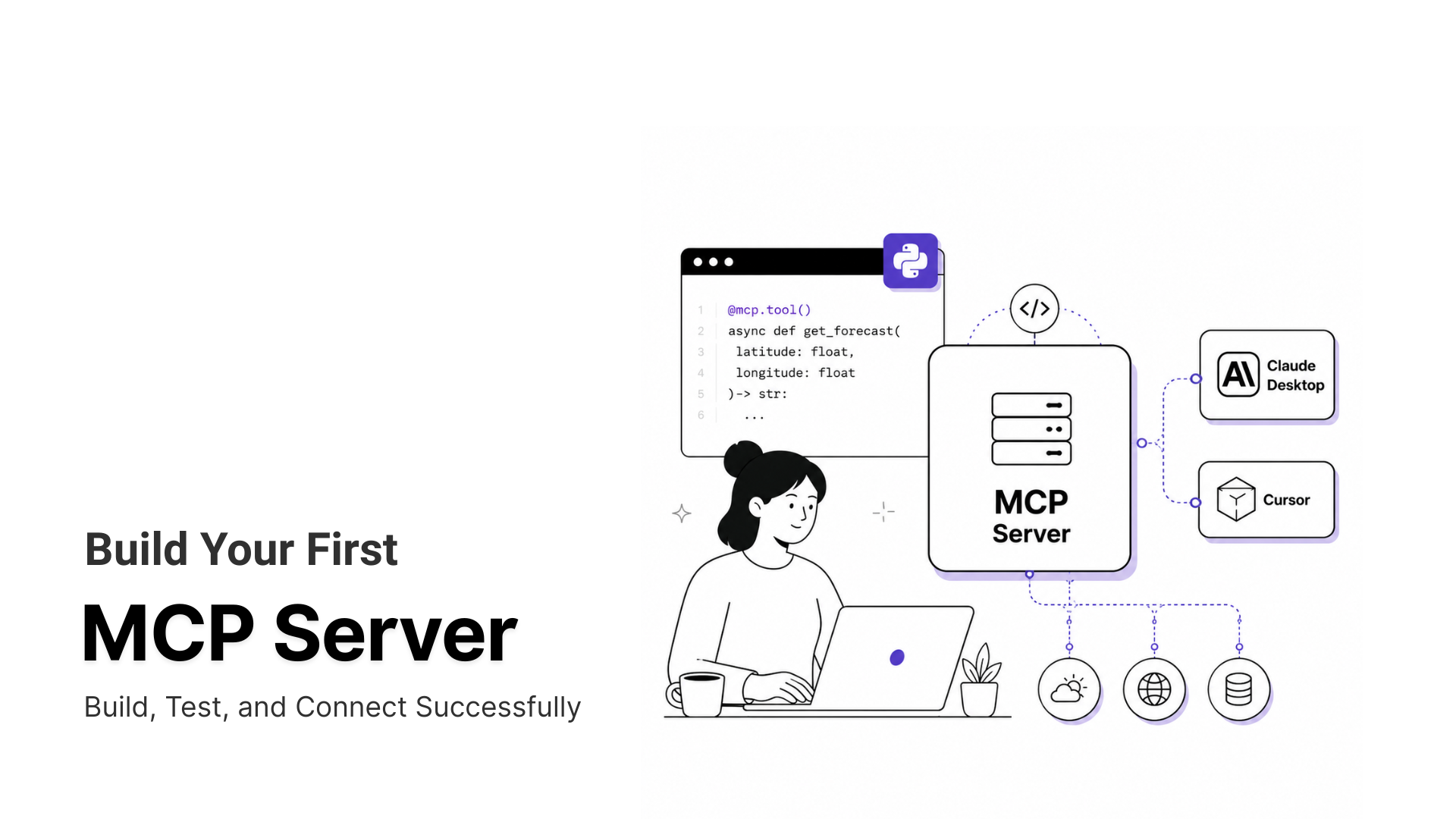
MCP is what an agent uses when it needs to reach an external system such as an API, a database, or file storage. Those systems are exposed through MCP servers, each describing what it can do and what inputs it expects. At runtime the agent reads that description, picks a tool, and sends a request with the right parameters. The response comes back structured, ready for the next step.
Without this layer, every integration is bespoke. Each API brings its own request format, its own auth flow, its own response shape. That sprawl is the N×M integration problem older API ecosystems hit, where every new tool has to be wired to every agent that needs it. MCP collapses it to N+M, one interface on each side, so adding a tool means writing one server instead of one connector per agent. We cover the protocol itself in depth in our complete guide to Model Context Protocol, and how it differs from older integration methods in MCP vs traditional APIs.
How A2A Handles Agent Coordination
A2A is what one agent uses to hand work to another. Each agent publishes an Agent Card, a description of what it can handle and how it expects input. An orchestrator, the agent whose only job is routing work to other agents, reads those cards to decide which agent should take a task, then sends a structured request along with any context from earlier steps. The receiving agent works the task and returns a result, streaming progress updates for longer jobs.
A workflow moves across agents without shared memory or manual prompting. Each agent does its assigned piece and returns something the next agent can consume. A2A is governed by the Linux Foundation as a vendor-neutral standard, sitting under its Agentic AI Foundation alongside MCP. Its stable v1.0 release added the pieces production deployments needed, including signed Agent Cards that let a receiving agent verify a card came from the real domain owner, and the spec has moved forward to v1.2 since.
Combining MCP and A2A in One Stack
The reason to run both is that the layers move independently. Change an external system and you touch only MCP. Change how agents delegate and you touch only A2A. Neither rewrite reaches the other.
The separation also unlocks orchestration patterns a single context cannot. The orchestrator takes a high-level task, breaks it into subtasks, assigns each to a suitable agent, and collects the results, without doing any of the work itself. It runs the show the way a scheduler coordinates workers in a distributed system.
Two things follow from that structure. Because every agent has a defined input and output, you can test, replace, or upgrade one without disturbing the rest. And because independent steps no longer share a context, they run in parallel, so pulling a customer record and a transaction history happens at once when neither depends on the other.
A Multi-Agent Workflow, Step by Step

A customer support workflow shows the two protocols working together. A ticket comes in and moves through a sequence of agents, each owning one part.
Step 1 Triage: The orchestrator sends the incoming ticket to a triage agent over an A2A task. The agent classifies it as billing, technical, or account related, and pulls out fields like user ID, product area, and severity. It returns a structured result.
Step 2 Context retrieval: The orchestrator forwards that result to a retrieval agent. Using MCP, the agent queries external systems to gather supporting information. It reads account details from a CRM, checks prior tickets in the ticketing system, and pulls relevant docs from a knowledge base. Those responses combine into one context object and come back.
Step 3 Response generation: The orchestrator passes the context to a resolution agent. It uses the classification and retrieved data to draft a reply and recommend an action. If it needs to confirm something, refund eligibility for example, it queries an external system through MCP. The output carries both the response text and the suggested next step.
Step 4 Execution: The orchestrator hands the result to an action agent. This agent applies the response by updating the ticketing system, triggering any downstream actions, and recording the outcome. The workflow is done.
Across the whole run, A2A passes tasks and results between agents. MCP handles tool access inside each agent. The orchestrator manages the sequence without touching tool-level execution. Every step has a defined input, output, and owner, so you can inspect or replay any one of them in isolation.
Multi-agent workflows are also easier to operate than a single long prompt. Intermediate outputs exist as structured artifacts outside any one agent’s context, which makes them inspectable, storable, and auditable. A failure surfaces at the boundary where it happened instead of hiding inside a context window. The orchestrator defines control flow in explicit logic, so which agent runs next, what input it gets, and how failures are handled all live in code you can review.
Security in a Multi-Agent Stack
A multi-agent stack widens the attack surface in ways a single agent does not. The moment agents discover each other and delegate work, you have to decide which agents to trust and how to prove identity between them.
The clearest example is the Agent Card itself. Because most orchestrators choose a specialist by reasoning over card descriptions, a rogue agent can publish an inflated card with text crafted to manipulate that selection logic. Security researchers have demonstrated this as a prompt injection that operates at the discovery layer, hijacking task routing through persuasive language in a card field. A2A v1.0 answers part of this with signed Agent Cards, which let a receiving agent verify a card was issued by the domain owner rather than forged. That closes card spoofing. It does not remove the need to vet what an agent claims it can do.
A few practices carry most of the weight here.
- Verify Agent Cards cryptographically. Confirm the signature instead of trusting the text, and keep an allowlist of known agent identities rather than accepting any new agent that appears.
- Scope credentials per agent. The common pattern is OAuth 2.0 machine-to-machine tokens, issued per agent identity, short-lived, automatically rotated, and scoped to specific endpoints.
- Instrument the boundaries. When one request fans out through several agents, distributed tracing is the only way to see where it went. Inject W3C traceparent headers so spans chain across agent calls, and log every task state transition so a failed run can be reconstructed.
The MCP layer carries its own risk. Centralizing tool access through one interface means a misconfigured permission can expose more than it should. Granting an agent tool access grants it the ability to act, so the same care you apply to API keys applies to every MCP server it can reach. When access breaks, the cause is usually the connection, not the model. That points debugging at the gateway and its permissions, not the prompt.
Add Agents Without Adding Integrations
A2A gets the attention because it is the newer layer. In a real build, the layer that decides how fast you can add the next agent is the tool layer beneath all of them.
The workflow above ran on four agents, each reaching its own tools through MCP. Add two more next quarter and, in a naive build, that is two more rounds of integrations, credentials, and upkeep. The coordination layer scales cleanly because A2A standardized it. The tool layer scales cleanly only when you standardize it the same way.
A unified MCP gateway like MCP360 fills that gap, and it helps to be precise about what it does. MCP360 is not A2A and it does not orchestrate. It is the MCP layer, shared across every agent. One integration gives all of them the same catalog of 100+ tools, loaded on demand through the search_tools and execute_tool meta-tools, so an agent pulls only what a task needs. That keeps context free where it counts, because a multi-agent stack already spends its budget on coordination, and a tool layer that does not inflate each agent’s window leaves that budget alone. When the catalog does not cover something, the Custom MCP Builder wraps your own REST API or runs your own code behind the same gateway.
You still bring your own A2A orchestration. MCP360 only makes sure every agent in the stack can reach its tools without a separate integration project each.
Where MCP and A2A Go Next
The coordination layer consolidated faster than most people expected. A2A reached a stable release and now anchors agent-to-agent communication for a long list of enterprise vendors. MCP sits beside it under the same Agentic AI Foundation, the Linux Foundation body that governs both, as the tool layer.The two-protocol split that looked speculative a year ago is now the default assumption in enterprise agent architectures, part of why MCP keeps gaining ground as the integration standard.
The open problem lives above the protocol layer, in discipline. Gartner expects over 40% of agentic AI projects to be canceled by the end of 2027, driven by unclear value, rising cost, and weak governance rather than by the technology. A clean protocol split helps with two of those three. Structured handoffs and isolated tool access make a system you can observe, cost out, and govern. Whether a workflow was worth building is a call the architecture does not make for you.
Frequently Asked Questions
What is the difference between MCP and A2A?
MCP and A2A solve different problems. MCP connects an AI agent to its tools, APIs, and data sources, while A2A connects multiple AI agents so they can delegate tasks and exchange results. In practice, most multi-agent systems use both together rather than choosing one over the other.
What is the A2A protocol?
A2A (Agent2Agent) is an open protocol that allows AI agents built on different frameworks to discover one another, delegate work, and exchange results. Each agent publishes an Agent Card describing its capabilities, and an orchestrator uses those cards to route tasks. The Linux Foundation maintains A2A as a vendor-neutral standard.
When should you use multiple agents instead of one?
Multiple agents are useful when a workflow involves several specialized tasks across different systems. Instead of placing retrieval, reasoning, and execution into a single context, dedicated agents can handle individual responsibilities in parallel, making workflows easier to scale, test, and maintain.
What is an Agent Card in A2A?
An Agent Card is a published description of an AI agent’s capabilities and expected inputs. Orchestrators use Agent Cards to determine where tasks should be routed. A2A also supports signed Agent Cards, allowing receiving agents to verify that they came from the legitimate domain owner.
How do MCP and A2A work together in a single stack?
A2A manages communication between AI agents, while MCP lets each agent access its own tools and data. This separation keeps orchestration independent from integrations. Platforms such as MCP360 can provide a shared MCP layer that every agent uses consistently.
What is an MCP gateway and why use one?
An MCP gateway provides access to multiple tools through a single connection instead of requiring separate integrations for every service. In multi-agent systems, this reduces duplicated setup because each agent can access the same tool catalog through one integration.
How do you secure a multi-agent system?
Secure multi-agent systems by verifying signed Agent Cards, maintaining an allowlist of trusted agents, using short-lived scoped credentials, and tracing requests across agent boundaries. These practices improve security while making failures easier to diagnose and audit.
Does adding more tools or agents bloat the context window?
Not if tools are loaded on demand. Context bloat happens when every available tool definition is added regardless of the task. Gateways such as MCP360 load only the tools required for each request, keeping context smaller and reducing unnecessary token usage.
Conclusion
A workflow that spans multiple systems cannot hang on one agent juggling context, execution, and coordination inside a single boundary. Separating those concerns is what makes a multi-agent system work. A2A defines how work moves between agents. MCP defines how each agent reaches its tools. The orchestrator owns the sequence and nothing else.
Built this way, a workflow runs as composed parts with traceable inputs and outputs at every step, which is the difference between a demo and something you can run in production.
If you are starting, do it in this order. Map the workflow as discrete steps and give each one an agent with a defined input and output. Wire those agents over A2A so the orchestrator routes work instead of one prompt carrying it. Standardize the tool layer underneath them once, governed in a single place, so the stack grows without a new integration each time.
The architecture buys you a system you can observe, replay, and scale. It does not decide which workflows deserve to exist. That judgment stays yours, and on the evidence it is the part most teams get wrong. The coordination layer is where the work flows. The tool layer is where it gets done.

Article by
MitaliAI & Automation | Content Writer
Mitali is a content writer covering AI agents, automation, and no-code tools. Her writing spans the AI landscape, from support and sales automation to MCP integrations and agent workflows, with a focus on practical business use.