



The TL;DR
Claude Sonnet 5 cut its price while GPT-5.5 and Gemini 3.5 Flash raised theirs, but an agent’s real bill now depends more on tool exposure, MCP routing, and repeated calls than the model price alone.
-
• The Price Split
Sonnet 5 launched at less than half of Opus 4.8’s price, months after GPT-5.5 and Gemini 3.5 Flash both became more expensive. That split changes which model looks affordable once agents start running real workflows.
-
• The Tool Layer Doesn’t Follow
Cheaper model pricing does not automatically mean cheaper agent execution. An unfiltered MCP connection can use up to 32 times more tokens than the same task handled through a CLI, making tool design a major cost driver.
-
• More Calls Raise the Stakes
As agents make more tool calls, inefficient or compromised tool servers become expensive fast. A compromised tool server can push per-query cost up by as much as 658 times while still returning an answer that appears correct.
A cheaper model buys an agent room for more tool calls, not a smaller bill. Claude Sonnet 5 made that split visible. OpenAI doubled the price of GPT-5.5. Google tripled the price of Gemini 3.5 Flash. Anthropic cut the price of Sonnet 5 to less than half of Opus 4.8’s rate, in the same stretch of months.
On its own, that price cut reads as relief for anyone running AI agents. It is closer to a permission slip.
The reason is structural. An agent spends most of its tokens on the loop that produces an answer, not on the answer itself. That loop consists of planning a step, calling a tool, reading the result, and repeating until the task is done. When that loop gets cheaper, a fixed monthly budget covers far more of it.
Whether that turns into savings or a bigger bill depends on a number companies rarely track. It is how many tool calls a workflow makes. The model’s per-token rate alone does not answer that question.
What follows examines where that bill comes from, and sets out four ways to keep a cheaper model’s savings from disappearing into it.
Cheaper AI Agent Models Reshaping AI Agent Costs
Sonnet 5 costs $2 per million input tokens and $10 per million output tokens through August 31, 2026, then moves to $3 and $15, according to Anthropic’s own launch documentation. Sonnet 5’s standard rate is unchanged from Sonnet 4.6. Opus 4.8 costs $5 and $25. Sonnet 5’s introductory price sits at 40% of that, for benchmark scores that land close to it.
Three of Anthropic’s biggest closed-frontier competitors moved the other way. A separate, open-weight tier moved further still, undercutting all four flagships by an order of magnitude.
| Model | Lab | Prior Price | New Price | Move | Launch Date |
|---|---|---|---|---|---|
| Claude Sonnet 5 | Anthropic | Sonnet 4.6: $3 / $15 | $2 / $10 Intro pricing through August 31 |
Down | June 30, 2026 |
| GPT-5.5 | OpenAI | GPT-5.4: $2.50 / $15 | $5 / $30 | Up, 2× | April 23, 2026 |
| Gemini 3.5 Flash | Gemini 3 Flash: $0.50 / $3.00 | $1.50 / $9.00 | Up, 3× | May 19, 2026 | |
| Grok 4.5 | xAI | Grok 4.3: $1.25 / $2.50 | $2 / $6 | Up | July 8, 2026 |
| DeepSeek V4 Pro | DeepSeek | $1.74 / $3.48 | $0.435 / $0.87 | Down, 75% | April 24, 2026 |
| Kimi K2.6 | Moonshot | N/A | $0.95 / $4.00 | N/A | April 20, 2026 |
| GLM-5.2 | Zhipu | N/A | $1.40 / $4.40 | N/A | June 2026 |
| Qwen3.6 Plus | Alibaba | N/A | $0.32 / $1.28 | N/A | March 30, 2026 |
The multipliers in the Move column are confirmed on each lab’s own pricing page, OpenAI’s, Google’s, and xAI’s among them. Grok 4.5 is the one exception worth flagging directly. It costs more per token than Grok 4.3, even while undercutting Opus 4.8 and GPT-5.6 Sol.
OpenAI’s move goes beyond GPT-5.5. The company also launched a new family, GPT-5.6, on June 26, four days before Sonnet 5 shipped, still limited to the API and Codex and not available in ChatGPT.
- Sol: The closest match to GPT-5.5, priced identically at $5 and $30.
- Terra: Undercuts Sol by half at $2.50 and $15, close to GPT-5.4’s old rate.
- Luna: The cheapest tier, at $1 and $6, aimed at high-volume, lower-stakes tasks.
None of the three had reached general availability at the time of this comparison, so GPT-5.5 remains the reference point in the table above.
The four open-weight rows don’t follow that pattern. They aren’t positioned as replacements for the closed flagships, just a separate tier most teams route simpler tasks toward, priced too unstably for any number here to hold for long.
One price cut against three price hikes is not an industry getting cheaper. It is one lab pricing against the grain while three of its closest rivals moved the other direction, two before Sonnet 5 shipped and one confirming the pattern more than a week after. Teams still running workloads on Sonnet 4.6 can find the full migration tradeoffs in our breakdown of whether to switch.
Sonnet 5’s price move is real. What it changes for a team already running agents in production is a separate question, and it starts with where the token bill actually goes once a model begins working instead of just answering.
Why Cheaper AI Models Lead to More Tool Calls
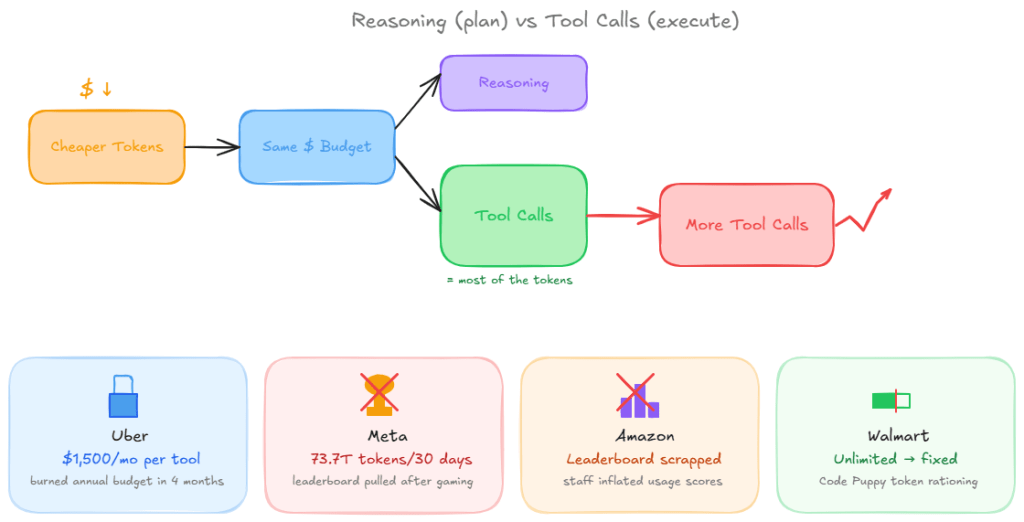
An agent’s token bill splits two ways. One part is the reasoning that produces a plan. The other is the tool calls that carry the plan out. Drop the price of a model and a fixed budget covers more of both, and the tool-call side is where most of an agent’s tokens go once it starts working through a multi-step task.
What Unmonitored Tool Calls Already Cost Four Companies
- Uber: Burned through its entire annual AI budget in four months and now limits employees to $1,500 a month per agentic coding tool.
- Meta: Built an internal leaderboard called Claudeonomics that tracked employee token use, watched consumption climb past 70 trillion tokens in a single 30-day window, and pulled the leaderboard down once it started rewarding volume over output.
- Amazon: Scrapped its own usage leaderboard after employees inflated their numbers to climb it.
- Walmart: Capped use of its in-house coding assistant.
In each case, tool-call volume outran anyone’s tracking, at prices that were already falling.
The Broader Spending Numbers
Gartner puts AI agent software spending at $206.5 billion in 2026, up 139% from $86.4 billion in 2025. Gartner separately estimates that up to $234 billion in enterprise application spending is at risk of moving away from traditional per-seat software, as agents complete more tasks directly instead of routing through a human at a screen. Read together, both figures describe the same direction of travel for enterprise budgets. A cheaper Sonnet 5 funds more of that movement, faster.
The jump from $86.4 billion to $206.5 billion is the backdrop Sonnet 5’s price cut lands on. The next question is whether the infrastructure underneath the model can turn a lower sticker price into a lower bill, and that comes down to how tools get loaded into an agent’s context in the first place.
The Tool Layer Doesn’t Share the Model’s Discount
A cheaper per-token rate doesn’t change what happens before a model reads a single word of a request. Most MCP clients load the full schema for every connected tool at the start of a session, whether the task needs it or not.
Three separate teams measured this problem from three different angles, and landed on the same fix.
The 32x Gap Between CLI and MCP
A benchmark from infrastructure vendor Scalekit tested this against GitHub’s own Copilot MCP server, which exposes 43 tools. A task that cost 1,365 tokens through GitHub’s CLI cost 44,026 tokens through the unfiltered MCP server for the identical request. That’s 32 times more, because the model paid for webhook, gist, and pull-request schemas it never touched. At 10,000 monthly operations, the gap runs to roughly $3.20 through the CLI against $55.20 through the unfiltered MCP connection.
GitHub’s Own Toolset Told the Same Story
GitHub found a related pattern inside its own product, separate from that external server. GitHub’s engineering team trimmed the default built-in toolset inside VS Code Copilot Chat from 40 tools down to 13, and measured a 2 to 5 percentage point accuracy gain on top of the token savings, plus a 400 millisecond drop in response latency. Fewer tools loaded at once meant less time spent deciding which one to call. For a broader look at how MCP and CLI execution compare, see our comparison of how AI systems execute and coordinate work.
Anthropic Cut One Workflow by 98.7%
Anthropic’s own engineering team reported a similar result from a different angle. A workflow moving a meeting transcript from Google Drive into Salesforce used 150,000 tokens under standard tool calling. Rewritten so the agent discovers and loads only the tool definitions a task actually needs, the same workflow ran on 2,000 tokens. A 98.7% reduction.
The Fix Is Loading Tools on Demand
A tool’s definition should enter an agent’s context only when a task calls for it, rather than every schema loading upfront for every request. That pattern is what all three examples above have in common.
Our unified MCP gateway, MCP360, applies this pattern across its full catalog, giving an agent access to over 100 tools through a single connection and pulling in a tool’s definition only when a search step locates it and an execution step runs it. Progressive loading doesn’t lower Sonnet 5’s per-token price, but it keeps the tool layer from spending the model’s savings before they reach an invoice.
Loading fewer tools into context does more than trim the bill. It also narrows what an agent has available to misuse, which starts to matter once tool calls become a target in their own right.
The Hidden Costs and Security Risks of More Tool Calls
Some of the cost from more tool calls never shows up as a token bill. It shows up as a bigger attack surface, and a cheaper model that calls tools more freely raises the stakes without anyone changing a permission setting.
An Attack That Inflates Cost by 658x
A January 2026 paper by Kaiyu Zhou and co-authors at Nanyang Technological University and partner institutions documented an attack the researchers call an economic denial-of-service attack. A compromised tool server leaves the tool’s actual function untouched. It edits only the text an agent reads back after each call, steering the agent into longer and more verbose tool-calling chains than the task requires. Tested across several models on standard agent benchmarks, the attack pushed per-query cost up by as much as 658 times, while the agent still returned a correct, ordinary-looking answer. Standard prompt filters and output monitors miss this pattern, because the input looks normal and the final output is right.
Prompt Injection Hits Six of OWASP’s Top Ten Risks
OWASP’s 2026 report on agentic AI security ties prompt injection to six of its ten top risk categories this year, a sharp jump from a 2025 edition that catalogued mostly theoretical threats. The defense here is watching the shape of a run itself. A task that should call three tools and suddenly calls thirty is the signal, whatever the final answer looks like.
Cost and security sit on the same instrumentation problem. A team that already tracks tool-call volume to control spend has the visibility it needs to catch this kind of attack early too.
Four Ways to Reduce AI Agent Costs Without Limiting Tool Calls
Standard pricing returns on September 1, and by then an unmeasured tool layer will have turned from a theoretical risk into a real line on the invoice. Four steps make that visible before it happens.
- Split the line items: Track model spend and tool-call spend separately, starting now. A team that only watches the per-token rate will see it drop after switching to Sonnet 5, then miss that tool-call volume, and the context overhead riding along with it, grew to cover the difference.
- Audit the default tool count: Check how many tool schemas load into context on a typical request, not how many tools are technically connected. A client loading 40 schemas for a task that touches two of them is paying for 38 it never needed.
- Load tools on demand, not upfront: Whether built in-house or through a gateway, the pattern that separates a 2,000-token task from a 150,000-token one is discovery, not preloading the entire catalog at the start of a session.
- Re-run your numbers before migrating: The token inflation from Sonnet 5’s new tokenizer and the token inflation from an unfiltered tool catalog compound each other. Test a real workload against both before assuming the sticker price is what lands on next month’s invoice.
None of this requires new tooling to start. Tracking two numbers, model spend and tool-call spend, in a single spreadsheet is enough to see whether Sonnet 5’s price cut is actually reaching the total bill or getting absorbed somewhere else.
Frequently Asked Questions
What is Model Context Protocol (MCP)?
Model Context Protocol, or MCP, is a shared standard that lets AI agents connect to outside tools such as search engines, databases, and business software through one common setup instead of custom code for every tool. It defines how an agent discovers a tool, calls it, and reads back the result.
How much does it cost to run an AI agent?
Cost depends on the price per token for the model in use, how many tokens a task consumes, and how many tool calls the agent makes along the way. A cheaper model changes only the first factor. Tool-call volume usually drives the largest share of an agent’s total bill.
Does a cheaper AI model mean a cheaper AI agent?
Not on its own. Claude Sonnet 5 costs less per token than its predecessor, but an agent’s total bill depends more on how many tool calls it makes than on the model’s rate. A cheaper model often leads teams to run more tool calls, which can offset or exceed the per-token savings.
How does Claude Sonnet 5’s pricing compare to GPT-5.5 and Gemini 3.5 Flash?
Sonnet 5 moved against the market. GPT-5.5 launched at double GPT-5.4’s price and Gemini 3.5 Flash at roughly triple its predecessor’s rate, while Anthropic held Sonnet 5’s rate flat and discounted it further. Grok 4.5 later confirmed the same upward pattern, leaving Sonnet 5 as the exception among closed-frontier flagships.
Why does MCP use more tokens than a CLI?
Most MCP clients load every connected tool’s full schema at the start of a session, even tools a task never touches. One benchmark found a simple task cost 32 times more tokens through an unfiltered MCP connection than through a CLI. Our unified MCP gateway, MCP360, loads a tool’s definition only when needed.
Why are companies like Uber and Meta capping AI spending?
Both let AI agent usage grow without limits, and costs escalated fast. Uber used its entire annual AI budget in four months and now caps spending at $1,500 a month per coding tool. Meta tracked employee token use on an internal leaderboard that hit tens of trillions of tokens a month before being pulled down.
Can more AI tool calls make an agent less secure?
Yes. Each additional tool call is another chance for something to go wrong. A 2026 study found that a compromised tool server could steer an agent into far more tool calls than a task required, pushing per-query cost up by as much as 658 times while the final answer still looked correct and unremarkable.
How can I lower AI agent costs?
Track tool-call spending apart from model spending, since a cheaper model can hide a growing tool bill underneath a shrinking one. Load tool definitions only when a task needs them, either by building that discovery step yourself or by routing calls through a gateway such as our own MCP360.
Do I need a separate integration for every AI tool I connect to an agent?
No. Each direct integration usually means its own API key, its own authentication setup, and its own maintenance burden as that tool’s API changes over time. A unified gateway like MCP360 consolidates that into a single connection, covering over 100 tools across many categories.
Conclusion
Claude Sonnet 5’s price cut is real, and it arrived in a quarter where GPT-5.5 and Gemini 3.5 Flash both moved the other direction. Read on its own, that’s worth taking at face value. Read as a savings event a team can file away once the model swap finishes, it overstates what actually changed.
Standard pricing returns on September 1. If AI agent spending keeps growing at the pace Gartner has already forecast, pricing pressure is unlikely to stay on the model card much longer. It is more likely to move to the tool layer next, toward metered access, scoped permissions, and gateways that charge for what an agent actually uses.
Teams already tracking tool-call spend, loading tool definitions on demand, and scoping access per call will see this price cut convert directly into savings. Teams still loading every schema for every request should weigh Sonnet 5’s performance gains on their own merits, then fix that gap before migrating, not after. Otherwise the invoice will look close to the one being paid today, just with more steps along the way.
A cheaper model is an opportunity, not a guarantee. The tool layer decides which one a team actually gets. Run last month’s real usage through those four steps before the next bill arrives.

Article by
HarsheenMCP & AI Agents | Content Writer
Harsheen is a content writer covering AI agents, automation, and no-code tools. She writes across topics from chatbots and customer experience to MCP and enterprise workflows, showing how real teams adopt AI in everyday operations.